

156
16 Two Axiomatic Systems for Special Relativity
H. Minkowski recognised that this could be given a geometric formulation in the
following way: The three-dimensional space and the time can be combined to a fourdimensional spacetime continuum. Every physical event E at the location x at time
t corresponds to exactly one point P in the spacetime continuum. In order not to
overcomplicate our considerations, we will suppress the two space dimensions y and
z. A certain inertial system o corresponds to a certain coordinate system (x, t) in
Minkowski’s spacetime; see Fig. 16.1. In this coordinate system, we define a distance
s of a point P(x, t) from the coordinate origin, the point O(0, 0), according to
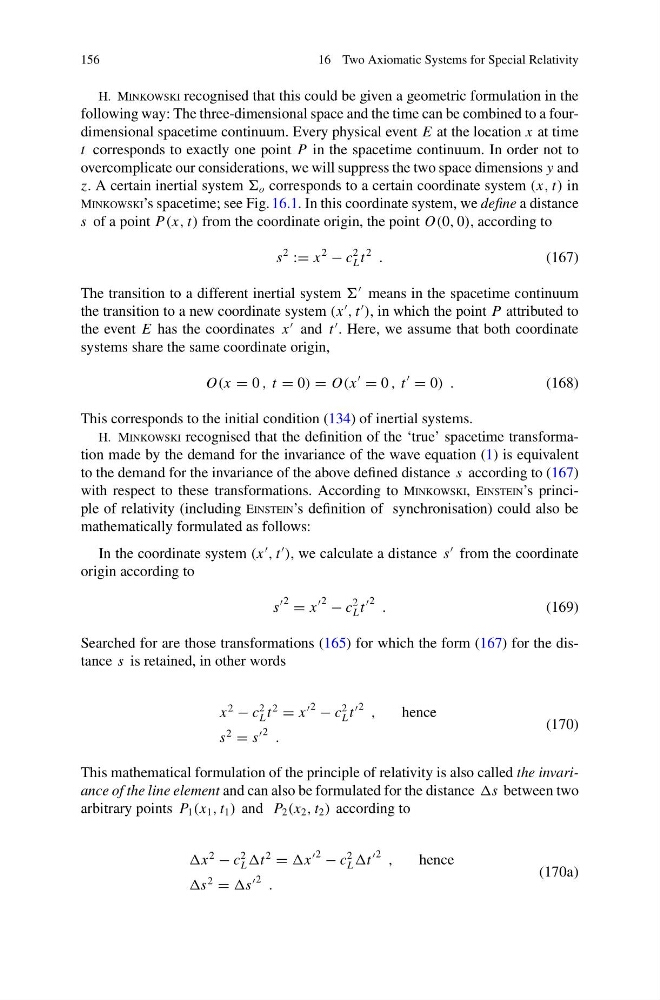
s
2
:= x
2
− c
2
L t
2
.
(167)
The transition to a different inertial system
means in the spacetime continuum
the transition to a new coordinate system (x
, t
), in which the point P attributed to
the event E has the coordinates x
and t
. Here, we assume that both coordinate
systems share the same coordinate origin,
O(x = 0 , t = 0) = O(x
= 0 , t
= 0) .
(168)
This corresponds to the initial condition (134) of inertial systems.
H. Minkowski recognised that the definition of the ‘true’ spacetime transformation made by the demand for the invariance of the wave equation (1) is equivalent
to the demand for the invariance of the above defined distance s according to (167)
with respect to these transformations. According to Minkowski, Einstein’s principle of relativity (including Einstein’s definition of synchronisation) could also be
mathematically formulated as follows:
In the coordinate system (x
, t
), we calculate a distance s
from the coordinate
origin according to
s
2 = x
2 − c
2
L t
2 .
(169)
Searched for are those transformations (165) for which the form (167) for the distance s is retained, in other words
x
2
− c
2
L t
2
= x
2 − c
2
L t
2 ,
hence
s
2
= s
2 .
(170)
This mathematical formulation of the principle of relativity is also called the invariance of the line element and can also be formulated for the distance s between two
arbitrary points P 1 (x 1 , t 1 ) and P 2 (x 2 , t 2 ) according to
x
2
− c
2
L t
2
= x
2 − c
2
L t
2 ,
hence
s
2
= s
2 .
(170a)
16 Two Axiomatic Systems for Special Relativity
H. Minkowski recognised that this could be given a geometric formulation in the
following way: The three-dimensional space and the time can be combined to a fourdimensional spacetime continuum. Every physical event E at the location x at time
t corresponds to exactly one point P in the spacetime continuum. In order not to
overcomplicate our considerations, we will suppress the two space dimensions y and
z. A certain inertial system o corresponds to a certain coordinate system (x, t) in
Minkowski’s spacetime; see Fig. 16.1. In this coordinate system, we define a distance
s of a point P(x, t) from the coordinate origin, the point O(0, 0), according to
s
2
:= x
2
− c
2
L t
2
.
(167)
The transition to a different inertial system
means in the spacetime continuum
the transition to a new coordinate system (x
, t
), in which the point P attributed to
the event E has the coordinates x
and t
. Here, we assume that both coordinate
systems share the same coordinate origin,
O(x = 0 , t = 0) = O(x
= 0 , t
= 0) .
(168)
This corresponds to the initial condition (134) of inertial systems.
H. Minkowski recognised that the definition of the ‘true’ spacetime transformation made by the demand for the invariance of the wave equation (1) is equivalent
to the demand for the invariance of the above defined distance s according to (167)
with respect to these transformations. According to Minkowski, Einstein’s principle of relativity (including Einstein’s definition of synchronisation) could also be
mathematically formulated as follows:
In the coordinate system (x
, t
), we calculate a distance s
from the coordinate
origin according to
s
2 = x
2 − c
2
L t
2 .
(169)
Searched for are those transformations (165) for which the form (167) for the distance s is retained, in other words
x
2
− c
2
L t
2
= x
2 − c
2
L t
2 ,
hence
s
2
= s
2 .
(170)
This mathematical formulation of the principle of relativity is also called the invariance of the line element and can also be formulated for the distance s between two
arbitrary points P 1 (x 1 , t 1 ) and P 2 (x 2 , t 2 ) according to
x
2
− c
2
L t
2
= x
2 − c
2
L t
2 ,
hence
s
2
= s
2 .
(170a)