

16 Two Axiomatic Systems for Special Relativity
155
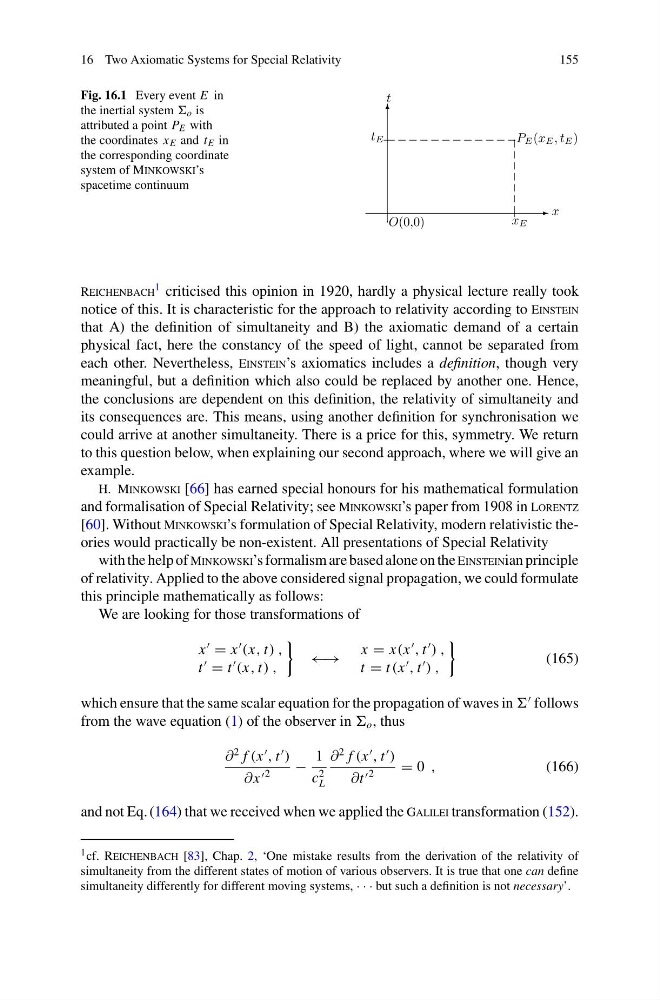
Fig. 16.1 Every event E in
the inertial system o is
attributed a point P E with
the coordinates x E and t E in
the corresponding coordinate
system of Minkowski’s
spacetime continuum
t E
P E (x E , t E )
x
t
x E
p
p O(0,0)
-
6
Reichenbach
1 criticised this opinion in 1920, hardly a physical lecture really took
notice of this. It is characteristic for the approach to relativity according to Einstein
that A) the definition of simultaneity and B) the axiomatic demand of a certain
physical fact, here the constancy of the speed of light, cannot be separated from
each other. Nevertheless, Einstein’s axiomatics includes a definition, though very
meaningful, but a definition which also could be replaced by another one. Hence,
the conclusions are dependent on this definition, the relativity of simultaneity and
its consequences are. This means, using another definition for synchronisation we
could arrive at another simultaneity. There is a price for this, symmetry. We return
to this question below, when explaining our second approach, where we will give an
example.
H. Minkowski [66] has earned special honours for his mathematical formulation
and formalisation of Special Relativity; see Minkowski’s paper from 1908 in Lorentz
[60]. Without Minkowski’s formulation of Special Relativity, modern relativistic theories would practically be non-existent. All presentations of Special Relativity
with the help of Minkowski’s formalism are based alone on the Einsteinian principle
of relativity. Applied to the above considered signal propagation, we could formulate
this principle mathematically as follows:
We are looking for those transformations of
x
= x
(x, t) ,
t
= t
(x, t) ,
←→
x = x(x
, t
) ,
t = t (x
, t
) ,
(165)
which ensure that the same scalar equation for the propagation of waves in
follows
from the wave equation (1) of the observer in o , thus
∂
2 f (x
, t
)
∂x 2
−
1
c
2
L
∂
2 f (x
, t
)
∂t 2
= 0 ,
(166)
and not Eq. (164) that we received when we applied the Galilei transformation (152).
1 cf. Reichenbach [83], Chap. 2, ‘One mistake results from the derivation of the relativity of
simultaneity from the different states of motion of various observers. It is true that one can define
simultaneity differently for different moving systems, · · · but such a definition is not necessary’.
155
Fig. 16.1 Every event E in
the inertial system o is
attributed a point P E with
the coordinates x E and t E in
the corresponding coordinate
system of Minkowski’s
spacetime continuum
t E
P E (x E , t E )
x
t
x E
p
p O(0,0)
-
6
Reichenbach
1 criticised this opinion in 1920, hardly a physical lecture really took
notice of this. It is characteristic for the approach to relativity according to Einstein
that A) the definition of simultaneity and B) the axiomatic demand of a certain
physical fact, here the constancy of the speed of light, cannot be separated from
each other. Nevertheless, Einstein’s axiomatics includes a definition, though very
meaningful, but a definition which also could be replaced by another one. Hence,
the conclusions are dependent on this definition, the relativity of simultaneity and
its consequences are. This means, using another definition for synchronisation we
could arrive at another simultaneity. There is a price for this, symmetry. We return
to this question below, when explaining our second approach, where we will give an
example.
H. Minkowski [66] has earned special honours for his mathematical formulation
and formalisation of Special Relativity; see Minkowski’s paper from 1908 in Lorentz
[60]. Without Minkowski’s formulation of Special Relativity, modern relativistic theories would practically be non-existent. All presentations of Special Relativity
with the help of Minkowski’s formalism are based alone on the Einsteinian principle
of relativity. Applied to the above considered signal propagation, we could formulate
this principle mathematically as follows:
We are looking for those transformations of
x
= x
(x, t) ,
t
= t
(x, t) ,
←→
x = x(x
, t
) ,
t = t (x
, t
) ,
(165)
which ensure that the same scalar equation for the propagation of waves in
follows
from the wave equation (1) of the observer in o , thus
∂
2 f (x
, t
)
∂x 2
−
1
c
2
L
∂
2 f (x
, t
)
∂t 2
= 0 ,
(166)
and not Eq. (164) that we received when we applied the Galilei transformation (152).
1 cf. Reichenbach [83], Chap. 2, ‘One mistake results from the derivation of the relativity of
simultaneity from the different states of motion of various observers. It is true that one can define
simultaneity differently for different moving systems, · · · but such a definition is not necessary’.