

12 The Measurement of the Critical Velocity
123
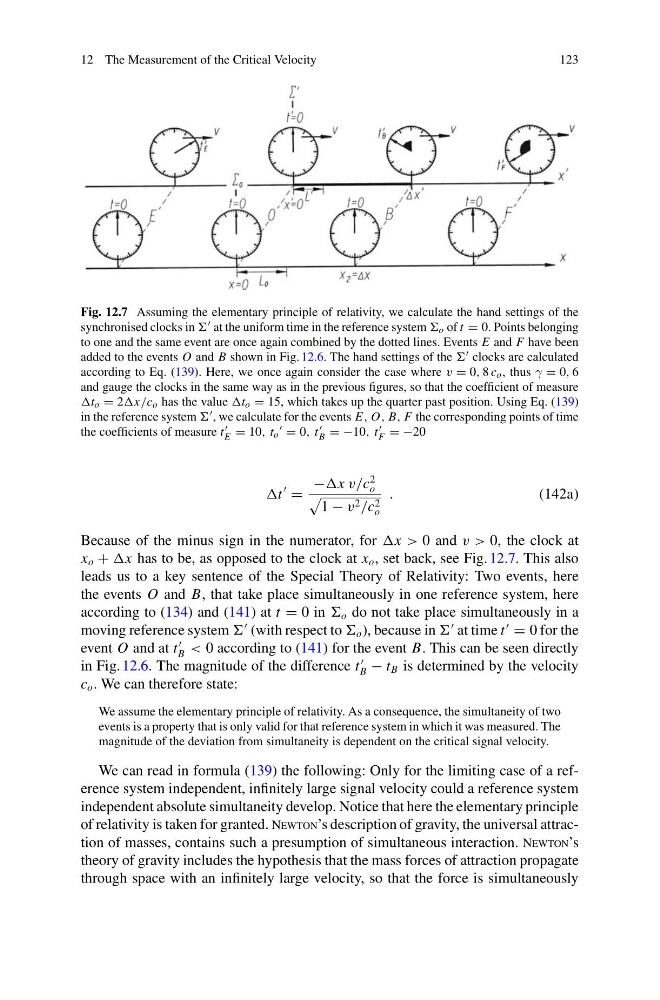
Fig. 12.7 Assuming the elementary principle of relativity, we calculate the hand settings of the
synchronised clocks in at the uniform time in the reference system o of t = 0. Points belonging
to one and the same event are once again combined by the dotted lines. Events E and F have been
added to the events O and B shown in Fig. 12.6. The hand settings of the clocks are calculated
according to Eq. (139). Here, we once again consider the case where v = 0, 8 c o , thus γ = 0, 6
and gauge the clocks in the same way as in the previous figures, so that the coefficient of measure
t o = 2x/c o has the value t o = 15, which takes up the quarter past position. Using Eq. (139)
in the reference system , we calculate for the events E, O, B, F the corresponding points of time
the coefficients of measure t
E = 10, t o
= 0, t
B = −10, t
F = −20
t
=
−x v/c
2
o
1 − v 2 /c 2
o
.
(142a)
Because of the minus sign in the numerator, for x > 0 and v > 0, the clock at
x o + x has to be, as opposed to the clock at x o , set back, see Fig. 12.7. This also
leads us to a key sentence of the Special Theory of Relativity: Two events, here
the events O and B, that take place simultaneously in one reference system, here
according to (134) and (141) at t = 0 in o do not take place simultaneously in a
moving reference system
(with respect to o ), because in
at time t
= 0 for the
event O and at t
B < 0 according to (141) for the event B. This can be seen directly
in Fig. 12.6. The magnitude of the difference t
B − t B is determined by the velocity
c o . We can therefore state:
We assume the elementary principle of relativity. As a consequence, the simultaneity of two
events is a property that is only valid for that reference system in which it was measured. The
magnitude of the deviation from simultaneity is dependent on the critical signal velocity.
We can read in formula (139) the following: Only for the limiting case of a reference system independent, infinitely large signal velocity could a reference system
independent absolute simultaneity develop. Notice that here the elementary principle
of relativity is taken for granted. Newton’s description of gravity, the universal attraction of masses, contains such a presumption of simultaneous interaction. Newton’s
theory of gravity includes the hypothesis that the mass forces of attraction propagate
through space with an infinitely large velocity, so that the force is simultaneously
123
Fig. 12.7 Assuming the elementary principle of relativity, we calculate the hand settings of the
synchronised clocks in at the uniform time in the reference system o of t = 0. Points belonging
to one and the same event are once again combined by the dotted lines. Events E and F have been
added to the events O and B shown in Fig. 12.6. The hand settings of the clocks are calculated
according to Eq. (139). Here, we once again consider the case where v = 0, 8 c o , thus γ = 0, 6
and gauge the clocks in the same way as in the previous figures, so that the coefficient of measure
t o = 2x/c o has the value t o = 15, which takes up the quarter past position. Using Eq. (139)
in the reference system , we calculate for the events E, O, B, F the corresponding points of time
the coefficients of measure t
E = 10, t o
= 0, t
B = −10, t
F = −20
t
=
−x v/c
2
o
1 − v 2 /c 2
o
.
(142a)
Because of the minus sign in the numerator, for x > 0 and v > 0, the clock at
x o + x has to be, as opposed to the clock at x o , set back, see Fig. 12.7. This also
leads us to a key sentence of the Special Theory of Relativity: Two events, here
the events O and B, that take place simultaneously in one reference system, here
according to (134) and (141) at t = 0 in o do not take place simultaneously in a
moving reference system
(with respect to o ), because in
at time t
= 0 for the
event O and at t
B < 0 according to (141) for the event B. This can be seen directly
in Fig. 12.6. The magnitude of the difference t
B − t B is determined by the velocity
c o . We can therefore state:
We assume the elementary principle of relativity. As a consequence, the simultaneity of two
events is a property that is only valid for that reference system in which it was measured. The
magnitude of the deviation from simultaneity is dependent on the critical signal velocity.
We can read in formula (139) the following: Only for the limiting case of a reference system independent, infinitely large signal velocity could a reference system
independent absolute simultaneity develop. Notice that here the elementary principle
of relativity is taken for granted. Newton’s description of gravity, the universal attraction of masses, contains such a presumption of simultaneous interaction. Newton’s
theory of gravity includes the hypothesis that the mass forces of attraction propagate
through space with an infinitely large velocity, so that the force is simultaneously