

122
12 The Measurement of the Critical Velocity
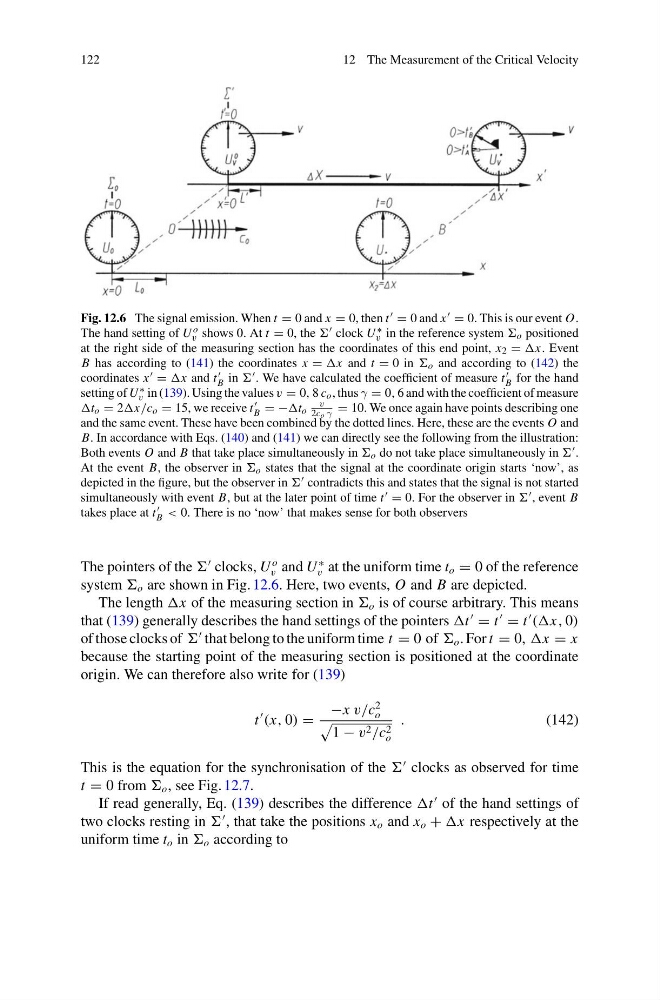
Fig. 12.6 The signal emission. When t = 0 and x = 0, then t = 0 and x = 0. This is our event O.
The hand setting of U o
v shows 0. At t = 0, the clock U ∗
v in the reference system o positioned
at the right side of the measuring section has the coordinates of this end point, x 2 = x. Event
B has according to (141) the coordinates x = x and t = 0 in o and according to (142) the
coordinates x = x and t
B in . We have calculated the coefficient of measure t
B for the hand
setting of U ∗
v in (139). Using the values v = 0, 8 c o , thus γ = 0, 6 and with the coefficient of measure
t o = 2x/c o = 15, we receive t
B = −t o
v
2co γ = 10. We once again have points describing one
and the same event. These have been combined by the dotted lines. Here, these are the events O and
B. In accordance with Eqs. (140) and (141) we can directly see the following from the illustration:
Both events O and B that take place simultaneously in o do not take place simultaneously in .
At the event B, the observer in o states that the signal at the coordinate origin starts ‘now’, as
depicted in the figure, but the observer in contradicts this and states that the signal is not started
simultaneously with event B, but at the later point of time t = 0. For the observer in , event B
takes place at t
B < 0. There is no ‘now’ that makes sense for both observers
The pointers of the
clocks, U
o
v and U
∗
v at the uniform time t o = 0 of the reference
system o are shown in Fig. 12.6. Here, two events, O and B are depicted.
The length x of the measuring section in o is of course arbitrary. This means
that (139) generally describes the hand settings of the pointers t
= t
= t
((x, 0)
of those clocks of
that belong to the uniform time t = 0 of o . For t = 0, x = x
because the starting point of the measuring section is positioned at the coordinate
origin. We can therefore also write for (139)
t
(x, 0) =
−x v/c
2
o
1 − v 2 /c 2
o
.
(142)
This is the equation for the synchronisation of the
clocks as observed for time
t = 0 from o , see Fig. 12.7.
If read generally, Eq. (139) describes the difference t
of the hand settings of
two clocks resting in
, that take the positions x o and x o + x respectively at the
uniform time t o in o according to
12 The Measurement of the Critical Velocity
Fig. 12.6 The signal emission. When t = 0 and x = 0, then t = 0 and x = 0. This is our event O.
The hand setting of U o
v shows 0. At t = 0, the clock U ∗
v in the reference system o positioned
at the right side of the measuring section has the coordinates of this end point, x 2 = x. Event
B has according to (141) the coordinates x = x and t = 0 in o and according to (142) the
coordinates x = x and t
B in . We have calculated the coefficient of measure t
B for the hand
setting of U ∗
v in (139). Using the values v = 0, 8 c o , thus γ = 0, 6 and with the coefficient of measure
t o = 2x/c o = 15, we receive t
B = −t o
v
2co γ = 10. We once again have points describing one
and the same event. These have been combined by the dotted lines. Here, these are the events O and
B. In accordance with Eqs. (140) and (141) we can directly see the following from the illustration:
Both events O and B that take place simultaneously in o do not take place simultaneously in .
At the event B, the observer in o states that the signal at the coordinate origin starts ‘now’, as
depicted in the figure, but the observer in contradicts this and states that the signal is not started
simultaneously with event B, but at the later point of time t = 0. For the observer in , event B
takes place at t
B < 0. There is no ‘now’ that makes sense for both observers
The pointers of the
clocks, U
o
v and U
∗
v at the uniform time t o = 0 of the reference
system o are shown in Fig. 12.6. Here, two events, O and B are depicted.
The length x of the measuring section in o is of course arbitrary. This means
that (139) generally describes the hand settings of the pointers t
= t
= t
((x, 0)
of those clocks of
that belong to the uniform time t = 0 of o . For t = 0, x = x
because the starting point of the measuring section is positioned at the coordinate
origin. We can therefore also write for (139)
t
(x, 0) =
−x v/c
2
o
1 − v 2 /c 2
o
.
(142)
This is the equation for the synchronisation of the
clocks as observed for time
t = 0 from o , see Fig. 12.7.
If read generally, Eq. (139) describes the difference t
of the hand settings of
two clocks resting in
, that take the positions x o and x o + x respectively at the
uniform time t o in o according to