

104
10 Measuring-Rods and Clocks in Motion
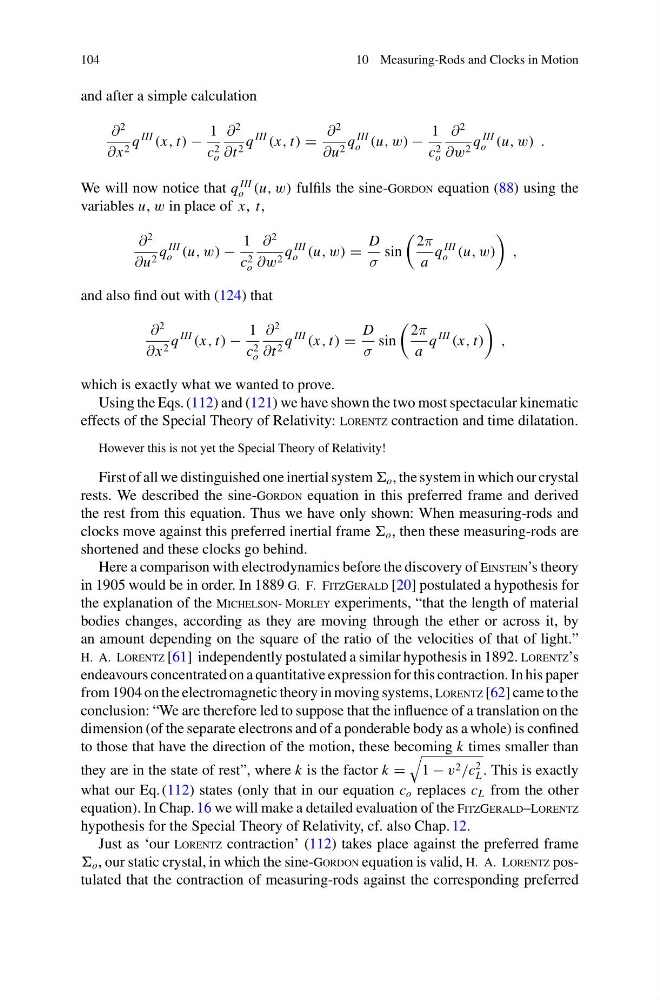
and after a simple calculation
∂
2
∂x 2 q
III
(x, t) −
1
c 2
o
∂
2
∂t 2 q
III
(x, t) =
∂
2
∂u 2 q
III
o (u, w) −
1
c 2
o
∂
2
∂w 2 q
III
o (u, w) .
We will now notice that q
III
o (u, w) fulfils the sine-Gordon equation (88) using the
variables u, w in place of x, t,
∂
2
∂u 2 q
III
o (u, w) −
1
c 2
o
∂
2
∂w 2 q
III
o (u, w) =
D
σ
sin
2π
a
q
III
o (u, w)
,
and also find out with (124) that
∂
2
∂x 2 q
III
(x, t) −
1
c 2
o
∂
2
∂t 2 q
III
(x, t) =
D
σ
sin
2π
a
q
III
(x, t)
,
which is exactly what we wanted to prove.
Using the Eqs. (112) and (121) we have shown the two most spectacular kinematic
effects of the Special Theory of Relativity: Lorentz contraction and time dilatation.
However this is not yet the Special Theory of Relativity!
First of all we distinguished one inertial system o , the system in which our crystal
rests. We described the sine-Gordon equation in this preferred frame and derived
the rest from this equation. Thus we have only shown: When measuring-rods and
clocks move against this preferred inertial frame o , then these measuring-rods are
shortened and these clocks go behind.
Here a comparison with electrodynamics before the discovery of Einstein’s theory
in 1905 would be in order. In 1889 G. F. FitzGerald [20] postulated a hypothesis for
the explanation of the Michelson- Morley experiments, “that the length of material
bodies changes, according as they are moving through the ether or across it, by
an amount depending on the square of the ratio of the velocities of that of light.”
H. A. Lorentz [61] independently postulated a similar hypothesis in 1892. Lorentz’s
endeavours concentrated on a quantitative expression for this contraction. In his paper
from 1904 on the electromagnetic theory in moving systems, Lorentz [62] came to the
conclusion: “We are therefore led to suppose that the influence of a translation on the
dimension (of the separate electrons and of a ponderable body as a whole) is confined
to those that have the direction of the motion, these becoming k times smaller than
they are in the state of rest”, where k is the factor k =
1 − v 2 /c
2
L . This is exactly
what our Eq. (112) states (only that in our equation c o replaces c L from the other
equation). In Chap. 16 we will make a detailed evaluation of the FitzGerald–Lorentz
hypothesis for the Special Theory of Relativity, cf. also Chap. 12.
Just as ‘our Lorentz contraction’ (112) takes place against the preferred frame
o , our static crystal, in which the sine-Gordon equation is valid, H. A. Lorentz postulated that the contraction of measuring-rods against the corresponding preferred
10 Measuring-Rods and Clocks in Motion
and after a simple calculation
∂
2
∂x 2 q
III
(x, t) −
1
c 2
o
∂
2
∂t 2 q
III
(x, t) =
∂
2
∂u 2 q
III
o (u, w) −
1
c 2
o
∂
2
∂w 2 q
III
o (u, w) .
We will now notice that q
III
o (u, w) fulfils the sine-Gordon equation (88) using the
variables u, w in place of x, t,
∂
2
∂u 2 q
III
o (u, w) −
1
c 2
o
∂
2
∂w 2 q
III
o (u, w) =
D
σ
sin
2π
a
q
III
o (u, w)
,
and also find out with (124) that
∂
2
∂x 2 q
III
(x, t) −
1
c 2
o
∂
2
∂t 2 q
III
(x, t) =
D
σ
sin
2π
a
q
III
(x, t)
,
which is exactly what we wanted to prove.
Using the Eqs. (112) and (121) we have shown the two most spectacular kinematic
effects of the Special Theory of Relativity: Lorentz contraction and time dilatation.
However this is not yet the Special Theory of Relativity!
First of all we distinguished one inertial system o , the system in which our crystal
rests. We described the sine-Gordon equation in this preferred frame and derived
the rest from this equation. Thus we have only shown: When measuring-rods and
clocks move against this preferred inertial frame o , then these measuring-rods are
shortened and these clocks go behind.
Here a comparison with electrodynamics before the discovery of Einstein’s theory
in 1905 would be in order. In 1889 G. F. FitzGerald [20] postulated a hypothesis for
the explanation of the Michelson- Morley experiments, “that the length of material
bodies changes, according as they are moving through the ether or across it, by
an amount depending on the square of the ratio of the velocities of that of light.”
H. A. Lorentz [61] independently postulated a similar hypothesis in 1892. Lorentz’s
endeavours concentrated on a quantitative expression for this contraction. In his paper
from 1904 on the electromagnetic theory in moving systems, Lorentz [62] came to the
conclusion: “We are therefore led to suppose that the influence of a translation on the
dimension (of the separate electrons and of a ponderable body as a whole) is confined
to those that have the direction of the motion, these becoming k times smaller than
they are in the state of rest”, where k is the factor k =
1 − v 2 /c
2
L . This is exactly
what our Eq. (112) states (only that in our equation c o replaces c L from the other
equation). In Chap. 16 we will make a detailed evaluation of the FitzGerald–Lorentz
hypothesis for the Special Theory of Relativity, cf. also Chap. 12.
Just as ‘our Lorentz contraction’ (112) takes place against the preferred frame
o , our static crystal, in which the sine-Gordon equation is valid, H. A. Lorentz postulated that the contraction of measuring-rods against the corresponding preferred