

61
Fundamentals of Electrochemical Double-Layer Supercapacitors
2.4.2 Capacitances of Porous Carbon Materials and
Their Associated Electrode Layers
Regarding the differential capacitance of such an electrode matrix layer, the
Gouy–Chapman–Stern (GCS) double-layer modeling for capacitance is still
applicable if the concentration of the electrolyte used is high enough to make
the diffuse layer disappear. However, if a very dilute electrolyte solution is
used, the situation will become more complicated due to the potential distribution within the electrolyte channels inside the porous layer.
In supercapacitors, the electrolyte concentration is normally high (>1.0 M),
causing the diffuse layer to disappear and the Helmholtz layer to remain.
This increases the capacitance of the electrode layer and allows more charge
storage. Furthermore, if the material particle size is larger than the thickness of the Helmholtz layer (<1 nm), conclusions derived from the planar
electrode may still be applicable to the situation of particles. For example,
the carbon particle materials used in supercapacitors are normally 10 to 50
nm—much larger than the thickness of the Helmholtz layer of <1 nm.
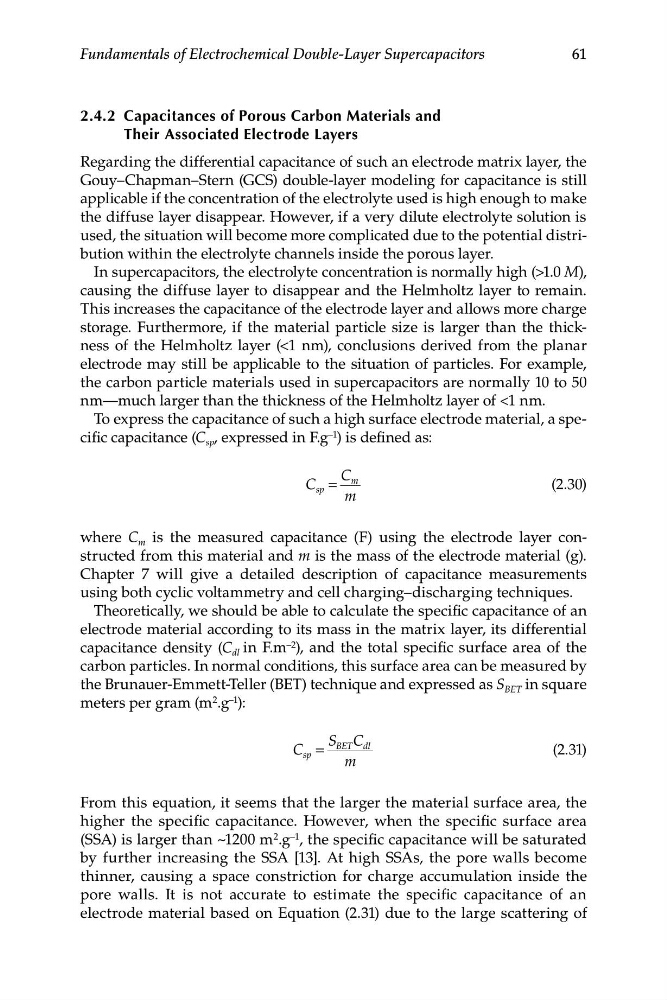
To express the capacitance of such a high surface electrode material, a specific capacitance (C sp , expressed in F.g –1 ) is defined as:
C m
C sp =
(2.30)
m
where C m is the measured capacitance (F) using the electrode layer constructed from this material and m is the mass of the electrode material (g).
Chapter 7 will give a detailed description of capacitance measurements
using both cyclic voltammetry and cell charging–discharging techniques.
Theoretically, we should be able to calculate the specific capacitance of an
electrode material according to its mass in the matrix layer, its differential
capacitance density (C dl in F.m –2 ), and the total specific surface area of the
carbon particles. In normal conditions, this surface area can be measured by
the Brunauer-Emmett-Teller (BET) technique and expressed as S BET in square
meters per gram (m 2 .g –1 ):
S C dl
C sp =
BET
(2.31)
m
From this equation, it seems that the larger the material surface area, the
higher the specific capacitance. However, when the specific surface area
(SSA) is larger than ~1200 m 2 .g –1 , the specific capacitance will be saturated
by further increasing the SSA [13]. At high SSAs, the pore walls become
thinner, causing a space constriction for charge accumulation inside the
pore walls. It is not accurate to estimate the specific capacitance of an
electrode material based on Equation (2.31) due to the large scattering of
Fundamentals of Electrochemical Double-Layer Supercapacitors
2.4.2 Capacitances of Porous Carbon Materials and
Their Associated Electrode Layers
Regarding the differential capacitance of such an electrode matrix layer, the
Gouy–Chapman–Stern (GCS) double-layer modeling for capacitance is still
applicable if the concentration of the electrolyte used is high enough to make
the diffuse layer disappear. However, if a very dilute electrolyte solution is
used, the situation will become more complicated due to the potential distribution within the electrolyte channels inside the porous layer.
In supercapacitors, the electrolyte concentration is normally high (>1.0 M),
causing the diffuse layer to disappear and the Helmholtz layer to remain.
This increases the capacitance of the electrode layer and allows more charge
storage. Furthermore, if the material particle size is larger than the thickness of the Helmholtz layer (<1 nm), conclusions derived from the planar
electrode may still be applicable to the situation of particles. For example,
the carbon particle materials used in supercapacitors are normally 10 to 50
nm—much larger than the thickness of the Helmholtz layer of <1 nm.
To express the capacitance of such a high surface electrode material, a specific capacitance (C sp , expressed in F.g –1 ) is defined as:
C m
C sp =
(2.30)
m
where C m is the measured capacitance (F) using the electrode layer constructed from this material and m is the mass of the electrode material (g).
Chapter 7 will give a detailed description of capacitance measurements
using both cyclic voltammetry and cell charging–discharging techniques.
Theoretically, we should be able to calculate the specific capacitance of an
electrode material according to its mass in the matrix layer, its differential
capacitance density (C dl in F.m –2 ), and the total specific surface area of the
carbon particles. In normal conditions, this surface area can be measured by
the Brunauer-Emmett-Teller (BET) technique and expressed as S BET in square
meters per gram (m 2 .g –1 ):
S C dl
C sp =
BET
(2.31)
m
From this equation, it seems that the larger the material surface area, the
higher the specific capacitance. However, when the specific surface area
(SSA) is larger than ~1200 m 2 .g –1 , the specific capacitance will be saturated
by further increasing the SSA [13]. At high SSAs, the pore walls become
thinner, causing a space constriction for charge accumulation inside the
pore walls. It is not accurate to estimate the specific capacitance of an
electrode material based on Equation (2.31) due to the large scattering of