

60
Current collector
Porous carbon layer
Electric double layer
Electrolyte solution channel
Carbon
particle
Inaccessible
inner-pore
Accessible
inner-pore
Electrochemical Supercapacitors for Energy Storage and Delivery
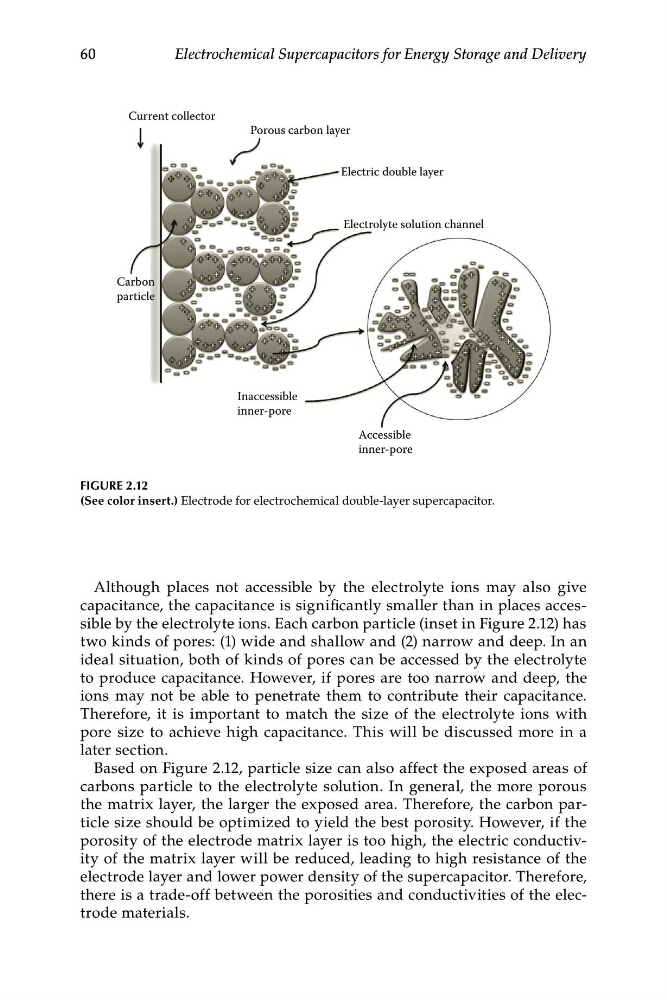
FIGURE 2.12
(See color insert.) Electrode for electrochemical double-layer supercapacitor.
Although places not accessible by the electrolyte ions may also give
capacitance, the capacitance is significantly smaller than in places accessible by the electrolyte ions. Each carbon particle (inset in Figure 2.12) has
two kinds of pores: (1) wide and shallow and (2) narrow and deep. In an
ideal situation, both of kinds of pores can be accessed by the electrolyte
to produce capacitance. However, if pores are too narrow and deep, the
ions may not be able to penetrate them to contribute their capacitance.
Therefore, it is important to match the size of the electrolyte ions with
pore size to achieve high capacitance. This will be discussed more in a
later section.
Based on Figure 2.12, particle size can also affect the exposed areas of
carbons particle to the electrolyte solution. In general, the more porous
the matrix layer, the larger the exposed area. Therefore, the carbon particle size should be optimized to yield the best porosity. However, if the
porosity of the electrode matrix layer is too high, the electric conductivity of the matrix layer will be reduced, leading to high resistance of the
electrode layer and lower power density of the supercapacitor. Therefore,
there is a trade-off between the porosities and conductivities of the electrode materials.
Current collector
Porous carbon layer
Electric double layer
Electrolyte solution channel
Carbon
particle
Inaccessible
inner-pore
Accessible
inner-pore
Electrochemical Supercapacitors for Energy Storage and Delivery
FIGURE 2.12
(See color insert.) Electrode for electrochemical double-layer supercapacitor.
Although places not accessible by the electrolyte ions may also give
capacitance, the capacitance is significantly smaller than in places accessible by the electrolyte ions. Each carbon particle (inset in Figure 2.12) has
two kinds of pores: (1) wide and shallow and (2) narrow and deep. In an
ideal situation, both of kinds of pores can be accessed by the electrolyte
to produce capacitance. However, if pores are too narrow and deep, the
ions may not be able to penetrate them to contribute their capacitance.
Therefore, it is important to match the size of the electrolyte ions with
pore size to achieve high capacitance. This will be discussed more in a
later section.
Based on Figure 2.12, particle size can also affect the exposed areas of
carbons particle to the electrolyte solution. In general, the more porous
the matrix layer, the larger the exposed area. Therefore, the carbon particle size should be optimized to yield the best porosity. However, if the
porosity of the electrode matrix layer is too high, the electric conductivity of the matrix layer will be reduced, leading to high resistance of the
electrode layer and lower power density of the supercapacitor. Therefore,
there is a trade-off between the porosities and conductivities of the electrode materials.