

39
Fundamentals of Electrochemical Double-Layer Supercapacitors
+ Positive charge
– Negative charge, carried by ion
+
–
V
+
–
–
+
+
+
–
–
+
+
–
–
+
+
–
–
+
+
–
–
+
+
–
–
+
+
–
–
–
+
+
–
+
+
–
–
+
–
+
–
Positive electrode
Separator
Negative electrode
(Conducting material)
(Conducting material)
Electrolyte medium
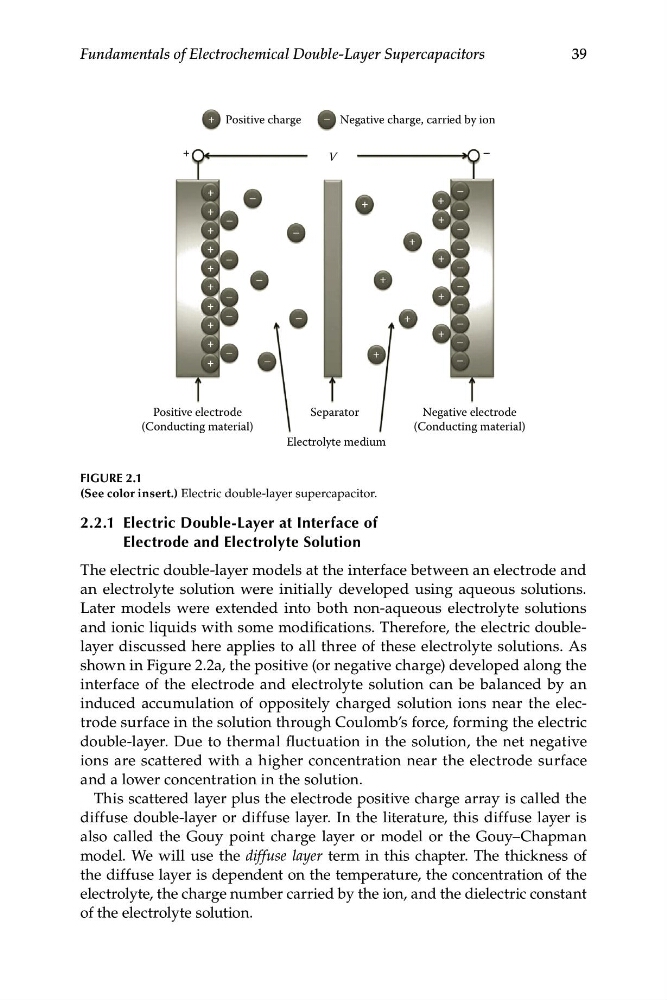
FIGURE 2.1
(See color insert.) Electric double-layer supercapacitor.
2.2.1 Electric Double-Layer at Interface of
Electrode and Electrolyte Solution
The electric double-layer models at the interface between an electrode and
an electrolyte solution were initially developed using aqueous solutions.
Later models were extended into both non-aqueous electrolyte solutions
and ionic liquids with some modifications. Therefore, the electric doublelayer discussed here applies to all three of these electrolyte solutions. As
shown in Figure 2.2a, the positive (or negative charge) developed along the
interface of the electrode and electrolyte solution can be balanced by an
induced accumulation of oppositely charged solution ions near the electrode surface in the solution through Coulomb’s force, forming the electric
double-layer. Due to thermal fluctuation in the solution, the net negative
ions are scattered with a higher concentration near the electrode surface
and a lower concentration in the solution.
This scattered layer plus the electrode positive charge array is called the
diffuse double-layer or diffuse layer. In the literature, this diffuse layer is
also called the Gouy point charge layer or model or the Gouy–Chapman
model. We will use the diffuse layer term in this chapter. The thickness of
the diffuse layer is dependent on the temperature, the concentration of the
electrolyte, the charge number carried by the ion, and the dielectric constant
of the electrolyte solution.
Fundamentals of Electrochemical Double-Layer Supercapacitors
+ Positive charge
– Negative charge, carried by ion
+
–
V
+
–
–
+
+
+
–
–
+
+
–
–
+
+
–
–
+
+
–
–
+
+
–
–
+
+
–
–
–
+
+
–
+
+
–
–
+
–
+
–
Positive electrode
Separator
Negative electrode
(Conducting material)
(Conducting material)
Electrolyte medium
FIGURE 2.1
(See color insert.) Electric double-layer supercapacitor.
2.2.1 Electric Double-Layer at Interface of
Electrode and Electrolyte Solution
The electric double-layer models at the interface between an electrode and
an electrolyte solution were initially developed using aqueous solutions.
Later models were extended into both non-aqueous electrolyte solutions
and ionic liquids with some modifications. Therefore, the electric doublelayer discussed here applies to all three of these electrolyte solutions. As
shown in Figure 2.2a, the positive (or negative charge) developed along the
interface of the electrode and electrolyte solution can be balanced by an
induced accumulation of oppositely charged solution ions near the electrode surface in the solution through Coulomb’s force, forming the electric
double-layer. Due to thermal fluctuation in the solution, the net negative
ions are scattered with a higher concentration near the electrode surface
and a lower concentration in the solution.
This scattered layer plus the electrode positive charge array is called the
diffuse double-layer or diffuse layer. In the literature, this diffuse layer is
also called the Gouy point charge layer or model or the Gouy–Chapman
model. We will use the diffuse layer term in this chapter. The thickness of
the diffuse layer is dependent on the temperature, the concentration of the
electrolyte, the charge number carried by the ion, and the dielectric constant
of the electrolyte solution.