

24
Electrochemical Supercapacitors for Energy Storage and Delivery
+
–
B
ε
a
b
S
R
L
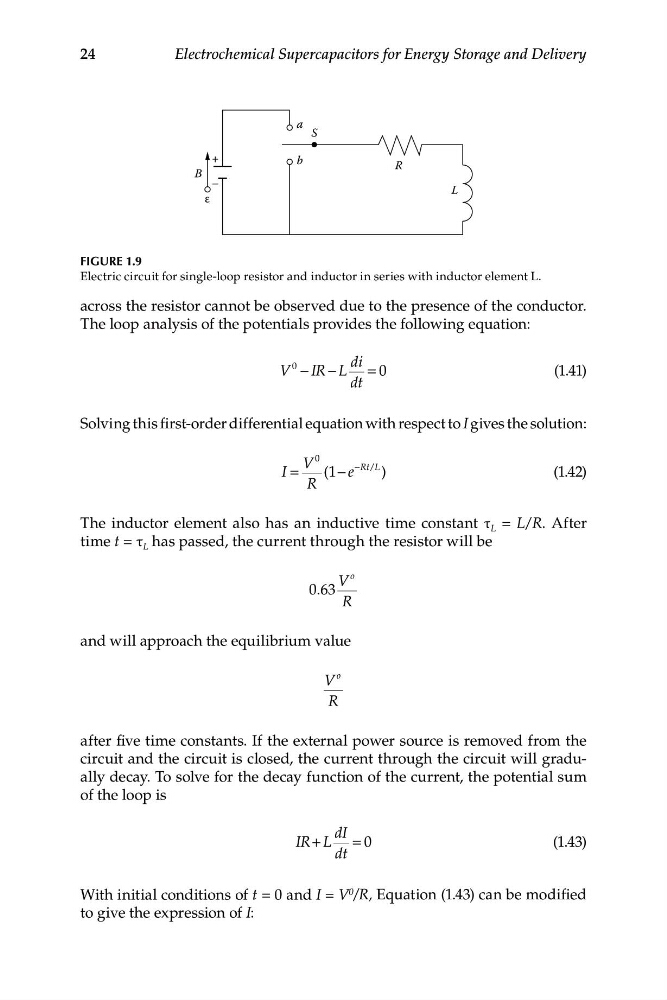
FIGURE 1.9
Electric circuit for single-loop resistor and inductor in series with inductor element L.
across the resistor cannot be observed due to the presence of the conductor.
The loop analysis of the potentials provides the following equation:
0
di
V − IR L =
−
0
(1.41)
dt
Solving this first-order differential equation with respect to I gives the solution:
V
0
−Rt L
I =
(1− e
/ )
(1.42)
R
The inductor element also has an inductive time constant τ L = L/R. After
time t = τ L has passed, the current through the resistor will be
V
o
0 63
.
R
and will approach the equilibrium value
V
o
R
after five time constants. If the external power source is removed from the
circuit and the circuit is closed, the current through the circuit will gradually decay. To solve for the decay function of the current, the potential sum
of the loop is
dI
IR L
+
= 0
(1.43)
dt
With initial conditions of t = 0 and I = V 0 /R, Equation (1.43) can be modified
to give the expression of I:
Electrochemical Supercapacitors for Energy Storage and Delivery
+
–
B
ε
a
b
S
R
L
FIGURE 1.9
Electric circuit for single-loop resistor and inductor in series with inductor element L.
across the resistor cannot be observed due to the presence of the conductor.
The loop analysis of the potentials provides the following equation:
0
di
V − IR L =
−
0
(1.41)
dt
Solving this first-order differential equation with respect to I gives the solution:
V
0
−Rt L
I =
(1− e
/ )
(1.42)
R
The inductor element also has an inductive time constant τ L = L/R. After
time t = τ L has passed, the current through the resistor will be
V
o
0 63
.
R
and will approach the equilibrium value
V
o
R
after five time constants. If the external power source is removed from the
circuit and the circuit is closed, the current through the circuit will gradually decay. To solve for the decay function of the current, the potential sum
of the loop is
dI
IR L
+
= 0
(1.43)
dt
With initial conditions of t = 0 and I = V 0 /R, Equation (1.43) can be modified
to give the expression of I: