

327
100000
ASD Rating (kVA)
10000
1000
100
10
1
Flywheels
Supercapacitors
Flywheels
Fuel cells
SMES
Motor-generator sets
0
5
10
15
3500
ASD Ride Through Duration (seconds)
Applications of Electrochemical Supercapacitors
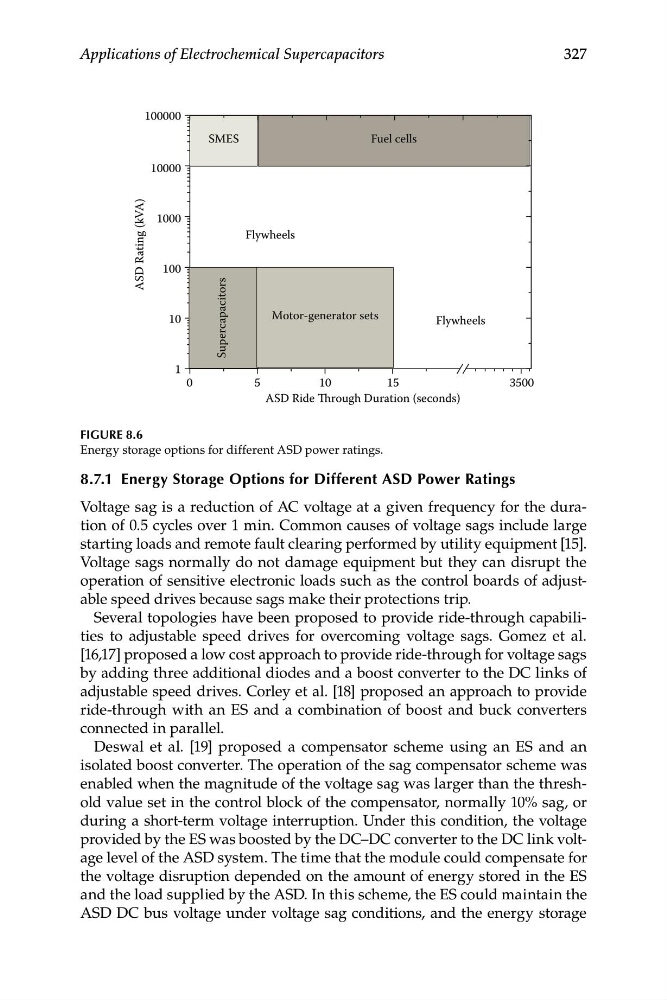
FIGURE 8.6
Energy storage options for different ASD power ratings.
8.7.1 Energy Storage Options for Different ASD Power Ratings
Voltage sag is a reduction of AC voltage at a given frequency for the duration of 0.5 cycles over 1 min. Common causes of voltage sags include large
starting loads and remote fault clearing performed by utility equipment [15].
Voltage sags normally do not damage equipment but they can disrupt the
operation of sensitive electronic loads such as the control boards of adjustable speed drives because sags make their protections trip.
Several topologies have been proposed to provide ride-through capabilities to adjustable speed drives for overcoming voltage sags. Gomez et al.
[16,17] proposed a low cost approach to provide ride-through for voltage sags
by adding three additional diodes and a boost converter to the DC links of
adjustable speed drives. Corley et al. [18] proposed an approach to provide
ride-through with an ES and a combination of boost and buck converters
connected in parallel.
Deswal et al. [19] proposed a compensator scheme using an ES and an
isolated boost converter. The operation of the sag compensator scheme was
enabled when the magnitude of the voltage sag was larger than the threshold value set in the control block of the compensator, normally 10% sag, or
during a short-term voltage interruption. Under this condition, the voltage
provided by the ES was boosted by the DC–DC converter to the DC link voltage level of the ASD system. The time that the module could compensate for
the voltage disruption depended on the amount of energy stored in the ES
and the load supplied by the ASD. In this scheme, the ES could maintain the
ASD DC bus voltage under voltage sag conditions, and the energy storage
100000
ASD Rating (kVA)
10000
1000
100
10
1
Flywheels
Supercapacitors
Flywheels
Fuel cells
SMES
Motor-generator sets
0
5
10
15
3500
ASD Ride Through Duration (seconds)
Applications of Electrochemical Supercapacitors
FIGURE 8.6
Energy storage options for different ASD power ratings.
8.7.1 Energy Storage Options for Different ASD Power Ratings
Voltage sag is a reduction of AC voltage at a given frequency for the duration of 0.5 cycles over 1 min. Common causes of voltage sags include large
starting loads and remote fault clearing performed by utility equipment [15].
Voltage sags normally do not damage equipment but they can disrupt the
operation of sensitive electronic loads such as the control boards of adjustable speed drives because sags make their protections trip.
Several topologies have been proposed to provide ride-through capabilities to adjustable speed drives for overcoming voltage sags. Gomez et al.
[16,17] proposed a low cost approach to provide ride-through for voltage sags
by adding three additional diodes and a boost converter to the DC links of
adjustable speed drives. Corley et al. [18] proposed an approach to provide
ride-through with an ES and a combination of boost and buck converters
connected in parallel.
Deswal et al. [19] proposed a compensator scheme using an ES and an
isolated boost converter. The operation of the sag compensator scheme was
enabled when the magnitude of the voltage sag was larger than the threshold value set in the control block of the compensator, normally 10% sag, or
during a short-term voltage interruption. Under this condition, the voltage
provided by the ES was boosted by the DC–DC converter to the DC link voltage level of the ASD system. The time that the module could compensate for
the voltage disruption depended on the amount of energy stored in the ES
and the load supplied by the ASD. In this scheme, the ES could maintain the
ASD DC bus voltage under voltage sag conditions, and the energy storage