

Reference chamber
Internal thermometer
Glass sample holder
Liquid nitrogen filled
sample chamber
311
Characterization and Diagnosis Techniques
deposition [53] and porous structures of poly(ethyleneimine)-modified graphene sheets [54].
7.7 Brunauer–Emmett–Teller (BET) Method
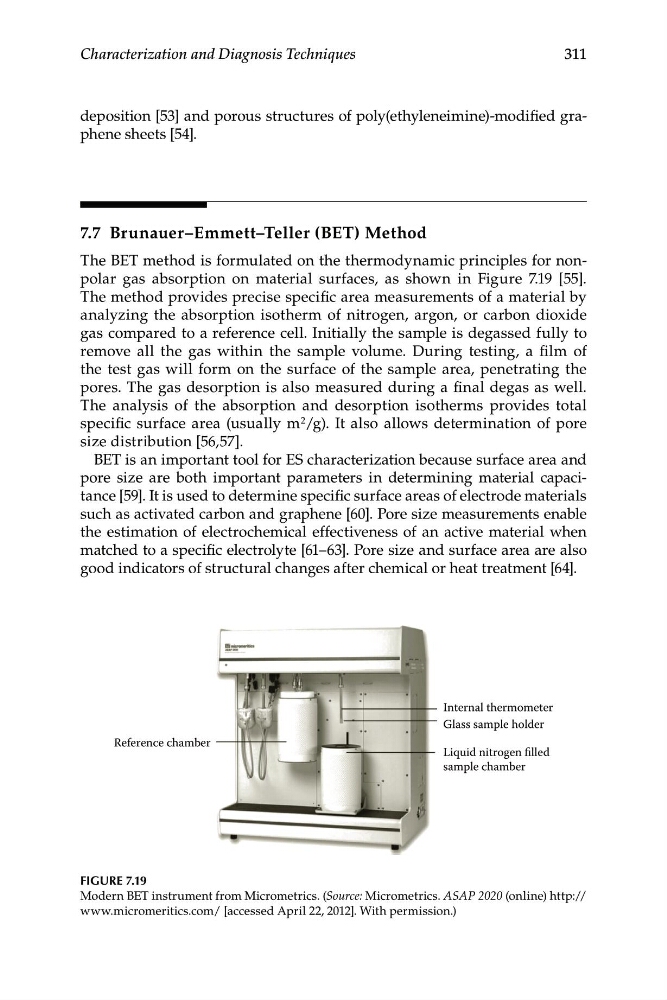
The BET method is formulated on the thermodynamic principles for nonpolar gas absorption on material surfaces, as shown in Figure 7.19 [55].
The method provides precise specific area measurements of a material by
analyzing the absorption isotherm of nitrogen, argon, or carbon dioxide
gas compared to a reference cell. Initially the sample is degassed fully to
remove all the gas within the sample volume. During testing, a film of
the test gas will form on the surface of the sample area, penetrating the
pores. The gas desorption is also measured during a final degas as well.
The analysis of the absorption and desorption isotherms provides total
specific surface area (usually m 2 /g). It also allows determination of pore
size distribution [56,57].
BET is an important tool for ES characterization because surface area and
pore size are both important parameters in determining material capacitance [59]. It is used to determine specific surface areas of electrode materials
such as activated carbon and graphene [60]. Pore size measurements enable
the estimation of electrochemical effectiveness of an active material when
matched to a specific electrolyte [61–63]. Pore size and surface area are also
good indicators of structural changes after chemical or heat treatment [64].
FIGURE 7.19
Modern BET instrument from Micrometrics. (Source: Micrometrics. ASAP 2020 (online) http://
www.micromeritics.com/ [accessed April 22, 2012]. With permission.)
Internal thermometer
Glass sample holder
Liquid nitrogen filled
sample chamber
311
Characterization and Diagnosis Techniques
deposition [53] and porous structures of poly(ethyleneimine)-modified graphene sheets [54].
7.7 Brunauer–Emmett–Teller (BET) Method
The BET method is formulated on the thermodynamic principles for nonpolar gas absorption on material surfaces, as shown in Figure 7.19 [55].
The method provides precise specific area measurements of a material by
analyzing the absorption isotherm of nitrogen, argon, or carbon dioxide
gas compared to a reference cell. Initially the sample is degassed fully to
remove all the gas within the sample volume. During testing, a film of
the test gas will form on the surface of the sample area, penetrating the
pores. The gas desorption is also measured during a final degas as well.
The analysis of the absorption and desorption isotherms provides total
specific surface area (usually m 2 /g). It also allows determination of pore
size distribution [56,57].
BET is an important tool for ES characterization because surface area and
pore size are both important parameters in determining material capacitance [59]. It is used to determine specific surface areas of electrode materials
such as activated carbon and graphene [60]. Pore size measurements enable
the estimation of electrochemical effectiveness of an active material when
matched to a specific electrolyte [61–63]. Pore size and surface area are also
good indicators of structural changes after chemical or heat treatment [64].
FIGURE 7.19
Modern BET instrument from Micrometrics. (Source: Micrometrics. ASAP 2020 (online) http://
www.micromeritics.com/ [accessed April 22, 2012]. With permission.)