

310
Electrochemical Supercapacitors for Energy Storage and Delivery
graphene–SnO2 nanocomposites in acidic solutions [47]. Raman investigation of CNTs after heat or chemical annealing has also been used to find
optimum capacitive characteristics.
7.6.7 Fourier Transform Infrared Spectroscopy (FTIR)
FTIR is an analytical spectroscopy method that utilizes the infrared light
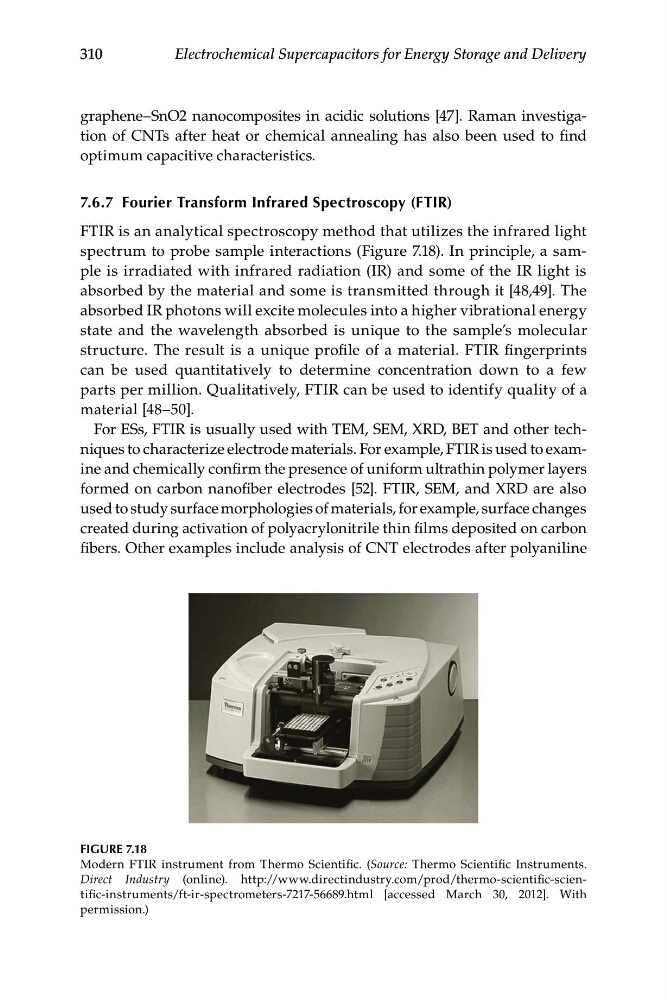
spectrum to probe sample interactions (Figure 7.18). In principle, a sample is irradiated with infrared radiation (IR) and some of the IR light is
absorbed by the material and some is transmitted through it [48,49]. The
absorbed IR photons will excite molecules into a higher vibrational energy
state and the wavelength absorbed is unique to the sample’s molecular
structure. The result is a unique profile of a material. FTIR fingerprints
can be used quantitatively to determine concentration down to a few
parts per million. Qualitatively, FTIR can be used to identify quality of a
material [48–50].
For ESs, FTIR is usually used with TEM, SEM, XRD, BET and other techniques to characterize electrode materials. For example, FTIR is used to examine and chemically confirm the presence of uniform ultrathin polymer layers
formed on carbon nanofiber electrodes [52]. FTIR, SEM, and XRD are also
used to study surface morphologies of materials, for example, surface changes
created during activation of polyacrylonitrile thin films deposited on carbon
fibers. Other examples include analysis of CNT electrodes after polyaniline
FIGURE 7.18
Modern FTIR instrument from Thermo Scientific. (Source: Thermo Scientific Instruments.
Direct Industry (online). http://www.directindustry.com/prod/thermo-scientific-scientific-instruments/ft-ir-spectrometers-7217-56689.html [accessed March 30, 2012]. With
permission.)
Electrochemical Supercapacitors for Energy Storage and Delivery
graphene–SnO2 nanocomposites in acidic solutions [47]. Raman investigation of CNTs after heat or chemical annealing has also been used to find
optimum capacitive characteristics.
7.6.7 Fourier Transform Infrared Spectroscopy (FTIR)
FTIR is an analytical spectroscopy method that utilizes the infrared light
spectrum to probe sample interactions (Figure 7.18). In principle, a sample is irradiated with infrared radiation (IR) and some of the IR light is
absorbed by the material and some is transmitted through it [48,49]. The
absorbed IR photons will excite molecules into a higher vibrational energy
state and the wavelength absorbed is unique to the sample’s molecular
structure. The result is a unique profile of a material. FTIR fingerprints
can be used quantitatively to determine concentration down to a few
parts per million. Qualitatively, FTIR can be used to identify quality of a
material [48–50].
For ESs, FTIR is usually used with TEM, SEM, XRD, BET and other techniques to characterize electrode materials. For example, FTIR is used to examine and chemically confirm the presence of uniform ultrathin polymer layers
formed on carbon nanofiber electrodes [52]. FTIR, SEM, and XRD are also
used to study surface morphologies of materials, for example, surface changes
created during activation of polyacrylonitrile thin films deposited on carbon
fibers. Other examples include analysis of CNT electrodes after polyaniline
FIGURE 7.18
Modern FTIR instrument from Thermo Scientific. (Source: Thermo Scientific Instruments.
Direct Industry (online). http://www.directindustry.com/prod/thermo-scientific-scientific-instruments/ft-ir-spectrometers-7217-56689.html [accessed March 30, 2012]. With
permission.)