

306
Electrochemical Supercapacitors for Energy Storage and Delivery
be useful for identifying the positions of pseudocapacitive metal elements
within composite carbon structures.
7.6.2 Transmission Electron Microscopy (TEM)
Similar to SEM, transmission electron microscopy (TEM) also utilizes a
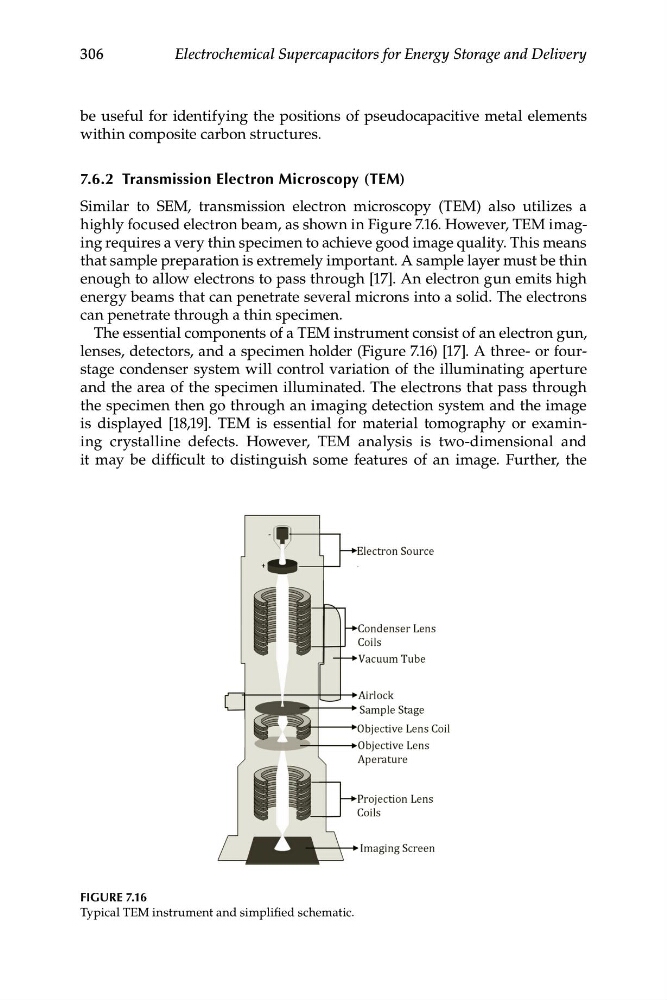
highly focused electron beam, as shown in Figure 7.16. However, TEM imaging requires a very thin specimen to achieve good image quality. This means
that sample preparation is extremely important. A sample layer must be thin
enough to allow electrons to pass through [17]. An electron gun emits high
energy beams that can penetrate several microns into a solid. The electrons
can penetrate through a thin specimen.
The essential components of a TEM instrument consist of an electron gun,
lenses, detectors, and a specimen holder (Figure 7.16) [17]. A three- or fourstage condenser system will control variation of the illuminating aperture
and the area of the specimen illuminated. The electrons that pass through
the specimen then go through an imaging detection system and the image
is displayed [18,19]. TEM is essential for material tomography or examining crystalline defects. However, TEM analysis is two-dimensional and
it may be difficult to distinguish some features of an image. Further, the
FIGURE 7.16
Typical TEM instrument and simplified schematic.
Electrochemical Supercapacitors for Energy Storage and Delivery
be useful for identifying the positions of pseudocapacitive metal elements
within composite carbon structures.
7.6.2 Transmission Electron Microscopy (TEM)
Similar to SEM, transmission electron microscopy (TEM) also utilizes a
highly focused electron beam, as shown in Figure 7.16. However, TEM imaging requires a very thin specimen to achieve good image quality. This means
that sample preparation is extremely important. A sample layer must be thin
enough to allow electrons to pass through [17]. An electron gun emits high
energy beams that can penetrate several microns into a solid. The electrons
can penetrate through a thin specimen.
The essential components of a TEM instrument consist of an electron gun,
lenses, detectors, and a specimen holder (Figure 7.16) [17]. A three- or fourstage condenser system will control variation of the illuminating aperture
and the area of the specimen illuminated. The electrons that pass through
the specimen then go through an imaging detection system and the image
is displayed [18,19]. TEM is essential for material tomography or examining crystalline defects. However, TEM analysis is two-dimensional and
it may be difficult to distinguish some features of an image. Further, the
FIGURE 7.16
Typical TEM instrument and simplified schematic.