

269
Coupling with Batteries and Fuel Cells
Fuel cell
Desired power
power
(mechanical)
Motor
efficiency
map
Desired
power
(electrical)
Desired
fuel cell
power
Desired
ESS
Available
fuel cell
power
Available
ESS
power
Motor
inverter
power
command
command
Saturation
and rate
limiters
Saturation
and rate
limiters
Low-pass
filter
–
+
+
+
1
(1 + sτ)
power
Controller Variable: Filter time constant, τ
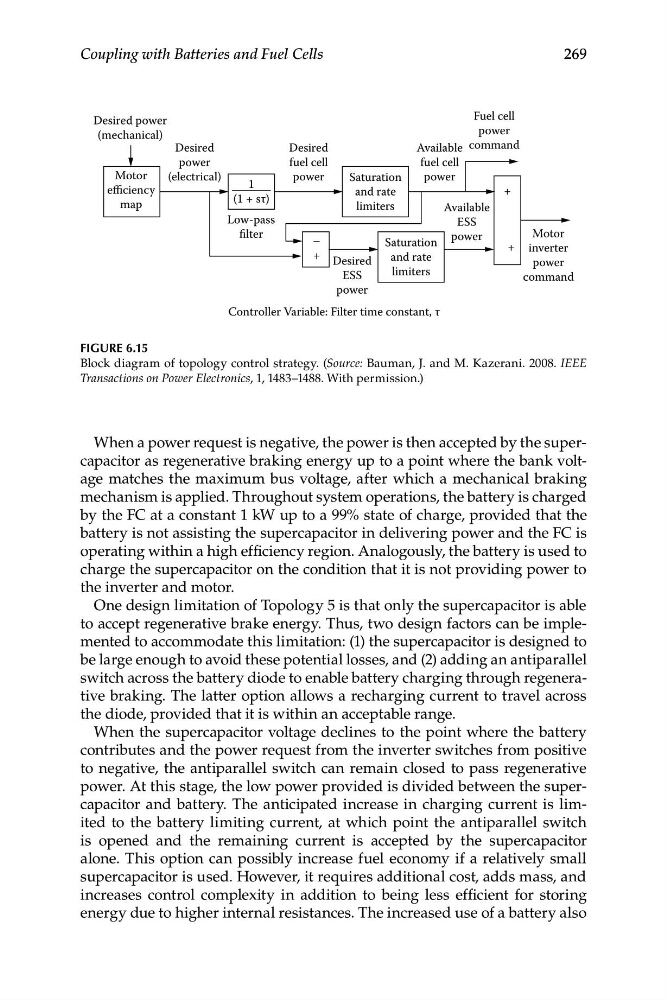
FIGURE 6.15
Block diagram of topology control strategy. (Source: Bauman, J. and M. Kazerani. 2008. IEEE
Transactions on Power Electronics, 1, 1483–1488. With permission.)
When a power request is negative, the power is then accepted by the supercapacitor as regenerative braking energy up to a point where the bank voltage matches the maximum bus voltage, after which a mechanical braking
mechanism is applied. Throughout system operations, the battery is charged
by the FC at a constant 1 kW up to a 99% state of charge, provided that the
battery is not assisting the supercapacitor in delivering power and the FC is
operating within a high efficiency region. Analogously, the battery is used to
charge the supercapacitor on the condition that it is not providing power to
the inverter and motor.
One design limitation of Topology 5 is that only the supercapacitor is able
to accept regenerative brake energy. Thus, two design factors can be implemented to accommodate this limitation: (1) the supercapacitor is designed to
be large enough to avoid these potential losses, and (2) adding an antiparallel
switch across the battery diode to enable battery charging through regenerative braking. The latter option allows a recharging current to travel across
the diode, provided that it is within an acceptable range.
When the supercapacitor voltage declines to the point where the battery
contributes and the power request from the inverter switches from positive
to negative, the antiparallel switch can remain closed to pass regenerative
power. At this stage, the low power provided is divided between the supercapacitor and battery. The anticipated increase in charging current is limited to the battery limiting current, at which point the antiparallel switch
is opened and the remaining current is accepted by the supercapacitor
alone. This option can possibly increase fuel economy if a relatively small
supercapacitor is used. However, it requires additional cost, adds mass, and
increases control complexity in addition to being less efficient for storing
energy due to higher internal resistances. The increased use of a battery also
Coupling with Batteries and Fuel Cells
Fuel cell
Desired power
power
(mechanical)
Motor
efficiency
map
Desired
power
(electrical)
Desired
fuel cell
power
Desired
ESS
Available
fuel cell
power
Available
ESS
power
Motor
inverter
power
command
command
Saturation
and rate
limiters
Saturation
and rate
limiters
Low-pass
filter
–
+
+
+
1
(1 + sτ)
power
Controller Variable: Filter time constant, τ
FIGURE 6.15
Block diagram of topology control strategy. (Source: Bauman, J. and M. Kazerani. 2008. IEEE
Transactions on Power Electronics, 1, 1483–1488. With permission.)
When a power request is negative, the power is then accepted by the supercapacitor as regenerative braking energy up to a point where the bank voltage matches the maximum bus voltage, after which a mechanical braking
mechanism is applied. Throughout system operations, the battery is charged
by the FC at a constant 1 kW up to a 99% state of charge, provided that the
battery is not assisting the supercapacitor in delivering power and the FC is
operating within a high efficiency region. Analogously, the battery is used to
charge the supercapacitor on the condition that it is not providing power to
the inverter and motor.
One design limitation of Topology 5 is that only the supercapacitor is able
to accept regenerative brake energy. Thus, two design factors can be implemented to accommodate this limitation: (1) the supercapacitor is designed to
be large enough to avoid these potential losses, and (2) adding an antiparallel
switch across the battery diode to enable battery charging through regenerative braking. The latter option allows a recharging current to travel across
the diode, provided that it is within an acceptable range.
When the supercapacitor voltage declines to the point where the battery
contributes and the power request from the inverter switches from positive
to negative, the antiparallel switch can remain closed to pass regenerative
power. At this stage, the low power provided is divided between the supercapacitor and battery. The anticipated increase in charging current is limited to the battery limiting current, at which point the antiparallel switch
is opened and the remaining current is accepted by the supercapacitor
alone. This option can possibly increase fuel economy if a relatively small
supercapacitor is used. However, it requires additional cost, adds mass, and
increases control complexity in addition to being less efficient for storing
energy due to higher internal resistances. The increased use of a battery also