

FC
Boost
converter
Inverter
& Motor
UC
B
(a) Topology 1
Boost
converter
Inverter
& Motor
Bidirect.
Converter
UC
B
FC
(b) Topology 2
Boost
converter
Inverter
& Motor
Bidirect.
Converter
UC
B
FC
(c) Topology 3
Boost
converter
Inverter
& Motor
Bidirect.
Converter
Bidirect.
Converter
UC
B
FC
(d) Topology 4
266
Electrochemical Supercapacitors for Energy Storage and Delivery
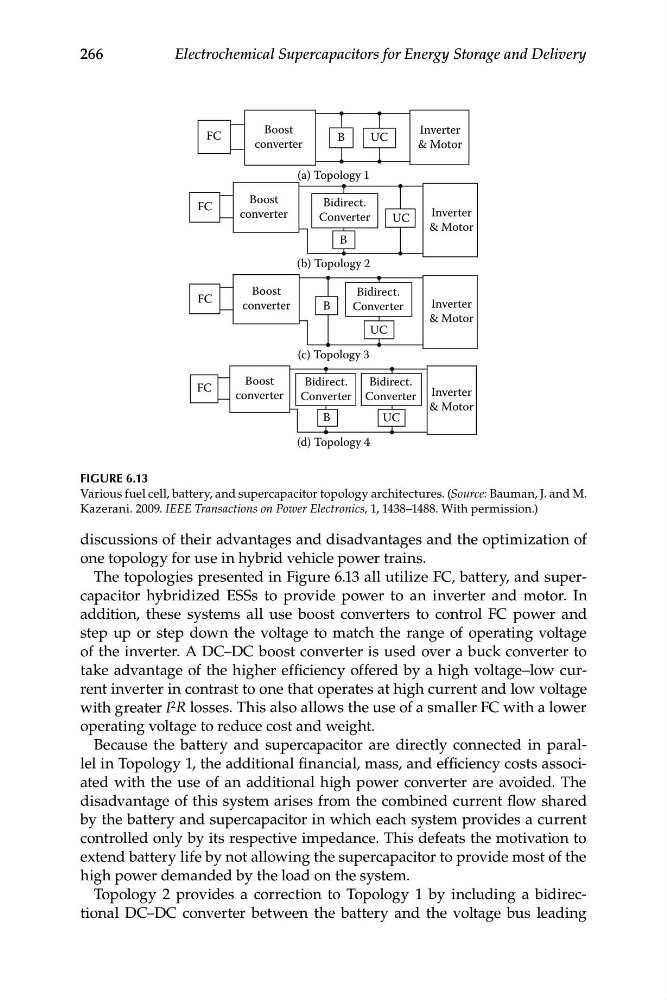
FIGURE 6.13
Various fuel cell, battery, and supercapacitor topology architectures. (Source: Bauman, J. and M.
Kazerani. 2009. IEEE Transactions on Power Electronics, 1, 1438–1488. With permission.)
discussions of their advantages and disadvantages and the optimization of
one topology for use in hybrid vehicle power trains.
The topologies presented in Figure 6.13 all utilize FC, battery, and supercapacitor hybridized ESSs to provide power to an inverter and motor. In
addition, these systems all use boost converters to control FC power and
step up or step down the voltage to match the range of operating voltage
of the inverter. A DC–DC boost converter is used over a buck converter to
take advantage of the higher efficiency offered by a high voltage–low current inverter in contrast to one that operates at high current and low voltage
with greater I 2 R losses. This also allows the use of a smaller FC with a lower
operating voltage to reduce cost and weight.
Because the battery and supercapacitor are directly connected in parallel in Topology 1, the additional financial, mass, and efficiency costs associated with the use of an additional high power converter are avoided. The
disadvantage of this system arises from the combined current flow shared
by the battery and supercapacitor in which each system provides a current
controlled only by its respective impedance. This defeats the motivation to
extend battery life by not allowing the supercapacitor to provide most of the
high power demanded by the load on the system.
Topology 2 provides a correction to Topology 1 by including a bidirectional DC–DC converter between the battery and the voltage bus leading
Boost
converter
Inverter
& Motor
UC
B
(a) Topology 1
Boost
converter
Inverter
& Motor
Bidirect.
Converter
UC
B
FC
(b) Topology 2
Boost
converter
Inverter
& Motor
Bidirect.
Converter
UC
B
FC
(c) Topology 3
Boost
converter
Inverter
& Motor
Bidirect.
Converter
Bidirect.
Converter
UC
B
FC
(d) Topology 4
266
Electrochemical Supercapacitors for Energy Storage and Delivery
FIGURE 6.13
Various fuel cell, battery, and supercapacitor topology architectures. (Source: Bauman, J. and M.
Kazerani. 2009. IEEE Transactions on Power Electronics, 1, 1438–1488. With permission.)
discussions of their advantages and disadvantages and the optimization of
one topology for use in hybrid vehicle power trains.
The topologies presented in Figure 6.13 all utilize FC, battery, and supercapacitor hybridized ESSs to provide power to an inverter and motor. In
addition, these systems all use boost converters to control FC power and
step up or step down the voltage to match the range of operating voltage
of the inverter. A DC–DC boost converter is used over a buck converter to
take advantage of the higher efficiency offered by a high voltage–low current inverter in contrast to one that operates at high current and low voltage
with greater I 2 R losses. This also allows the use of a smaller FC with a lower
operating voltage to reduce cost and weight.
Because the battery and supercapacitor are directly connected in parallel in Topology 1, the additional financial, mass, and efficiency costs associated with the use of an additional high power converter are avoided. The
disadvantage of this system arises from the combined current flow shared
by the battery and supercapacitor in which each system provides a current
controlled only by its respective impedance. This defeats the motivation to
extend battery life by not allowing the supercapacitor to provide most of the
high power demanded by the load on the system.
Topology 2 provides a correction to Topology 1 by including a bidirectional DC–DC converter between the battery and the voltage bus leading