

10
Electrochemical Supercapacitors for Energy Storage and Delivery
dielectric constant can be described as how effectively the dielectric allows
a capacitor to store more charge. Every material used in a capacitor has its
own dielectric constant, depending on the dielectric material. In practice,
this dielectric constant can be measured. For example, if a capacitor with a
vacuum as the dielectric is fully charged, the voltage difference across the
two electrodes can be measured as V 0 ; if a material is used as the dielectric
and is fully charged, the voltage difference between the two electrodes will
be measured as V. The dielectric constant of this material can be calculated as
a ratio of the cell voltage to the material in and out of the vacuum:
V 0
ε r =
V
(1.20)
Since V is always less than or equal to V 0 , the dielectric constant is greater
than or equal to 1. Equation (1.20) means that the dielectric constant of a
No Field
Applied Field
E
Electronic Polarization
+
+
Ionic Polarization
+
–
+
–
Dipole Polarization
Space Charge Polarization
+ – + –
+ + – –
– + – +
+ – + –
+ – + –
+ + – –
– + – +
+ + – –
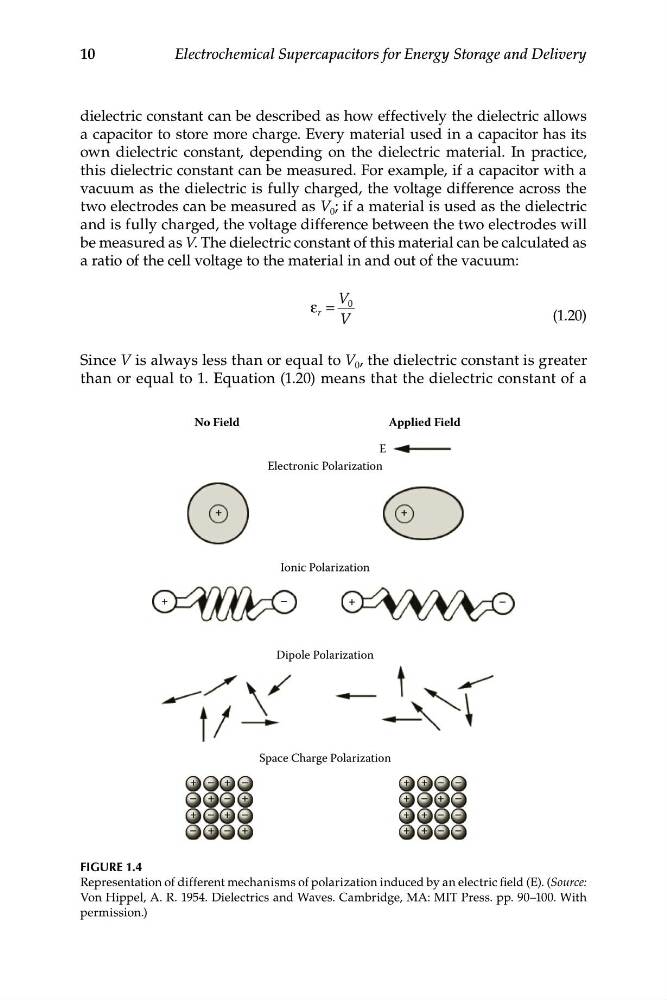
FIGURE 1.4
Representation of different mechanisms of polarization induced by an electric field (E). (Source:
Von Hippel, A. R. 1954. Dielectrics and Waves. Cambridge, MA: MIT Press. pp. 90–100. With
permission.)
Electrochemical Supercapacitors for Energy Storage and Delivery
dielectric constant can be described as how effectively the dielectric allows
a capacitor to store more charge. Every material used in a capacitor has its
own dielectric constant, depending on the dielectric material. In practice,
this dielectric constant can be measured. For example, if a capacitor with a
vacuum as the dielectric is fully charged, the voltage difference across the
two electrodes can be measured as V 0 ; if a material is used as the dielectric
and is fully charged, the voltage difference between the two electrodes will
be measured as V. The dielectric constant of this material can be calculated as
a ratio of the cell voltage to the material in and out of the vacuum:
V 0
ε r =
V
(1.20)
Since V is always less than or equal to V 0 , the dielectric constant is greater
than or equal to 1. Equation (1.20) means that the dielectric constant of a
No Field
Applied Field
E
Electronic Polarization
+
+
Ionic Polarization
+
–
+
–
Dipole Polarization
Space Charge Polarization
+ – + –
+ + – –
– + – +
+ – + –
+ – + –
+ + – –
– + – +
+ + – –
FIGURE 1.4
Representation of different mechanisms of polarization induced by an electric field (E). (Source:
Von Hippel, A. R. 1954. Dielectrics and Waves. Cambridge, MA: MIT Press. pp. 90–100. With
permission.)