

249
Coupling with Batteries and Fuel Cells
range of the circuit and power requirements. Commercial module banks
manufactured by companies such as Maxwell Technologies, Nesscap, and
Power Systems are thus accessible and often used in evaluations of simulation designs, prototypes, and commercial HESS to assess their performance
under various environmental and operating conditions required by an
application.
Efforts in hybrid electric vehicle design initially considered the performance requirements of a hybrid power system from a standard set of operating parameters, along with specific requirements related to usable peak
power (kW) and energy storage capacity (kWh). After identifying adequate
energy storage units that could address the defined needs of an integrated
engine, these parameters were used to evaluate the effects of power management and control strategies necessary to ensure operation of the engine and
electric drive train at optimal levels over various driving cycles.
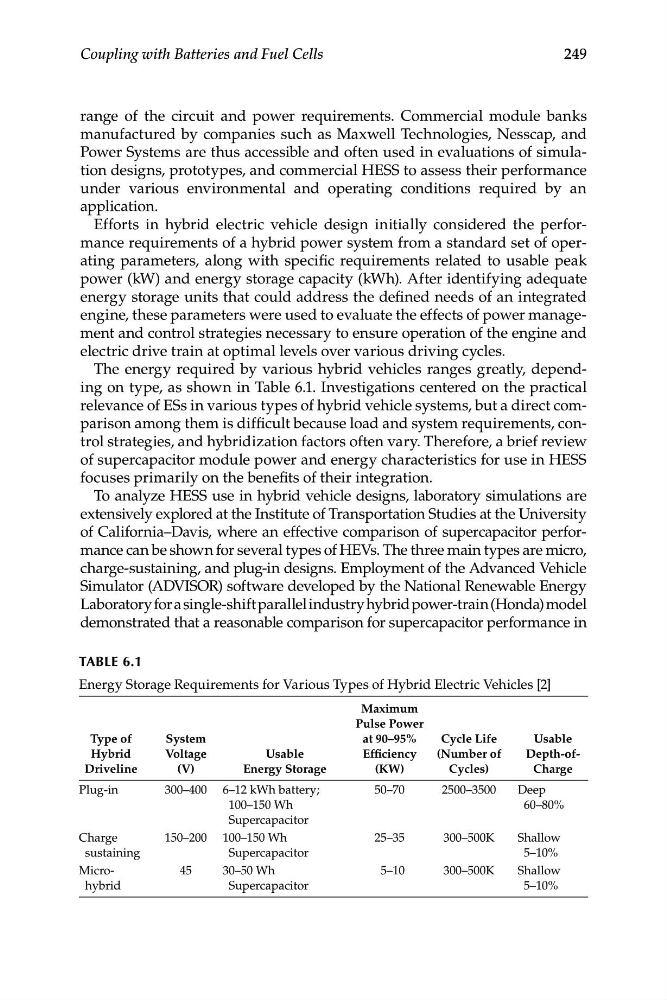
The energy required by various hybrid vehicles ranges greatly, depending on type, as shown in Table 6.1. Investigations centered on the practical
relevance of ESs in various types of hybrid vehicle systems, but a direct comparison among them is difficult because load and system requirements, control strategies, and hybridization factors often vary. Therefore, a brief review
of supercapacitor module power and energy characteristics for use in HESS
focuses primarily on the benefits of their integration.
To analyze HESS use in hybrid vehicle designs, laboratory simulations are
extensively explored at the Institute of Transportation Studies at the University
of California–Davis, where an effective comparison of supercapacitor performance can be shown for several types of HEVs. The three main types are micro,
charge-sustaining, and plug-in designs. Employment of the Advanced Vehicle
Simulator (ADVISOR) software developed by the National Renewable Energy
Laboratory for a single-shift parallel industry hybrid power-train (Honda) model
demonstrated that a reasonable comparison for supercapacitor performance in
TABLE 6.1
Energy Storage Requirements for Various Types of Hybrid Electric Vehicles [2]
Maximum
Pulse Power
Type of
System
at 90–95%
Cycle Life
Usable
Hybrid
Voltage
Usable
Efficiency
(Number of
Depth-ofDriveline
(V)
Energy Storage
(KW)
Cycles)
Charge
Plug-in
300–400 6–12 kWh battery;
50–70
2500–3500
Deep
100–150 Wh
60–80%
Supercapacitor
Charge
150–200 100–150 Wh
25–35
300–500K
Shallow
sustaining
Supercapacitor
5–10%
Micro45
30–50 Wh
5–10
300–500K
Shallow
hybrid
Supercapacitor
5–10%
Coupling with Batteries and Fuel Cells
range of the circuit and power requirements. Commercial module banks
manufactured by companies such as Maxwell Technologies, Nesscap, and
Power Systems are thus accessible and often used in evaluations of simulation designs, prototypes, and commercial HESS to assess their performance
under various environmental and operating conditions required by an
application.
Efforts in hybrid electric vehicle design initially considered the performance requirements of a hybrid power system from a standard set of operating parameters, along with specific requirements related to usable peak
power (kW) and energy storage capacity (kWh). After identifying adequate
energy storage units that could address the defined needs of an integrated
engine, these parameters were used to evaluate the effects of power management and control strategies necessary to ensure operation of the engine and
electric drive train at optimal levels over various driving cycles.
The energy required by various hybrid vehicles ranges greatly, depending on type, as shown in Table 6.1. Investigations centered on the practical
relevance of ESs in various types of hybrid vehicle systems, but a direct comparison among them is difficult because load and system requirements, control strategies, and hybridization factors often vary. Therefore, a brief review
of supercapacitor module power and energy characteristics for use in HESS
focuses primarily on the benefits of their integration.
To analyze HESS use in hybrid vehicle designs, laboratory simulations are
extensively explored at the Institute of Transportation Studies at the University
of California–Davis, where an effective comparison of supercapacitor performance can be shown for several types of HEVs. The three main types are micro,
charge-sustaining, and plug-in designs. Employment of the Advanced Vehicle
Simulator (ADVISOR) software developed by the National Renewable Energy
Laboratory for a single-shift parallel industry hybrid power-train (Honda) model
demonstrated that a reasonable comparison for supercapacitor performance in
TABLE 6.1
Energy Storage Requirements for Various Types of Hybrid Electric Vehicles [2]
Maximum
Pulse Power
Type of
System
at 90–95%
Cycle Life
Usable
Hybrid
Voltage
Usable
Efficiency
(Number of
Depth-ofDriveline
(V)
Energy Storage
(KW)
Cycles)
Charge
Plug-in
300–400 6–12 kWh battery;
50–70
2500–3500
Deep
100–150 Wh
60–80%
Supercapacitor
Charge
150–200 100–150 Wh
25–35
300–500K
Shallow
sustaining
Supercapacitor
5–10%
Micro45
30–50 Wh
5–10
300–500K
Shallow
hybrid
Supercapacitor
5–10%