

248
Electrochemical Supercapacitors for Energy Storage and Delivery
on enhanced energy storage via increases in capacitance or operating voltage. Both the energy and power densities of modern ES systems can be
improved significantly.
In comparison with typical primary energy sources such as batteries, fuel
cells (FCs), and internal combustion engines (ICEs), ESs are particularly useful for addressing typical or periodic high pulse power demands made by a
system load to an otherwise slow-to-respond energy supply. Coupling ES with
another energy device can form a hybrid system. The purpose of coupling is
to increase overall energy efficiency of a system and extend its useful life.
For example, a promising near-term alternative is hybrid electric vehicle
(HEV) technology that seeks to combine the best characteristics of fueldriven engines, electric motor drives, and energy storage components to
address energy efficiency issues. Energy efficiency, as a critical design factor
for these alternative electric power storage systems, serves to benefit from
supercapacitor systems to handle peak power demands for acceleration and
capture regenerative braking energy.
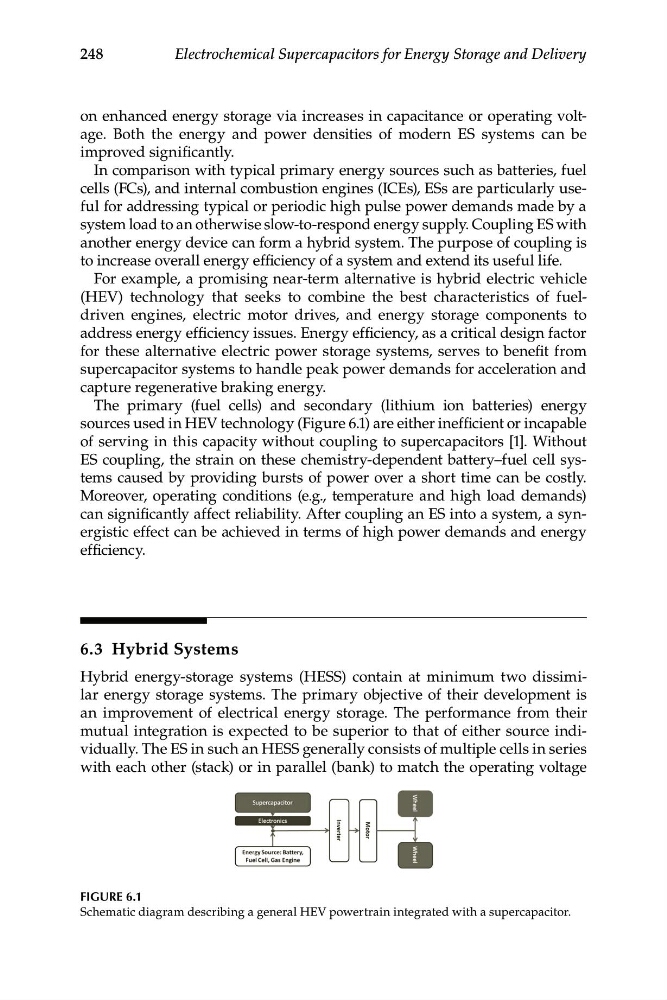
The primary (fuel cells) and secondary (lithium ion batteries) energy
sources used in HEV technology (Figure 6.1) are either inefficient or incapable
of serving in this capacity without coupling to supercapacitors [1]. Without
ES coupling, the strain on these chemistry-dependent battery–fuel cell systems caused by providing bursts of power over a short time can be costly.
Moreover, operating conditions (e.g., temperature and high load demands)
can significantly affect reliability. After coupling an ES into a system, a synergistic effect can be achieved in terms of high power demands and energy
efficiency.
6.3 Hybrid Systems
Hybrid energy-storage systems (HESS) contain at minimum two dissimilar energy storage systems. The primary objective of their development is
an improvement of electrical energy storage. The performance from their
mutual integration is expected to be superior to that of either source individually. The ES in such an HESS generally consists of multiple cells in series
with each other (stack) or in parallel (bank) to match the operating voltage
FIGURE 6.1
Schematic diagram describing a general HEV powertrain integrated with a supercapacitor.
Electrochemical Supercapacitors for Energy Storage and Delivery
on enhanced energy storage via increases in capacitance or operating voltage. Both the energy and power densities of modern ES systems can be
improved significantly.
In comparison with typical primary energy sources such as batteries, fuel
cells (FCs), and internal combustion engines (ICEs), ESs are particularly useful for addressing typical or periodic high pulse power demands made by a
system load to an otherwise slow-to-respond energy supply. Coupling ES with
another energy device can form a hybrid system. The purpose of coupling is
to increase overall energy efficiency of a system and extend its useful life.
For example, a promising near-term alternative is hybrid electric vehicle
(HEV) technology that seeks to combine the best characteristics of fueldriven engines, electric motor drives, and energy storage components to
address energy efficiency issues. Energy efficiency, as a critical design factor
for these alternative electric power storage systems, serves to benefit from
supercapacitor systems to handle peak power demands for acceleration and
capture regenerative braking energy.
The primary (fuel cells) and secondary (lithium ion batteries) energy
sources used in HEV technology (Figure 6.1) are either inefficient or incapable
of serving in this capacity without coupling to supercapacitors [1]. Without
ES coupling, the strain on these chemistry-dependent battery–fuel cell systems caused by providing bursts of power over a short time can be costly.
Moreover, operating conditions (e.g., temperature and high load demands)
can significantly affect reliability. After coupling an ES into a system, a synergistic effect can be achieved in terms of high power demands and energy
efficiency.
6.3 Hybrid Systems
Hybrid energy-storage systems (HESS) contain at minimum two dissimilar energy storage systems. The primary objective of their development is
an improvement of electrical energy storage. The performance from their
mutual integration is expected to be superior to that of either source individually. The ES in such an HESS generally consists of multiple cells in series
with each other (stack) or in parallel (bank) to match the operating voltage
FIGURE 6.1
Schematic diagram describing a general HEV powertrain integrated with a supercapacitor.