

Dielectric
Dielectric Constant κ
Air
1.00054
Paper
Plastics
2.0 to 6.0
2.1 to 6.0
LDPE/HDPE
Mineral oil
2.3
2.2 to 2.3
Silicone oil
2.7 to 2.8
Quartz
3.8 to 4.4
Glass
4.8 to 8.0
Mica
7
Silicone
12
Germanium
16
Tantalum pentoxide
Ethanol
26
25
Ethylene glycol
Dipropyl ketone
Glycol
Glycerol
Water (20°C)
Acids
3.7
12.6
37
42.5
80.4
Acetic
6.2
Butyric
Lactic
3
22
Cresol
5 to 11.5
Propanoic
Ceramics
3.1
12 to 400,000
Aluminum oxide
4.5 to 11.5
Titanium dioxide
14 to 110
Porcelain
5.1 to 8.0
Porcelain (zircon)
Titanates (Ba, Sr, Ca, Mg, Pb)
7.1 to 10.5
15 to 12,000
8
Electrochemical Supercapacitors for Energy Storage and Delivery
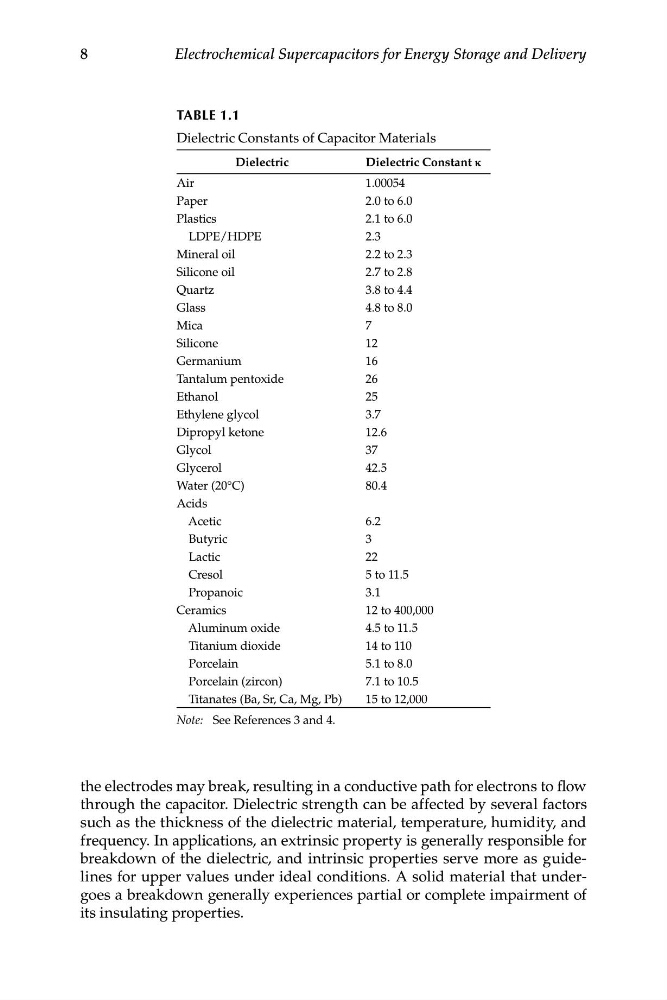
TABLE 1.1
Dielectric Constants of Capacitor Materials
Note: See References 3 and 4.
the electrodes may break, resulting in a conductive path for electrons to flow
through the capacitor. Dielectric strength can be affected by several factors
such as the thickness of the dielectric material, temperature, humidity, and
frequency. In applications, an extrinsic property is generally responsible for
breakdown of the dielectric, and intrinsic properties serve more as guidelines for upper values under ideal conditions. A solid material that undergoes a breakdown generally experiences partial or complete impairment of
its insulating properties.
Dielectric Constant κ
Air
1.00054
Paper
Plastics
2.0 to 6.0
2.1 to 6.0
LDPE/HDPE
Mineral oil
2.3
2.2 to 2.3
Silicone oil
2.7 to 2.8
Quartz
3.8 to 4.4
Glass
4.8 to 8.0
Mica
7
Silicone
12
Germanium
16
Tantalum pentoxide
Ethanol
26
25
Ethylene glycol
Dipropyl ketone
Glycol
Glycerol
Water (20°C)
Acids
3.7
12.6
37
42.5
80.4
Acetic
6.2
Butyric
Lactic
3
22
Cresol
5 to 11.5
Propanoic
Ceramics
3.1
12 to 400,000
Aluminum oxide
4.5 to 11.5
Titanium dioxide
14 to 110
Porcelain
5.1 to 8.0
Porcelain (zircon)
Titanates (Ba, Sr, Ca, Mg, Pb)
7.1 to 10.5
15 to 12,000
8
Electrochemical Supercapacitors for Energy Storage and Delivery
TABLE 1.1
Dielectric Constants of Capacitor Materials
Note: See References 3 and 4.
the electrodes may break, resulting in a conductive path for electrons to flow
through the capacitor. Dielectric strength can be affected by several factors
such as the thickness of the dielectric material, temperature, humidity, and
frequency. In applications, an extrinsic property is generally responsible for
breakdown of the dielectric, and intrinsic properties serve more as guidelines for upper values under ideal conditions. A solid material that undergoes a breakdown generally experiences partial or complete impairment of
its insulating properties.