

222
Electrochemical Supercapacitors for Energy Storage and Delivery
T 1
D 1
T 2
D 2
C 1
C 2
U c2
U
A
2I eq
I c1
I c2
L eq
I
U c1
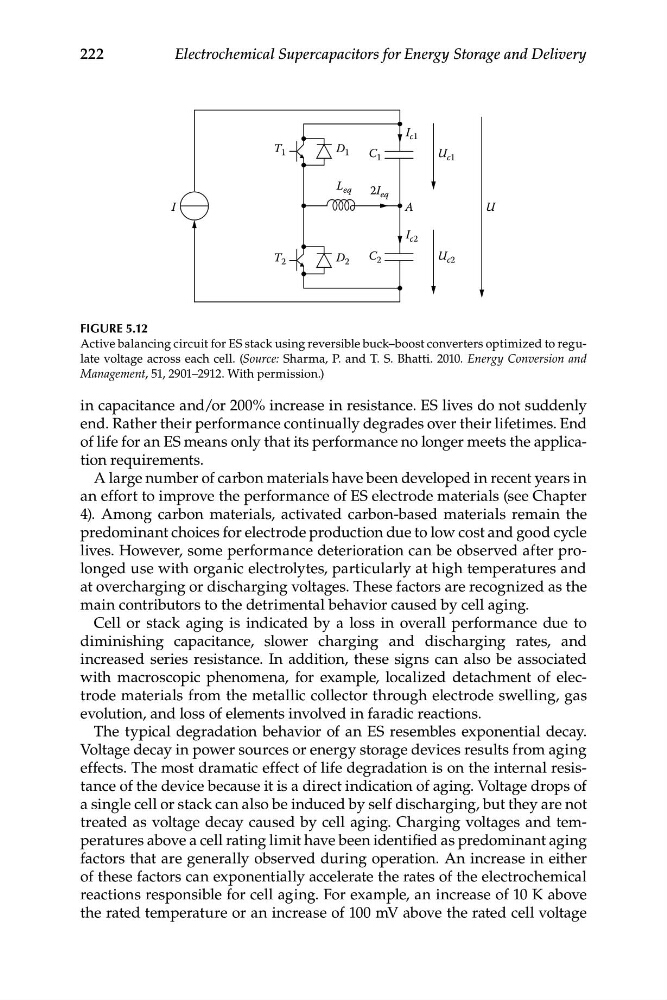
FIGURE 5.12
Active balancing circuit for ES stack using reversible buck–boost converters optimized to regulate voltage across each cell. (Source: Sharma, P. and T. S. Bhatti. 2010. Energy Conversion and
Management, 51, 2901–2912. With permission.)
in capacitance and/or 200% increase in resistance. ES lives do not suddenly
end. Rather their performance continually degrades over their lifetimes. End
of life for an ES means only that its performance no longer meets the application requirements.
A large number of carbon materials have been developed in recent years in
an effort to improve the performance of ES electrode materials (see Chapter
4). Among carbon materials, activated carbon-based materials remain the
predominant choices for electrode production due to low cost and good cycle
lives. However, some performance deterioration can be observed after prolonged use with organic electrolytes, particularly at high temperatures and
at overcharging or discharging voltages. These factors are recognized as the
main contributors to the detrimental behavior caused by cell aging.
Cell or stack aging is indicated by a loss in overall performance due to
diminishing capacitance, slower charging and discharging rates, and
increased series resistance. In addition, these signs can also be associated
with macroscopic phenomena, for example, localized detachment of electrode materials from the metallic collector through electrode swelling, gas
evolution, and loss of elements involved in faradic reactions.
The typical degradation behavior of an ES resembles exponential decay.
Voltage decay in power sources or energy storage devices results from aging
effects. The most dramatic effect of life degradation is on the internal resistance of the device because it is a direct indication of aging. Voltage drops of
a single cell or stack can also be induced by self discharging, but they are not
treated as voltage decay caused by cell aging. Charging voltages and temperatures above a cell rating limit have been identified as predominant aging
factors that are generally observed during operation. An increase in either
of these factors can exponentially accelerate the rates of the electrochemical
reactions responsible for cell aging. For example, an increase of 10 K above
the rated temperature or an increase of 100 mV above the rated cell voltage
Electrochemical Supercapacitors for Energy Storage and Delivery
T 1
D 1
T 2
D 2
C 1
C 2
U c2
U
A
2I eq
I c1
I c2
L eq
I
U c1
FIGURE 5.12
Active balancing circuit for ES stack using reversible buck–boost converters optimized to regulate voltage across each cell. (Source: Sharma, P. and T. S. Bhatti. 2010. Energy Conversion and
Management, 51, 2901–2912. With permission.)
in capacitance and/or 200% increase in resistance. ES lives do not suddenly
end. Rather their performance continually degrades over their lifetimes. End
of life for an ES means only that its performance no longer meets the application requirements.
A large number of carbon materials have been developed in recent years in
an effort to improve the performance of ES electrode materials (see Chapter
4). Among carbon materials, activated carbon-based materials remain the
predominant choices for electrode production due to low cost and good cycle
lives. However, some performance deterioration can be observed after prolonged use with organic electrolytes, particularly at high temperatures and
at overcharging or discharging voltages. These factors are recognized as the
main contributors to the detrimental behavior caused by cell aging.
Cell or stack aging is indicated by a loss in overall performance due to
diminishing capacitance, slower charging and discharging rates, and
increased series resistance. In addition, these signs can also be associated
with macroscopic phenomena, for example, localized detachment of electrode materials from the metallic collector through electrode swelling, gas
evolution, and loss of elements involved in faradic reactions.
The typical degradation behavior of an ES resembles exponential decay.
Voltage decay in power sources or energy storage devices results from aging
effects. The most dramatic effect of life degradation is on the internal resistance of the device because it is a direct indication of aging. Voltage drops of
a single cell or stack can also be induced by self discharging, but they are not
treated as voltage decay caused by cell aging. Charging voltages and temperatures above a cell rating limit have been identified as predominant aging
factors that are generally observed during operation. An increase in either
of these factors can exponentially accelerate the rates of the electrochemical
reactions responsible for cell aging. For example, an increase of 10 K above
the rated temperature or an increase of 100 mV above the rated cell voltage