

213
Electrochemical Supercapacitor Design, Fabrication, and Operation
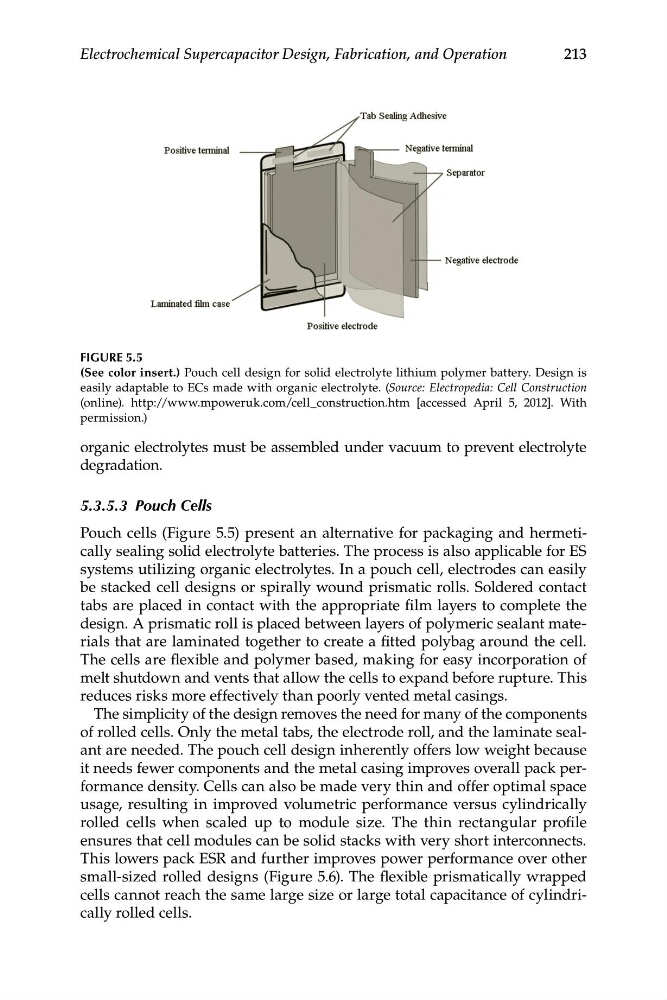
FIGURE 5.5
(See color insert.) Pouch cell design for solid electrolyte lithium polymer battery. Design is
easily adaptable to ECs made with organic electrolyte. (Source: Electropedia: Cell Construction
(online). http://www.mpoweruk.com/cell_construction.htm [accessed April 5, 2012]. With
permission.)
organic electrolytes must be assembled under vacuum to prevent electrolyte
degradation.
5.3.5.3 Pouch Cells
Pouch cells (Figure 5.5) present an alternative for packaging and hermetically sealing solid electrolyte batteries. The process is also applicable for ES
systems utilizing organic electrolytes. In a pouch cell, electrodes can easily
be stacked cell designs or spirally wound prismatic rolls. Soldered contact
tabs are placed in contact with the appropriate film layers to complete the
design. A prismatic roll is placed between layers of polymeric sealant materials that are laminated together to create a fitted polybag around the cell.
The cells are flexible and polymer based, making for easy incorporation of
melt shutdown and vents that allow the cells to expand before rupture. This
reduces risks more effectively than poorly vented metal casings.
The simplicity of the design removes the need for many of the components
of rolled cells. Only the metal tabs, the electrode roll, and the laminate sealant are needed. The pouch cell design inherently offers low weight because
it needs fewer components and the metal casing improves overall pack performance density. Cells can also be made very thin and offer optimal space
usage, resulting in improved volumetric performance versus cylindrically
rolled cells when scaled up to module size. The thin rectangular profile
ensures that cell modules can be solid stacks with very short interconnects.
This lowers pack ESR and further improves power performance over other
small-sized rolled designs (Figure 5.6). The flexible prismatically wrapped
cells cannot reach the same large size or large total capacitance of cylindrically rolled cells.
Electrochemical Supercapacitor Design, Fabrication, and Operation
FIGURE 5.5
(See color insert.) Pouch cell design for solid electrolyte lithium polymer battery. Design is
easily adaptable to ECs made with organic electrolyte. (Source: Electropedia: Cell Construction
(online). http://www.mpoweruk.com/cell_construction.htm [accessed April 5, 2012]. With
permission.)
organic electrolytes must be assembled under vacuum to prevent electrolyte
degradation.
5.3.5.3 Pouch Cells
Pouch cells (Figure 5.5) present an alternative for packaging and hermetically sealing solid electrolyte batteries. The process is also applicable for ES
systems utilizing organic electrolytes. In a pouch cell, electrodes can easily
be stacked cell designs or spirally wound prismatic rolls. Soldered contact
tabs are placed in contact with the appropriate film layers to complete the
design. A prismatic roll is placed between layers of polymeric sealant materials that are laminated together to create a fitted polybag around the cell.
The cells are flexible and polymer based, making for easy incorporation of
melt shutdown and vents that allow the cells to expand before rupture. This
reduces risks more effectively than poorly vented metal casings.
The simplicity of the design removes the need for many of the components
of rolled cells. Only the metal tabs, the electrode roll, and the laminate sealant are needed. The pouch cell design inherently offers low weight because
it needs fewer components and the metal casing improves overall pack performance density. Cells can also be made very thin and offer optimal space
usage, resulting in improved volumetric performance versus cylindrically
rolled cells when scaled up to module size. The thin rectangular profile
ensures that cell modules can be solid stacks with very short interconnects.
This lowers pack ESR and further improves power performance over other
small-sized rolled designs (Figure 5.6). The flexible prismatically wrapped
cells cannot reach the same large size or large total capacitance of cylindrically rolled cells.