

(a)
(b)
Top case
Spring
Current collector
Electrode
Electrode
Separator
Carbon coated
aluminum foil
Plastic inslator
Safety Vent
Positive Thermal
Top Insulator
Negative Terminal
(Steel Casing)
Bottom Insulator
Positive Terminal (Top Cap/Plate)
Gasket
Cathode Tab
Seperator
Anode
Cathode
Bottom case
(c)
(d)
211
Electrochemical Supercapacitor Design, Fabrication, and Operation
Commercially produced supercapacitors often take stacked cylindrical
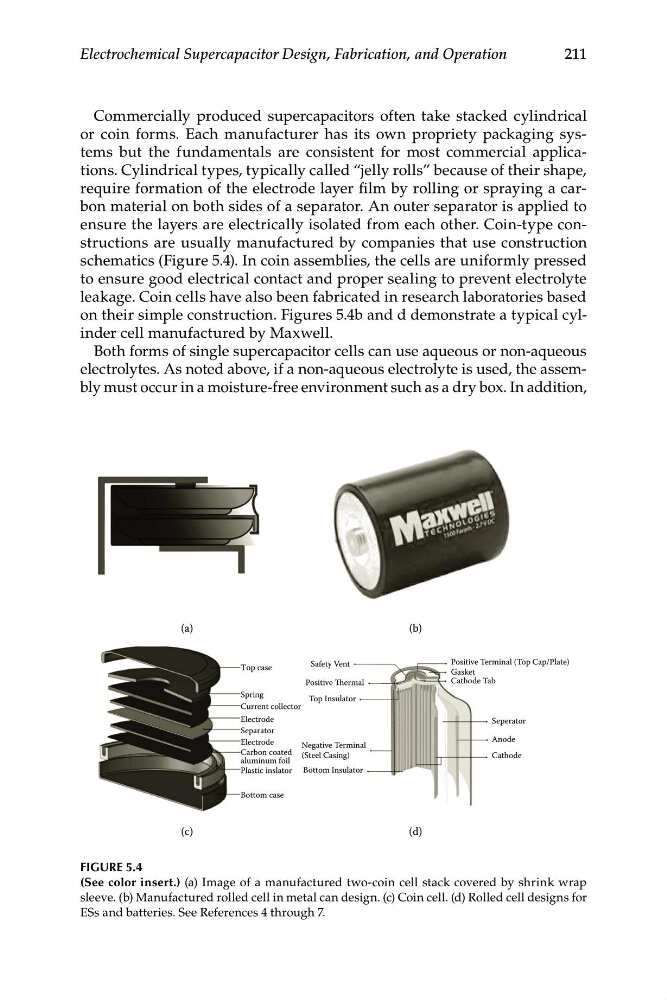
or coin forms. Each manufacturer has its own propriety packaging systems but the fundamentals are consistent for most commercial applications. Cylindrical types, typically called “jelly rolls” because of their shape,
require formation of the electrode layer film by rolling or spraying a carbon material on both sides of a separator. An outer separator is applied to
ensure the layers are electrically isolated from each other. Coin-type constructions are usually manufactured by companies that use construction
schematics (Figure 5.4). In coin assemblies, the cells are uniformly pressed
to ensure good electrical contact and proper sealing to prevent electrolyte
leakage. Coin cells have also been fabricated in research laboratories based
on their simple construction. Figures 5.4b and d demonstrate a typical cylinder cell manufactured by Maxwell.
Both forms of single supercapacitor cells can use aqueous or non-aqueous
electrolytes. As noted above, if a non-aqueous electrolyte is used, the assembly must occur in a moisture-free environment such as a dry box. In addition,
FIGURE 5.4
(See color insert.) (a) Image of a manufactured two-coin cell stack covered by shrink wrap
sleeve. (b) Manufactured rolled cell in metal can design. (c) Coin cell. (d) Rolled cell designs for
ESs and batteries. See References 4 through 7.
(b)
Top case
Spring
Current collector
Electrode
Electrode
Separator
Carbon coated
aluminum foil
Plastic inslator
Safety Vent
Positive Thermal
Top Insulator
Negative Terminal
(Steel Casing)
Bottom Insulator
Positive Terminal (Top Cap/Plate)
Gasket
Cathode Tab
Seperator
Anode
Cathode
Bottom case
(c)
(d)
211
Electrochemical Supercapacitor Design, Fabrication, and Operation
Commercially produced supercapacitors often take stacked cylindrical
or coin forms. Each manufacturer has its own propriety packaging systems but the fundamentals are consistent for most commercial applications. Cylindrical types, typically called “jelly rolls” because of their shape,
require formation of the electrode layer film by rolling or spraying a carbon material on both sides of a separator. An outer separator is applied to
ensure the layers are electrically isolated from each other. Coin-type constructions are usually manufactured by companies that use construction
schematics (Figure 5.4). In coin assemblies, the cells are uniformly pressed
to ensure good electrical contact and proper sealing to prevent electrolyte
leakage. Coin cells have also been fabricated in research laboratories based
on their simple construction. Figures 5.4b and d demonstrate a typical cylinder cell manufactured by Maxwell.
Both forms of single supercapacitor cells can use aqueous or non-aqueous
electrolytes. As noted above, if a non-aqueous electrolyte is used, the assembly must occur in a moisture-free environment such as a dry box. In addition,
FIGURE 5.4
(See color insert.) (a) Image of a manufactured two-coin cell stack covered by shrink wrap
sleeve. (b) Manufactured rolled cell in metal can design. (c) Coin cell. (d) Rolled cell designs for
ESs and batteries. See References 4 through 7.