

1M HCl
5 mA
Current
1M KOH
1M KCl
–1.6 –1.2 –0.8 –0.4 0.0 0.4 0.8 1.2 1.6 2.0
Potential (V) vs Ag/AgCl
182
Electrochemical Supercapacitors for Energy Storage and Delivery
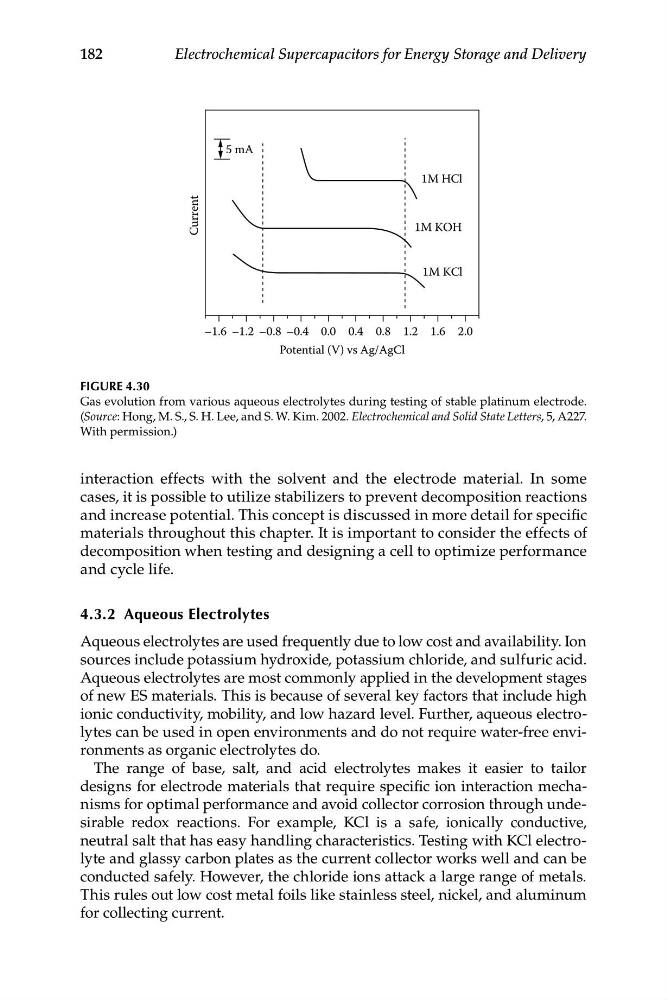
FIGURE 4.30
Gas evolution from various aqueous electrolytes during testing of stable platinum electrode.
(Source: Hong, M. S., S. H. Lee, and S. W. Kim. 2002. Electrochemical and Solid State Letters, 5, A227.
With permission.)
interaction effects with the solvent and the electrode material. In some
cases, it is possible to utilize stabilizers to prevent decomposition reactions
and increase potential. This concept is discussed in more detail for specific
materials throughout this chapter. It is important to consider the effects of
decomposition when testing and designing a cell to optimize performance
and cycle life.
4.3.2 Aqueous Electrolytes
Aqueous electrolytes are used frequently due to low cost and availability. Ion
sources include potassium hydroxide, potassium chloride, and sulfuric acid.
Aqueous electrolytes are most commonly applied in the development stages
of new ES materials. This is because of several key factors that include high
ionic conductivity, mobility, and low hazard level. Further, aqueous electrolytes can be used in open environments and do not require water-free environments as organic electrolytes do.
The range of base, salt, and acid electrolytes makes it easier to tailor
designs for electrode materials that require specific ion interaction mechanisms for optimal performance and avoid collector corrosion through undesirable redox reactions. For example, KCl is a safe, ionically conductive,
neutral salt that has easy handling characteristics. Testing with KCl electrolyte and glassy carbon plates as the current collector works well and can be
conducted safely. However, the chloride ions attack a large range of metals.
This rules out low cost metal foils like stainless steel, nickel, and aluminum
for collecting current.
5 mA
Current
1M KOH
1M KCl
–1.6 –1.2 –0.8 –0.4 0.0 0.4 0.8 1.2 1.6 2.0
Potential (V) vs Ag/AgCl
182
Electrochemical Supercapacitors for Energy Storage and Delivery
FIGURE 4.30
Gas evolution from various aqueous electrolytes during testing of stable platinum electrode.
(Source: Hong, M. S., S. H. Lee, and S. W. Kim. 2002. Electrochemical and Solid State Letters, 5, A227.
With permission.)
interaction effects with the solvent and the electrode material. In some
cases, it is possible to utilize stabilizers to prevent decomposition reactions
and increase potential. This concept is discussed in more detail for specific
materials throughout this chapter. It is important to consider the effects of
decomposition when testing and designing a cell to optimize performance
and cycle life.
4.3.2 Aqueous Electrolytes
Aqueous electrolytes are used frequently due to low cost and availability. Ion
sources include potassium hydroxide, potassium chloride, and sulfuric acid.
Aqueous electrolytes are most commonly applied in the development stages
of new ES materials. This is because of several key factors that include high
ionic conductivity, mobility, and low hazard level. Further, aqueous electrolytes can be used in open environments and do not require water-free environments as organic electrolytes do.
The range of base, salt, and acid electrolytes makes it easier to tailor
designs for electrode materials that require specific ion interaction mechanisms for optimal performance and avoid collector corrosion through undesirable redox reactions. For example, KCl is a safe, ionically conductive,
neutral salt that has easy handling characteristics. Testing with KCl electrolyte and glassy carbon plates as the current collector works well and can be
conducted safely. However, the chloride ions attack a large range of metals.
This rules out low cost metal foils like stainless steel, nickel, and aluminum
for collecting current.