

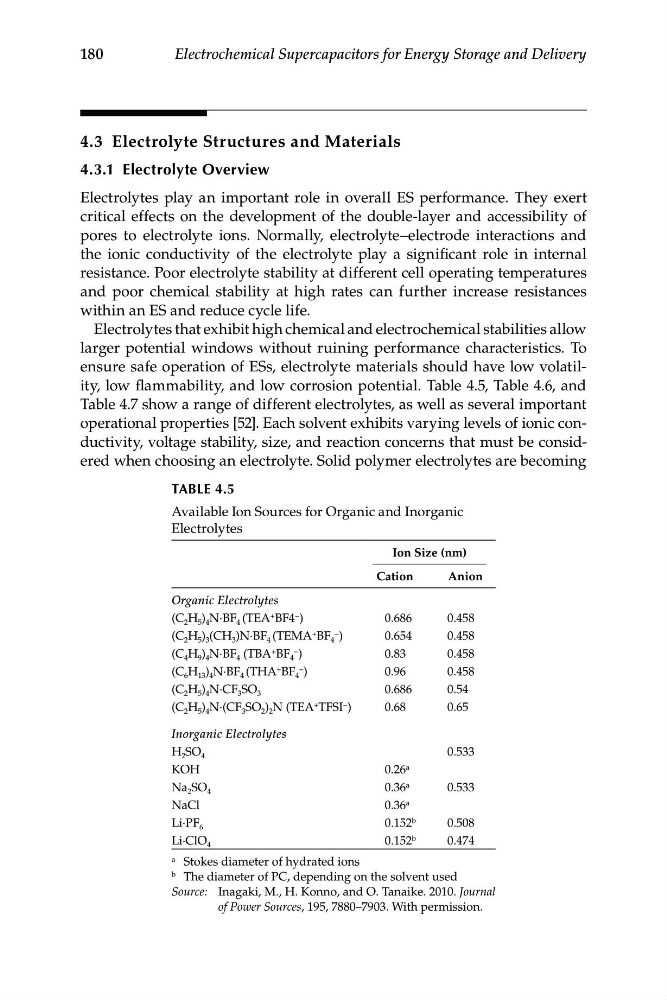
TABLE 4.5
Available Ion Sources for Organic and Inorganic
Electrolytes
Ion Size (nm)
Cation
Anion
Organic Electrolytes
(C 2 H 5 ) 4 N·BF 4 (TEA + BF4 − )
0.686
0.458
(C 2 H 5 ) 3 (CH 3 )N·BF 4 (TEMA + BF 4
− )
0.654
0.458
(C 4 H 9 ) 4 N·BF 4 (TBA + BF 4
− )
0.83
0.458
(C 6 H 13 ) 4 N·BF 4 (THA + BF 4
− )
0.96
0.458
(C 2 H 5 ) 4 N·CF 3 SO 3
0.686
0.54
(C 2 H 5 ) 4 N·(CF 3 SO 2 ) 2 N (TEA + TFSI − )
0.68
0.65
Inorganic Electrolytes
H 2 SO 4
0.533
KOH
0.26 a
Na 2 SO 4
0.36 a
0.533
NaCl
0.36 a
Li·PF 6
0.152 b
0.508
Li·ClO 4
0.152 b
0.474
180
Electrochemical Supercapacitors for Energy Storage and Delivery
4.3 Electrolyte Structures and Materials
4.3.1 Electrolyte Overview
Electrolytes play an important role in overall ES performance. They exert
critical effects on the development of the double-layer and accessibility of
pores to electrolyte ions. Normally, electrolyte–electrode interactions and
the ionic conductivity of the electrolyte play a significant role in internal
resistance. Poor electrolyte stability at different cell operating temperatures
and poor chemical stability at high rates can further increase resistances
within an ES and reduce cycle life.
Electrolytes that exhibit high chemical and electrochemical stabilities allow
larger potential windows without ruining performance characteristics. To
ensure safe operation of ESs, electrolyte materials should have low volatility, low flammability, and low corrosion potential. Table 4.5, Table 4.6, and
Table 4.7 show a range of different electrolytes, as well as several important
operational properties [52]. Each solvent exhibits varying levels of ionic conductivity, voltage stability, size, and reaction concerns that must be considered when choosing an electrolyte. Solid polymer electrolytes are becoming
a Stokes diameter of hydrated ions
b The diameter of PC, depending on the solvent used
Source: Inagaki, M., H. Konno, and O. Tanaike. 2010. Journal
of Power Sources, 195, 7880–7903. With permission.
Available Ion Sources for Organic and Inorganic
Electrolytes
Ion Size (nm)
Cation
Anion
Organic Electrolytes
(C 2 H 5 ) 4 N·BF 4 (TEA + BF4 − )
0.686
0.458
(C 2 H 5 ) 3 (CH 3 )N·BF 4 (TEMA + BF 4
− )
0.654
0.458
(C 4 H 9 ) 4 N·BF 4 (TBA + BF 4
− )
0.83
0.458
(C 6 H 13 ) 4 N·BF 4 (THA + BF 4
− )
0.96
0.458
(C 2 H 5 ) 4 N·CF 3 SO 3
0.686
0.54
(C 2 H 5 ) 4 N·(CF 3 SO 2 ) 2 N (TEA + TFSI − )
0.68
0.65
Inorganic Electrolytes
H 2 SO 4
0.533
KOH
0.26 a
Na 2 SO 4
0.36 a
0.533
NaCl
0.36 a
Li·PF 6
0.152 b
0.508
Li·ClO 4
0.152 b
0.474
180
Electrochemical Supercapacitors for Energy Storage and Delivery
4.3 Electrolyte Structures and Materials
4.3.1 Electrolyte Overview
Electrolytes play an important role in overall ES performance. They exert
critical effects on the development of the double-layer and accessibility of
pores to electrolyte ions. Normally, electrolyte–electrode interactions and
the ionic conductivity of the electrolyte play a significant role in internal
resistance. Poor electrolyte stability at different cell operating temperatures
and poor chemical stability at high rates can further increase resistances
within an ES and reduce cycle life.
Electrolytes that exhibit high chemical and electrochemical stabilities allow
larger potential windows without ruining performance characteristics. To
ensure safe operation of ESs, electrolyte materials should have low volatility, low flammability, and low corrosion potential. Table 4.5, Table 4.6, and
Table 4.7 show a range of different electrolytes, as well as several important
operational properties [52]. Each solvent exhibits varying levels of ionic conductivity, voltage stability, size, and reaction concerns that must be considered when choosing an electrolyte. Solid polymer electrolytes are becoming
a Stokes diameter of hydrated ions
b The diameter of PC, depending on the solvent used
Source: Inagaki, M., H. Konno, and O. Tanaike. 2010. Journal
of Power Sources, 195, 7880–7903. With permission.