

178
Electrochemical Supercapacitors for Energy Storage and Delivery
When designing a hybrid cell with optimal energy density, it is important
to maintain durability and power, as long cycle life and high power represent two major advantages over battery devices. Another major advantage
of the asymmetric design is the ability to match electrodes that exhibit overpotential reactions that block either oxygen or hydrogen gas evolution due
to water decomposition. This manages to overcome the 0 V NHE hydrogen
evolution and 1.2 V NHE oxygen evolution (water decomposition) that normally limit the potential window to 1 V (0.1 to 1.1 V NHE).
Belanger et al. [83] used a MnO 2 -coated cathode with an EDLC carbon
anode, leading to a system with a cell voltage of 2 V in neutral aqueous electrolyte. They achieved an energy density of 17.3 Wh.kg –1 and a maximum
power density of 19 kW.kg –1 , which is higher than the result from the symmetric MnO 2 device or the symmetric AC carbon cell tested. Further, the
device was stable for over 5000 cycles.
The carbon anode showed an overpotential reaction, adsorbing hydrogen
and preventing gas evolution until –0.65 V versus NHE. The proton absorption could block dihydrogen evolution until it became more thermodynamically feasible [83,86]. The reversible MnO 2 oxidation reactions at the cathode
show oxygen overpotential to 1.4 V versus NHE, which allows the device’s
potential window to be extended.
Khomenko et al. [85] illustrated that correctly mating electrodes could
extend potential range as high as 2 V for aqueous systems [28]. Results of
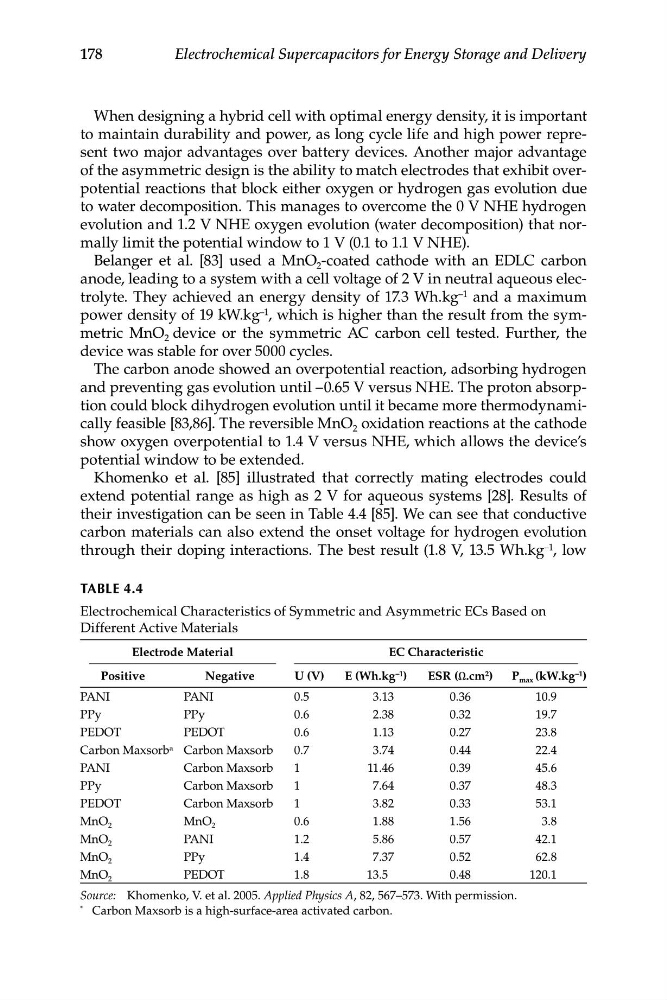
their investigation can be seen in Table 4.4 [85]. We can see that conductive
carbon materials can also extend the onset voltage for hydrogen evolution
through their doping interactions. The best result (1.8 V, 13.5 Wh.kg –1 , low
TABLE 4.4
Electrochemical Characteristics of Symmetric and Asymmetric ECs Based on
Different Active Materials
Electrode Material
EC Characteristic
Positive
Negative
U (V)
E (Wh.kg –1 )
ESR (Ω.cm 2 )
P max (kW.kg –1 )
PANI
PANI
0.5
3.13
0.36
10.9
PPy
PPy
0.6
2.38
0.32
19.7
PEDOT
PEDOT
0.6
1.13
0.27
23.8
Carbon Maxsorb a Carbon Maxsorb
0.7
3.74
0.44
22.4
PANI
Carbon Maxsorb
1
11.46
0.39
45.6
PPy
Carbon Maxsorb
1
7.64
0.37
48.3
PEDOT
Carbon Maxsorb
1
3.82
0.33
53.1
MnO 2
MnO 2
0.6
1.88
1.56
3.8
MnO 2
PANI
1.2
5.86
0.57
42.1
MnO 2
PPy
1.4
7.37
0.52
62.8
MnO 2
PEDOT
1.8
13.5
0.48
120.1
Source: Khomenko, V. et al. 2005. Applied Physics A, 82, 567–573. With permission.
* Carbon Maxsorb is a high-surface-area activated carbon.
Electrochemical Supercapacitors for Energy Storage and Delivery
When designing a hybrid cell with optimal energy density, it is important
to maintain durability and power, as long cycle life and high power represent two major advantages over battery devices. Another major advantage
of the asymmetric design is the ability to match electrodes that exhibit overpotential reactions that block either oxygen or hydrogen gas evolution due
to water decomposition. This manages to overcome the 0 V NHE hydrogen
evolution and 1.2 V NHE oxygen evolution (water decomposition) that normally limit the potential window to 1 V (0.1 to 1.1 V NHE).
Belanger et al. [83] used a MnO 2 -coated cathode with an EDLC carbon
anode, leading to a system with a cell voltage of 2 V in neutral aqueous electrolyte. They achieved an energy density of 17.3 Wh.kg –1 and a maximum
power density of 19 kW.kg –1 , which is higher than the result from the symmetric MnO 2 device or the symmetric AC carbon cell tested. Further, the
device was stable for over 5000 cycles.
The carbon anode showed an overpotential reaction, adsorbing hydrogen
and preventing gas evolution until –0.65 V versus NHE. The proton absorption could block dihydrogen evolution until it became more thermodynamically feasible [83,86]. The reversible MnO 2 oxidation reactions at the cathode
show oxygen overpotential to 1.4 V versus NHE, which allows the device’s
potential window to be extended.
Khomenko et al. [85] illustrated that correctly mating electrodes could
extend potential range as high as 2 V for aqueous systems [28]. Results of
their investigation can be seen in Table 4.4 [85]. We can see that conductive
carbon materials can also extend the onset voltage for hydrogen evolution
through their doping interactions. The best result (1.8 V, 13.5 Wh.kg –1 , low
TABLE 4.4
Electrochemical Characteristics of Symmetric and Asymmetric ECs Based on
Different Active Materials
Electrode Material
EC Characteristic
Positive
Negative
U (V)
E (Wh.kg –1 )
ESR (Ω.cm 2 )
P max (kW.kg –1 )
PANI
PANI
0.5
3.13
0.36
10.9
PPy
PPy
0.6
2.38
0.32
19.7
PEDOT
PEDOT
0.6
1.13
0.27
23.8
Carbon Maxsorb a Carbon Maxsorb
0.7
3.74
0.44
22.4
PANI
Carbon Maxsorb
1
11.46
0.39
45.6
PPy
Carbon Maxsorb
1
7.64
0.37
48.3
PEDOT
Carbon Maxsorb
1
3.82
0.33
53.1
MnO 2
MnO 2
0.6
1.88
1.56
3.8
MnO 2
PANI
1.2
5.86
0.57
42.1
MnO 2
PPy
1.4
7.37
0.52
62.8
MnO 2
PEDOT
1.8
13.5
0.48
120.1
Source: Khomenko, V. et al. 2005. Applied Physics A, 82, 567–573. With permission.
* Carbon Maxsorb is a high-surface-area activated carbon.