

173
Components and Materials for Electrochemical Supercapacitors
50
100
150
Specific Capacitance (F/g)
200
250
400°C
500°C
600°C
700°C
800°C
900°C
1000°C
1
10
100
Scan Rate (mV/s)
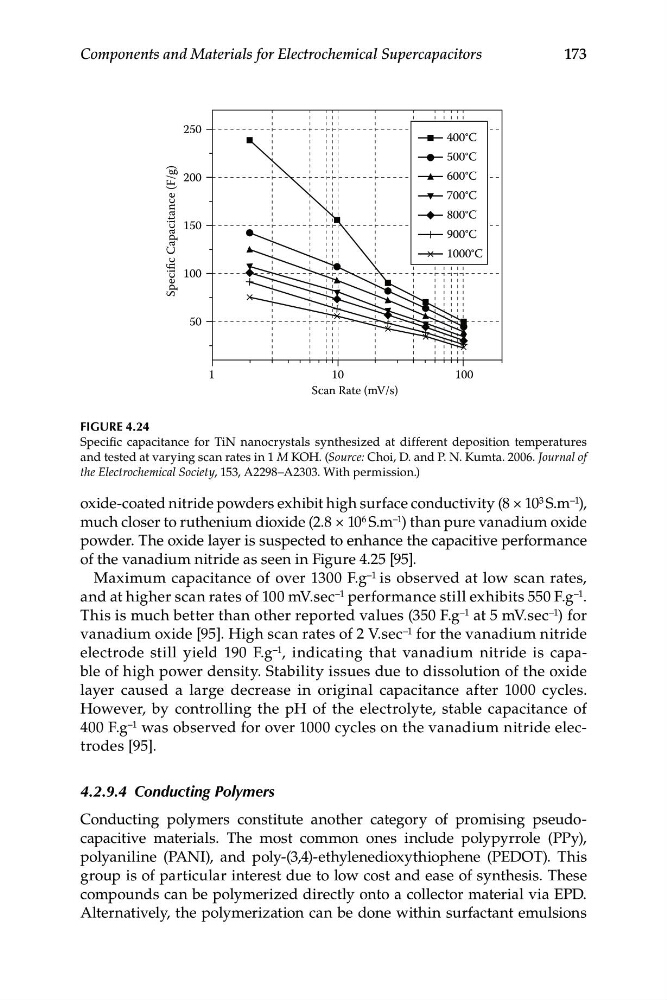
FIGURE 4.24
Specific capacitance for TiN nanocrystals synthesized at different deposition temperatures
and tested at varying scan rates in 1 M KOH. (Source: Choi, D. and P. N. Kumta. 2006. Journal of
the Electrochemical Society, 153, A2298–A2303. With permission.)
oxide-coated nitride powders exhibit high surface conductivity (8 × 10 3 S.m –1 ),
much closer to ruthenium dioxide (2.8 × 10 6 S.m –1 ) than pure vanadium oxide
powder. The oxide layer is suspected to enhance the capacitive performance
of the vanadium nitride as seen in Figure 4.25 [95].
Maximum capacitance of over 1300 F.g –1 is observed at low scan rates,
and at higher scan rates of 100 mV.sec –1 performance still exhibits 550 F.g –1 .
This is much better than other reported values (350 F.g –1 at 5 mV.sec –1 ) for
vanadium oxide [95]. High scan rates of 2 V.sec –1 for the vanadium nitride
electrode still yield 190 F.g –1 , indicating that vanadium nitride is capable of high power density. Stability issues due to dissolution of the oxide
layer caused a large decrease in original capacitance after 1000 cycles.
However, by controlling the pH of the electrolyte, stable capacitance of
400 F.g –1 was observed for over 1000 cycles on the vanadium nitride electrodes [95].
4.2.9.4 Conducting Polymers
Conducting polymers constitute another category of promising pseudocapacitive materials. The most common ones include polypyrrole (PPy),
polyaniline (PANI), and poly-(3,4)-ethylenedioxythiophene (PEDOT). This
group is of particular interest due to low cost and ease of synthesis. These
compounds can be polymerized directly onto a collector material via EPD.
Alternatively, the polymerization can be done within surfactant emulsions
Components and Materials for Electrochemical Supercapacitors
50
100
150
Specific Capacitance (F/g)
200
250
400°C
500°C
600°C
700°C
800°C
900°C
1000°C
1
10
100
Scan Rate (mV/s)
FIGURE 4.24
Specific capacitance for TiN nanocrystals synthesized at different deposition temperatures
and tested at varying scan rates in 1 M KOH. (Source: Choi, D. and P. N. Kumta. 2006. Journal of
the Electrochemical Society, 153, A2298–A2303. With permission.)
oxide-coated nitride powders exhibit high surface conductivity (8 × 10 3 S.m –1 ),
much closer to ruthenium dioxide (2.8 × 10 6 S.m –1 ) than pure vanadium oxide
powder. The oxide layer is suspected to enhance the capacitive performance
of the vanadium nitride as seen in Figure 4.25 [95].
Maximum capacitance of over 1300 F.g –1 is observed at low scan rates,
and at higher scan rates of 100 mV.sec –1 performance still exhibits 550 F.g –1 .
This is much better than other reported values (350 F.g –1 at 5 mV.sec –1 ) for
vanadium oxide [95]. High scan rates of 2 V.sec –1 for the vanadium nitride
electrode still yield 190 F.g –1 , indicating that vanadium nitride is capable of high power density. Stability issues due to dissolution of the oxide
layer caused a large decrease in original capacitance after 1000 cycles.
However, by controlling the pH of the electrolyte, stable capacitance of
400 F.g –1 was observed for over 1000 cycles on the vanadium nitride electrodes [95].
4.2.9.4 Conducting Polymers
Conducting polymers constitute another category of promising pseudocapacitive materials. The most common ones include polypyrrole (PPy),
polyaniline (PANI), and poly-(3,4)-ethylenedioxythiophene (PEDOT). This
group is of particular interest due to low cost and ease of synthesis. These
compounds can be polymerized directly onto a collector material via EPD.
Alternatively, the polymerization can be done within surfactant emulsions