

172
Electrochemical Supercapacitors for Energy Storage and Delivery
–0.8
–0.4
0.0
0.4
0.8
1.2
400°C
600°C
800°C
Current Density/mA cm
–2
–0.1
0.0
0.1
0.2
0.3
0.4
0.5
0.6
0.7
Potential/V vs. RHE
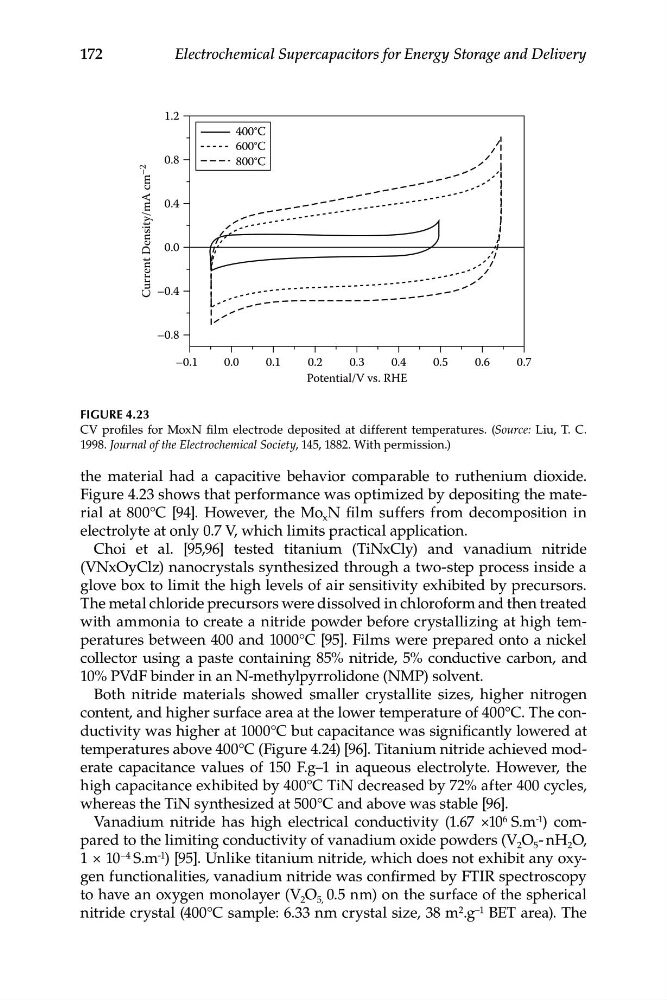
FIGURE 4.23
CV profiles for MoxN film electrode deposited at different temperatures. (Source: Liu, T. C.
1998. Journal of the Electrochemical Society, 145, 1882. With permission.)
the material had a capacitive behavior comparable to ruthenium dioxide.
Figure 4.23 shows that performance was optimized by depositing the material at 800°C [94]. However, the Mo x N film suffers from decomposition in
electrolyte at only 0.7 V, which limits practical application.
Choi et al. [95,96] tested titanium (TiNxCly) and vanadium nitride
(VNxOyClz) nanocrystals synthesized through a two-step process inside a
glove box to limit the high levels of air sensitivity exhibited by precursors.
The metal chloride precursors were dissolved in chloroform and then treated
with ammonia to create a nitride powder before crystallizing at high temperatures between 400 and 1000°C [95]. Films were prepared onto a nickel
collector using a paste containing 85% nitride, 5% conductive carbon, and
10% PVdF binder in an N-methylpyrrolidone (NMP) solvent.
Both nitride materials showed smaller crystallite sizes, higher nitrogen
content, and higher surface area at the lower temperature of 400°C. The conductivity was higher at 1000°C but capacitance was significantly lowered at
temperatures above 400°C (Figure 4.24) [96]. Titanium nitride achieved moderate capacitance values of 150 F.g–1 in aqueous electrolyte. However, the
high capacitance exhibited by 400°C TiN decreased by 72% after 400 cycles,
whereas the TiN synthesized at 500°C and above was stable [96].
Vanadium nitride has high electrical conductivity (1.67 ×10 6 S.m -1 ) compared to the limiting conductivity of vanadium oxide powders (V 2 O 5 - nH 2 O,
1 × 10 –4 S.m -1 ) [95]. Unlike titanium nitride, which does not exhibit any oxygen functionalities, vanadium nitride was confirmed by FTIR spectroscopy
to have an oxygen monolayer (V 2 O 5, 0.5 nm) on the surface of the spherical
nitride crystal (400°C sample: 6.33 nm crystal size, 38 m 2 .g –1 BET area). The
Electrochemical Supercapacitors for Energy Storage and Delivery
–0.8
–0.4
0.0
0.4
0.8
1.2
400°C
600°C
800°C
Current Density/mA cm
–2
–0.1
0.0
0.1
0.2
0.3
0.4
0.5
0.6
0.7
Potential/V vs. RHE
FIGURE 4.23
CV profiles for MoxN film electrode deposited at different temperatures. (Source: Liu, T. C.
1998. Journal of the Electrochemical Society, 145, 1882. With permission.)
the material had a capacitive behavior comparable to ruthenium dioxide.
Figure 4.23 shows that performance was optimized by depositing the material at 800°C [94]. However, the Mo x N film suffers from decomposition in
electrolyte at only 0.7 V, which limits practical application.
Choi et al. [95,96] tested titanium (TiNxCly) and vanadium nitride
(VNxOyClz) nanocrystals synthesized through a two-step process inside a
glove box to limit the high levels of air sensitivity exhibited by precursors.
The metal chloride precursors were dissolved in chloroform and then treated
with ammonia to create a nitride powder before crystallizing at high temperatures between 400 and 1000°C [95]. Films were prepared onto a nickel
collector using a paste containing 85% nitride, 5% conductive carbon, and
10% PVdF binder in an N-methylpyrrolidone (NMP) solvent.
Both nitride materials showed smaller crystallite sizes, higher nitrogen
content, and higher surface area at the lower temperature of 400°C. The conductivity was higher at 1000°C but capacitance was significantly lowered at
temperatures above 400°C (Figure 4.24) [96]. Titanium nitride achieved moderate capacitance values of 150 F.g–1 in aqueous electrolyte. However, the
high capacitance exhibited by 400°C TiN decreased by 72% after 400 cycles,
whereas the TiN synthesized at 500°C and above was stable [96].
Vanadium nitride has high electrical conductivity (1.67 ×10 6 S.m -1 ) compared to the limiting conductivity of vanadium oxide powders (V 2 O 5 - nH 2 O,
1 × 10 –4 S.m -1 ) [95]. Unlike titanium nitride, which does not exhibit any oxygen functionalities, vanadium nitride was confirmed by FTIR spectroscopy
to have an oxygen monolayer (V 2 O 5, 0.5 nm) on the surface of the spherical
nitride crystal (400°C sample: 6.33 nm crystal size, 38 m 2 .g –1 BET area). The