

+
e –
N
e –
N N
2
e –
+
O
O
O
O
O
O
Carbon
148
Electrochemical Supercapacitors for Energy Storage and Delivery
I/A g
–1
–6
–4
–2
0
2
4
6
8
–0.6
–0.4
–0.2
0.0
0.2
0.4
0.6
E vs. Ag/AgCl/V
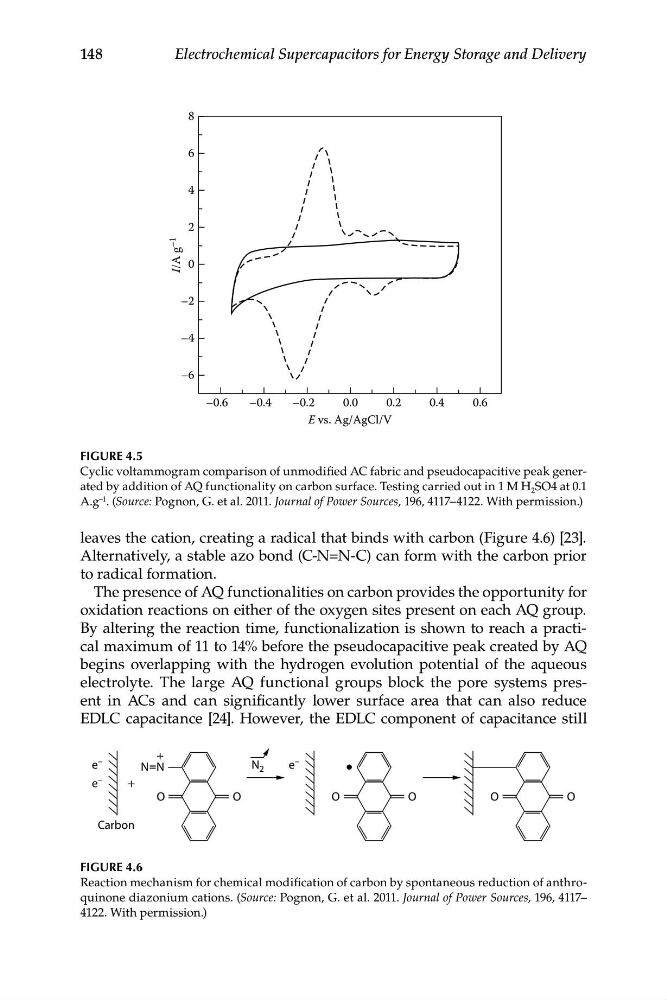
FIGURE 4.5
Cyclic voltammogram comparison of unmodified AC fabric and pseudocapacitive peak generated by addition of AQ functionality on carbon surface. Testing carried out in 1 M H 2 SO4 at 0.1
A.g –1 . (Source: Pognon, G. et al. 2011. Journal of Power Sources, 196, 4117–4122. With permission.)
leaves the cation, creating a radical that binds with carbon (Figure 4.6) [23].
Alternatively, a stable azo bond (C-N=N-C) can form with the carbon prior
to radical formation.
The presence of AQ functionalities on carbon provides the opportunity for
oxidation reactions on either of the oxygen sites present on each AQ group.
By altering the reaction time, functionalization is shown to reach a practical maximum of 11 to 14% before the pseudocapacitive peak created by AQ
begins overlapping with the hydrogen evolution potential of the aqueous
electrolyte. The large AQ functional groups block the pore systems present in ACs and can significantly lower surface area that can also reduce
EDLC capacitance [24]. However, the EDLC component of capacitance still
FIGURE 4.6
Reaction mechanism for chemical modification of carbon by spontaneous reduction of anthroquinone diazonium cations. (Source: Pognon, G. et al. 2011. Journal of Power Sources, 196, 4117–
4122. With permission.)
e –
N
e –
N N
2
e –
+
O
O
O
O
O
O
Carbon
148
Electrochemical Supercapacitors for Energy Storage and Delivery
I/A g
–1
–6
–4
–2
0
2
4
6
8
–0.6
–0.4
–0.2
0.0
0.2
0.4
0.6
E vs. Ag/AgCl/V
FIGURE 4.5
Cyclic voltammogram comparison of unmodified AC fabric and pseudocapacitive peak generated by addition of AQ functionality on carbon surface. Testing carried out in 1 M H 2 SO4 at 0.1
A.g –1 . (Source: Pognon, G. et al. 2011. Journal of Power Sources, 196, 4117–4122. With permission.)
leaves the cation, creating a radical that binds with carbon (Figure 4.6) [23].
Alternatively, a stable azo bond (C-N=N-C) can form with the carbon prior
to radical formation.
The presence of AQ functionalities on carbon provides the opportunity for
oxidation reactions on either of the oxygen sites present on each AQ group.
By altering the reaction time, functionalization is shown to reach a practical maximum of 11 to 14% before the pseudocapacitive peak created by AQ
begins overlapping with the hydrogen evolution potential of the aqueous
electrolyte. The large AQ functional groups block the pore systems present in ACs and can significantly lower surface area that can also reduce
EDLC capacitance [24]. However, the EDLC component of capacitance still
FIGURE 4.6
Reaction mechanism for chemical modification of carbon by spontaneous reduction of anthroquinone diazonium cations. (Source: Pognon, G. et al. 2011. Journal of Power Sources, 196, 4117–
4122. With permission.)