

BF – +
4 N 2
R
147
Components and Materials for Electrochemical Supercapacitors
Lin et al. [20] illustrate that a complete reduction is not necessary to achieve
acceptable graphene capacitance. By using a low temperature reduction
(150°C) of GO in DMF under a nitrogen environment for time varying from
1 to 6 hr, they were able to optimize the electrolyte-wetting benefit of oxygen
functionality against the capacitance developed by restoring graphitic plane
conductivity (3 hours was optimal). After 2000 cycles, the capacitance even
increased because of the increased oxygen content adsorbed from the aqueous electrolyte over time (230 F.g –1 at 1 A.g –1 and 0 cycles; 250 F.g –1 at 1 A.g –1
and 2000 cycles) [20]. This achieved a higher level than hydrazine-reduced
graphene and thermally or surfactant exfoliated graphene (100 to 200 F.g –1 ).
This further illustrates the importance of balanced oxygen functionalities.
Nitrogen functionalities can be incorporated into carbon materials by
treating them with ammonia or using precursor materials that contain nitrogen compounds, such as melamine, polyacrylonitriles, or polyvinylpyridine
[18]. Nitrogen can form strong covalent bonds with carbon that can regulate
electrical and chemical properties of carbon because of its comparable size
and five valence electrons. Dopants can manifest in the form of pyridinic,
pyrrolic, and quaternary bonds that contribute a large number of electrons
to the delocalized graphitic π network within the carbon structure, and can
alter the surface and catalytic properties of the carbon structures [21].
Theory further suggests that nitrogen dopants increase the positive charge
present on adjacent carbon atoms [18]. The effects of nitrogen on ES performance were illustrated by Jeong et al. [21] when investigating nitrogen
effects on few-layer graphenes by achieving high capacitance (250 F.g –1 at 1
A.g –1 ), increased hydrophilic character, continued performance at high rates
(30 A.g –1 and 175 F.g –1 ), and stability of the increased capacitance for more
than 10,000 cycles.
Belanger et al. [88] propose enhanced performance through pseudocapacitance using diazonium chemistry to covalently bond specific functional
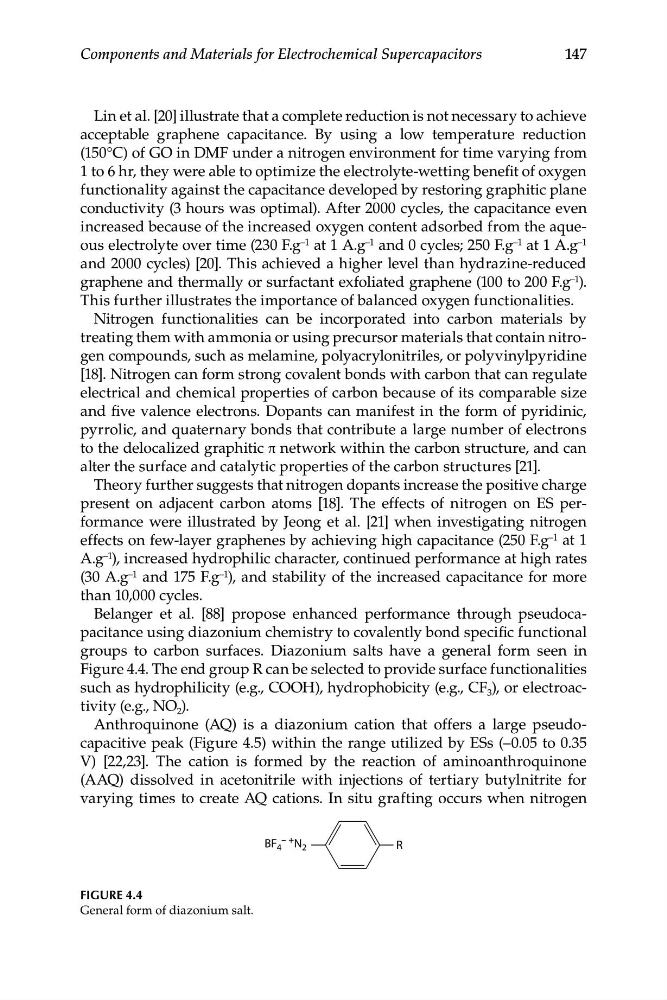
groups to carbon surfaces. Diazonium salts have a general form seen in
Figure 4.4. The end group R can be selected to provide surface functionalities
such as hydrophilicity (e.g., COOH), hydrophobicity (e.g., CF 3 ), or electroactivity (e.g., NO 2 ).
Anthroquinone (AQ) is a diazonium cation that offers a large pseudocapacitive peak (Figure 4.5) within the range utilized by ESs (–0.05 to 0.35
V) [22,23]. The cation is formed by the reaction of aminoanthroquinone
(AAQ) dissolved in acetonitrile with injections of tertiary butylnitrite for
varying times to create AQ cations. In situ grafting occurs when nitrogen
FIGURE 4.4
General form of diazonium salt.
4 N 2
R
147
Components and Materials for Electrochemical Supercapacitors
Lin et al. [20] illustrate that a complete reduction is not necessary to achieve
acceptable graphene capacitance. By using a low temperature reduction
(150°C) of GO in DMF under a nitrogen environment for time varying from
1 to 6 hr, they were able to optimize the electrolyte-wetting benefit of oxygen
functionality against the capacitance developed by restoring graphitic plane
conductivity (3 hours was optimal). After 2000 cycles, the capacitance even
increased because of the increased oxygen content adsorbed from the aqueous electrolyte over time (230 F.g –1 at 1 A.g –1 and 0 cycles; 250 F.g –1 at 1 A.g –1
and 2000 cycles) [20]. This achieved a higher level than hydrazine-reduced
graphene and thermally or surfactant exfoliated graphene (100 to 200 F.g –1 ).
This further illustrates the importance of balanced oxygen functionalities.
Nitrogen functionalities can be incorporated into carbon materials by
treating them with ammonia or using precursor materials that contain nitrogen compounds, such as melamine, polyacrylonitriles, or polyvinylpyridine
[18]. Nitrogen can form strong covalent bonds with carbon that can regulate
electrical and chemical properties of carbon because of its comparable size
and five valence electrons. Dopants can manifest in the form of pyridinic,
pyrrolic, and quaternary bonds that contribute a large number of electrons
to the delocalized graphitic π network within the carbon structure, and can
alter the surface and catalytic properties of the carbon structures [21].
Theory further suggests that nitrogen dopants increase the positive charge
present on adjacent carbon atoms [18]. The effects of nitrogen on ES performance were illustrated by Jeong et al. [21] when investigating nitrogen
effects on few-layer graphenes by achieving high capacitance (250 F.g –1 at 1
A.g –1 ), increased hydrophilic character, continued performance at high rates
(30 A.g –1 and 175 F.g –1 ), and stability of the increased capacitance for more
than 10,000 cycles.
Belanger et al. [88] propose enhanced performance through pseudocapacitance using diazonium chemistry to covalently bond specific functional
groups to carbon surfaces. Diazonium salts have a general form seen in
Figure 4.4. The end group R can be selected to provide surface functionalities
such as hydrophilicity (e.g., COOH), hydrophobicity (e.g., CF 3 ), or electroactivity (e.g., NO 2 ).
Anthroquinone (AQ) is a diazonium cation that offers a large pseudocapacitive peak (Figure 4.5) within the range utilized by ESs (–0.05 to 0.35
V) [22,23]. The cation is formed by the reaction of aminoanthroquinone
(AAQ) dissolved in acetonitrile with injections of tertiary butylnitrite for
varying times to create AQ cations. In situ grafting occurs when nitrogen
FIGURE 4.4
General form of diazonium salt.