

2e -
2e -
2H 2 SO 4
4H + , SO 4
2- ,SO 4
22H 2 O
I
PbSO 4
PbSO 4 +4H 2 O
Pb
PbO
2
Pb 2+ +4OH -
–
+
(a)
Negative Cell
Connection
Negative
Pole
Valve
Positive
Pole
Microporous Separator
Negative
Plate
Positive
Plate
Grid
Plate
(b)
140
Electrochemical Supercapacitors for Energy Storage and Delivery
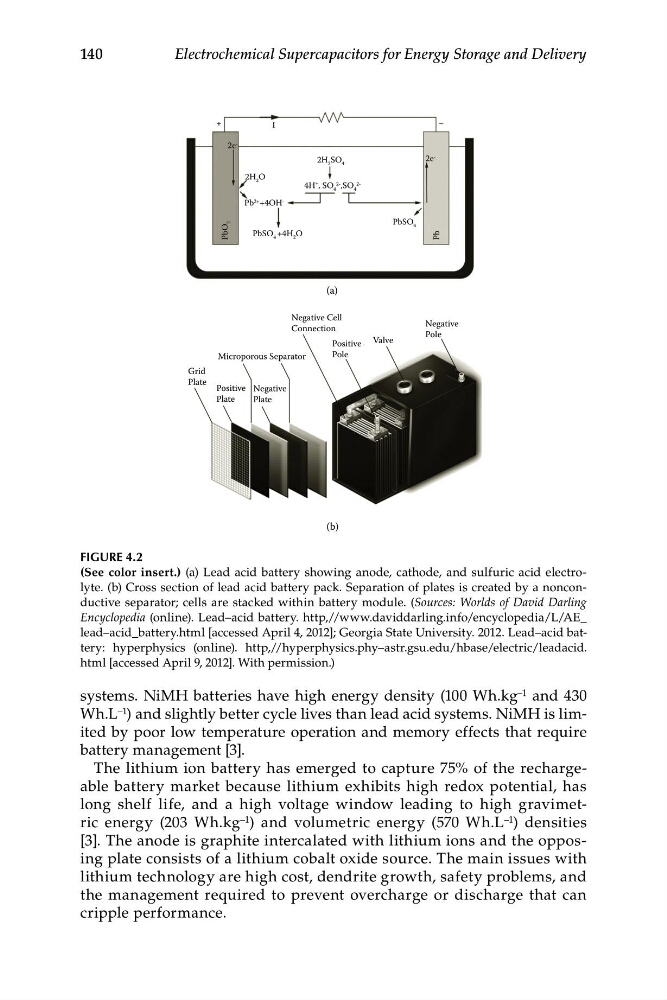
FIGURE 4.2
(See color insert.) (a) Lead acid battery showing anode, cathode, and sulfuric acid electrolyte. (b) Cross section of lead acid battery pack. Separation of plates is created by a nonconductive separator; cells are stacked within battery module. (Sources: Worlds of David Darling
Encyclopedia (online). Lead–acid battery. http,//www.daviddarling.info/encyclopedia/L/AE_
lead–acid_battery.html [accessed April 4, 2012]; Georgia State University. 2012. Lead–acid battery: hyperphysics (online). http,//hyperphysics.phy–astr.gsu.edu/hbase/electric/leadacid.
html [accessed April 9, 2012]. With permission.)
systems. NiMH batteries have high energy density (100 Wh.kg –1 and 430
Wh.L –1 ) and slightly better cycle lives than lead acid systems. NiMH is limited by poor low temperature operation and memory effects that require
battery management [3].
The lithium ion battery has emerged to capture 75% of the rechargeable battery market because lithium exhibits high redox potential, has
long shelf life, and a high voltage window leading to high gravimetric energy (203 Wh.kg –1 ) and volumetric energy (570 Wh.L –1 ) densities
[3]. The anode is graphite intercalated with lithium ions and the opposing plate consists of a lithium cobalt oxide source. The main issues with
lithium technology are high cost, dendrite growth, safety problems, and
the management required to prevent overcharge or discharge that can
cripple performance.
2e -
2H 2 SO 4
4H + , SO 4
2- ,SO 4
22H 2 O
I
PbSO 4
PbSO 4 +4H 2 O
Pb
PbO
2
Pb 2+ +4OH -
–
+
(a)
Negative Cell
Connection
Negative
Pole
Valve
Positive
Pole
Microporous Separator
Negative
Plate
Positive
Plate
Grid
Plate
(b)
140
Electrochemical Supercapacitors for Energy Storage and Delivery
FIGURE 4.2
(See color insert.) (a) Lead acid battery showing anode, cathode, and sulfuric acid electrolyte. (b) Cross section of lead acid battery pack. Separation of plates is created by a nonconductive separator; cells are stacked within battery module. (Sources: Worlds of David Darling
Encyclopedia (online). Lead–acid battery. http,//www.daviddarling.info/encyclopedia/L/AE_
lead–acid_battery.html [accessed April 4, 2012]; Georgia State University. 2012. Lead–acid battery: hyperphysics (online). http,//hyperphysics.phy–astr.gsu.edu/hbase/electric/leadacid.
html [accessed April 9, 2012]. With permission.)
systems. NiMH batteries have high energy density (100 Wh.kg –1 and 430
Wh.L –1 ) and slightly better cycle lives than lead acid systems. NiMH is limited by poor low temperature operation and memory effects that require
battery management [3].
The lithium ion battery has emerged to capture 75% of the rechargeable battery market because lithium exhibits high redox potential, has
long shelf life, and a high voltage window leading to high gravimetric energy (203 Wh.kg –1 ) and volumetric energy (570 Wh.L –1 ) densities
[3]. The anode is graphite intercalated with lithium ions and the opposing plate consists of a lithium cobalt oxide source. The main issues with
lithium technology are high cost, dendrite growth, safety problems, and
the management required to prevent overcharge or discharge that can
cripple performance.