

139
Components and Materials for Electrochemical Supercapacitors
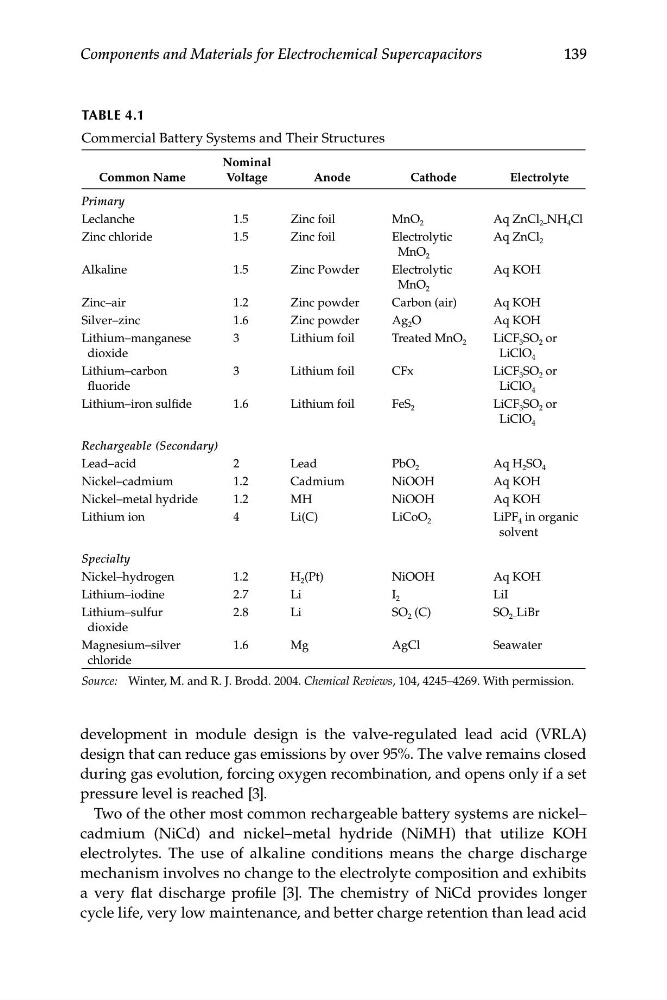
TABLE 4.1
Commercial Battery Systems and Their Structures
Nominal
Common Name
Voltage
Anode
Cathode
Electrolyte
Primary
Leclanche
1.5
Zinc foil
MnO 2
Aq ZnCl 2– NH 4 Cl
Zinc chloride
1.5
Zinc foil
Electrolytic
Aq ZnCl 2
MnO 2
Alkaline
1.5
Zinc Powder
Electrolytic
Aq KOH
MnO 2
Zinc–air
1.2
Zinc powder
Carbon (air)
Aq KOH
Silver–zinc
1.6
Zinc powder
Ag 2 O
Aq KOH
Lithium–manganese
3
Lithium foil
Treated MnO 2
LiCF 3 SO 2 or
dioxide
LiClO 4
Lithium–carbon
3
Lithium foil
CFx
LiCF 3 SO 2 or
fluoride
LiClO 4
Lithium–iron sulfide
1.6
Lithium foil
FeS 2
LiCF 3 SO 2 or
LiClO 4
Rechargeable (Secondary)
Lead–acid
2
Lead
PbO 2
Aq H 2 SO 4
Nickel–cadmium
1.2
Cadmium
NiOOH
Aq KOH
Nickel–metal hydride
1.2
MH
NiOOH
Aq KOH
Lithium ion
4
Li(C)
LiCoO 2
LiPF 4 in organic
solvent
Specialty
Nickel–hydrogen
1.2
H 2 (Pt)
NiOOH
Aq KOH
Lithium–iodine
2.7
Li
I 2
LiI
Lithium–sulfur
2.8
Li
SO 2 (C)
SO 2– LiBr
dioxide
Magnesium–silver
1.6
Mg
AgCl
Seawater
chloride
Source: Winter, M. and R. J. Brodd. 2004. Chemical Reviews, 104, 4245–4269. With permission.
development in module design is the valve-regulated lead acid (VRLA)
design that can reduce gas emissions by over 95%. The valve remains closed
during gas evolution, forcing oxygen recombination, and opens only if a set
pressure level is reached [3].
Two of the other most common rechargeable battery systems are nickel–
cadmium (NiCd) and nickel–metal hydride (NiMH) that utilize KOH
electrolytes. The use of alkaline conditions means the charge discharge
mechanism involves no change to the electrolyte composition and exhibits
a very flat discharge profile [3]. The chemistry of NiCd provides longer
cycle life, very low maintenance, and better charge retention than lead acid
Components and Materials for Electrochemical Supercapacitors
TABLE 4.1
Commercial Battery Systems and Their Structures
Nominal
Common Name
Voltage
Anode
Cathode
Electrolyte
Primary
Leclanche
1.5
Zinc foil
MnO 2
Aq ZnCl 2– NH 4 Cl
Zinc chloride
1.5
Zinc foil
Electrolytic
Aq ZnCl 2
MnO 2
Alkaline
1.5
Zinc Powder
Electrolytic
Aq KOH
MnO 2
Zinc–air
1.2
Zinc powder
Carbon (air)
Aq KOH
Silver–zinc
1.6
Zinc powder
Ag 2 O
Aq KOH
Lithium–manganese
3
Lithium foil
Treated MnO 2
LiCF 3 SO 2 or
dioxide
LiClO 4
Lithium–carbon
3
Lithium foil
CFx
LiCF 3 SO 2 or
fluoride
LiClO 4
Lithium–iron sulfide
1.6
Lithium foil
FeS 2
LiCF 3 SO 2 or
LiClO 4
Rechargeable (Secondary)
Lead–acid
2
Lead
PbO 2
Aq H 2 SO 4
Nickel–cadmium
1.2
Cadmium
NiOOH
Aq KOH
Nickel–metal hydride
1.2
MH
NiOOH
Aq KOH
Lithium ion
4
Li(C)
LiCoO 2
LiPF 4 in organic
solvent
Specialty
Nickel–hydrogen
1.2
H 2 (Pt)
NiOOH
Aq KOH
Lithium–iodine
2.7
Li
I 2
LiI
Lithium–sulfur
2.8
Li
SO 2 (C)
SO 2– LiBr
dioxide
Magnesium–silver
1.6
Mg
AgCl
Seawater
chloride
Source: Winter, M. and R. J. Brodd. 2004. Chemical Reviews, 104, 4245–4269. With permission.
development in module design is the valve-regulated lead acid (VRLA)
design that can reduce gas emissions by over 95%. The valve remains closed
during gas evolution, forcing oxygen recombination, and opens only if a set
pressure level is reached [3].
Two of the other most common rechargeable battery systems are nickel–
cadmium (NiCd) and nickel–metal hydride (NiMH) that utilize KOH
electrolytes. The use of alkaline conditions means the charge discharge
mechanism involves no change to the electrolyte composition and exhibits
a very flat discharge profile [3]. The chemistry of NiCd provides longer
cycle life, very low maintenance, and better charge retention than lead acid