

118
Electrochemical Supercapacitors for Energy Storage and Delivery
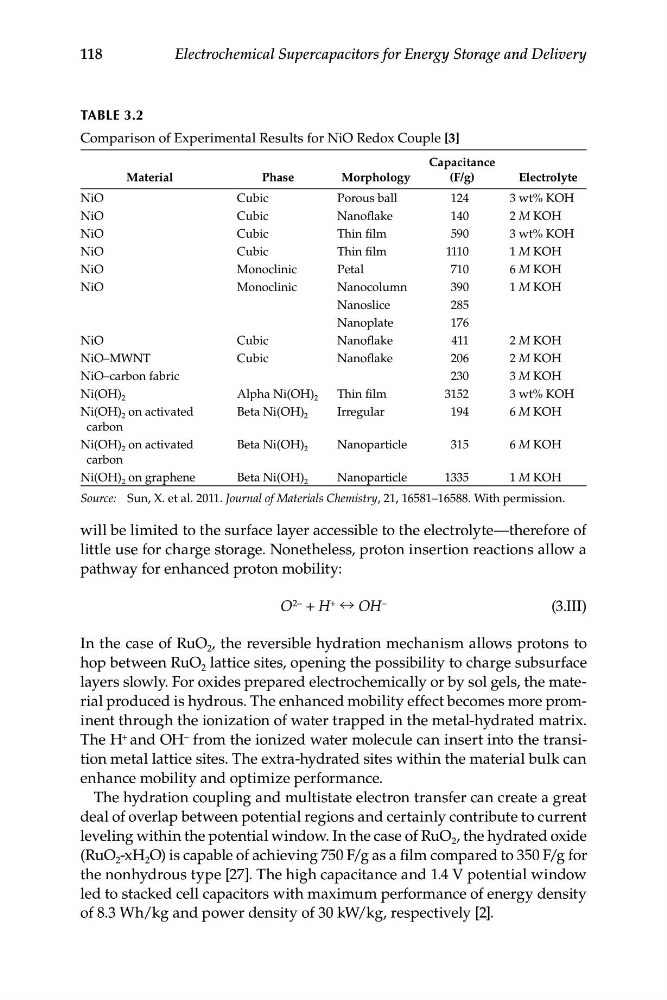
TABLE 3.2
Comparison of Experimental Results for NiO Redox Couple [3]
Material
Phase
Morphology
Capacitance
(F/g)
Electrolyte
NiO
Cubic
Porous ball
124
3 wt% KOH
NiO
Cubic
Nanoflake
140
2 M KOH
NiO
Cubic
Thin film
590
3 wt% KOH
NiO
Cubic
Thin film
1110
1 M KOH
NiO
Monoclinic
Petal
710
6 M KOH
NiO
Monoclinic
Nanocolumn
390
1 M KOH
Nanoslice
285
Nanoplate
176
NiO
Cubic
Nanoflake
411
2 M KOH
NiO–MWNT
Cubic
Nanoflake
206
2 M KOH
NiO–carbon fabric
230
3 M KOH
Ni(OH) 2
Alpha Ni(OH) 2
Thin film
3152
3 wt% KOH
Ni(OH) 2 on activated
carbon
Beta Ni(OH) 2
Irregular
194
6 M KOH
Ni(OH) 2 on activated
carbon
Beta Ni(OH) 2
Nanoparticle
315
6 M KOH
Ni(OH) 2 on graphene
Beta Ni(OH) 2
Nanoparticle
1335
1 M KOH
Source: Sun, X. et al. 2011. Journal of Materials Chemistry, 21, 16581–16588. With permission.
will be limited to the surface layer accessible to the electrolyte—therefore of
little use for charge storage. Nonetheless, proton insertion reactions allow a
pathway for enhanced proton mobility:
O 2– + H + ↔ OH –
(3.III)
In the case of RuO 2 , the reversible hydration mechanism allows protons to
hop between RuO 2 lattice sites, opening the possibility to charge subsurface
layers slowly. For oxides prepared electrochemically or by sol gels, the material produced is hydrous. The enhanced mobility effect becomes more prominent through the ionization of water trapped in the metal-hydrated matrix.
The H + and OH – from the ionized water molecule can insert into the transition metal lattice sites. The extra-hydrated sites within the material bulk can
enhance mobility and optimize performance.
The hydration coupling and multistate electron transfer can create a great
deal of overlap between potential regions and certainly contribute to current
leveling within the potential window. In the case of RuO 2 , the hydrated oxide
(RuO 2 -xH 2 O) is capable of achieving 750 F/g as a film compared to 350 F/g for
the nonhydrous type [27]. The high capacitance and 1.4 V potential window
led to stacked cell capacitors with maximum performance of energy density
of 8.3 Wh/kg and power density of 30 kW/kg, respectively [2].
Electrochemical Supercapacitors for Energy Storage and Delivery
TABLE 3.2
Comparison of Experimental Results for NiO Redox Couple [3]
Material
Phase
Morphology
Capacitance
(F/g)
Electrolyte
NiO
Cubic
Porous ball
124
3 wt% KOH
NiO
Cubic
Nanoflake
140
2 M KOH
NiO
Cubic
Thin film
590
3 wt% KOH
NiO
Cubic
Thin film
1110
1 M KOH
NiO
Monoclinic
Petal
710
6 M KOH
NiO
Monoclinic
Nanocolumn
390
1 M KOH
Nanoslice
285
Nanoplate
176
NiO
Cubic
Nanoflake
411
2 M KOH
NiO–MWNT
Cubic
Nanoflake
206
2 M KOH
NiO–carbon fabric
230
3 M KOH
Ni(OH) 2
Alpha Ni(OH) 2
Thin film
3152
3 wt% KOH
Ni(OH) 2 on activated
carbon
Beta Ni(OH) 2
Irregular
194
6 M KOH
Ni(OH) 2 on activated
carbon
Beta Ni(OH) 2
Nanoparticle
315
6 M KOH
Ni(OH) 2 on graphene
Beta Ni(OH) 2
Nanoparticle
1335
1 M KOH
Source: Sun, X. et al. 2011. Journal of Materials Chemistry, 21, 16581–16588. With permission.
will be limited to the surface layer accessible to the electrolyte—therefore of
little use for charge storage. Nonetheless, proton insertion reactions allow a
pathway for enhanced proton mobility:
O 2– + H + ↔ OH –
(3.III)
In the case of RuO 2 , the reversible hydration mechanism allows protons to
hop between RuO 2 lattice sites, opening the possibility to charge subsurface
layers slowly. For oxides prepared electrochemically or by sol gels, the material produced is hydrous. The enhanced mobility effect becomes more prominent through the ionization of water trapped in the metal-hydrated matrix.
The H + and OH – from the ionized water molecule can insert into the transition metal lattice sites. The extra-hydrated sites within the material bulk can
enhance mobility and optimize performance.
The hydration coupling and multistate electron transfer can create a great
deal of overlap between potential regions and certainly contribute to current
leveling within the potential window. In the case of RuO 2 , the hydrated oxide
(RuO 2 -xH 2 O) is capable of achieving 750 F/g as a film compared to 350 F/g for
the nonhydrous type [27]. The high capacitance and 1.4 V potential window
led to stacked cell capacitors with maximum performance of energy density
of 8.3 Wh/kg and power density of 30 kW/kg, respectively [2].