

Current/mA cm –2
substrate
Cathodic
Anodic
RuO 2 film
12.5
6.25
0
6.25
Potential/V, RHE
12.5
2.0
1.5
1.0
0.5
Oxidized W in 1 M aq. H 2 SO 4 (298 K)
Potential/V vs RHE
0.4
0
1.6
1.4
1.2
0.8
0.2
0.6
1.0
1.4
Current/mA
0
–0.5
–1.0
–1.5
–2.0
117
Fundamentals of Electrochemical Pseudocapacitors
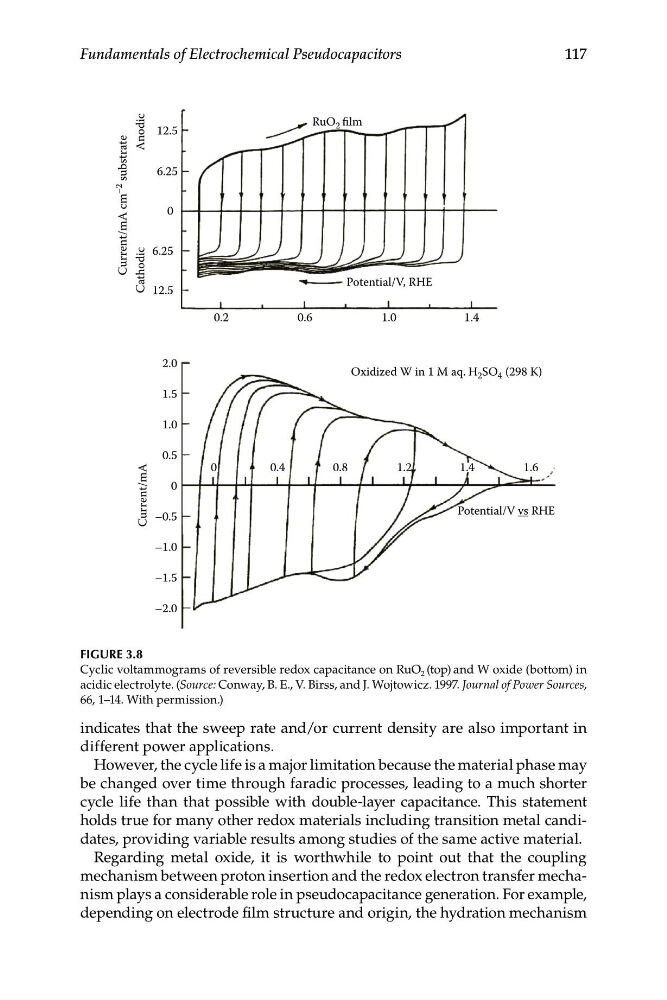
FIGURE 3.8
Cyclic voltammograms of reversible redox capacitance on RuO 2 (top) and W oxide (bottom) in
acidic electrolyte. (Source: Conway, B. E., V. Birss, and J. Wojtowicz. 1997. Journal of Power Sources,
66, 1–14. With permission.)
indicates that the sweep rate and/or current density are also important in
different power applications.
However, the cycle life is a major limitation because the material phase may
be changed over time through faradic processes, leading to a much shorter
cycle life than that possible with double-layer capacitance. This statement
holds true for many other redox materials including transition metal candidates, providing variable results among studies of the same active material.
Regarding metal oxide, it is worthwhile to point out that the coupling
mechanism between proton insertion and the redox electron transfer mechanism plays a considerable role in pseudocapacitance generation. For example,
depending on electrode film structure and origin, the hydration mechanism
substrate
Cathodic
Anodic
RuO 2 film
12.5
6.25
0
6.25
Potential/V, RHE
12.5
2.0
1.5
1.0
0.5
Oxidized W in 1 M aq. H 2 SO 4 (298 K)
Potential/V vs RHE
0.4
0
1.6
1.4
1.2
0.8
0.2
0.6
1.0
1.4
Current/mA
0
–0.5
–1.0
–1.5
–2.0
117
Fundamentals of Electrochemical Pseudocapacitors
FIGURE 3.8
Cyclic voltammograms of reversible redox capacitance on RuO 2 (top) and W oxide (bottom) in
acidic electrolyte. (Source: Conway, B. E., V. Birss, and J. Wojtowicz. 1997. Journal of Power Sources,
66, 1–14. With permission.)
indicates that the sweep rate and/or current density are also important in
different power applications.
However, the cycle life is a major limitation because the material phase may
be changed over time through faradic processes, leading to a much shorter
cycle life than that possible with double-layer capacitance. This statement
holds true for many other redox materials including transition metal candidates, providing variable results among studies of the same active material.
Regarding metal oxide, it is worthwhile to point out that the coupling
mechanism between proton insertion and the redox electron transfer mechanism plays a considerable role in pseudocapacitance generation. For example,
depending on electrode film structure and origin, the hydration mechanism