

Fundamentals of Electrochemical Pseudocapacitors
111
For H on polycrystalline Pt, the well recognized value of q
o
1 × 10 –4
P H
−
is 2.
C/
cm 2 . Using this value and other parameters’ values in Equation (3.16) such as
C
1 0
. mol/
3
+ =
dm , and T = 298 K (25°C), the obtained pseudocapacitance
H
can be as high as 2045 F/cm 2 at standard electrode potential ( E
o
+
), which
H P
/ t−H
is more than 100 times the double-layer capacitance.
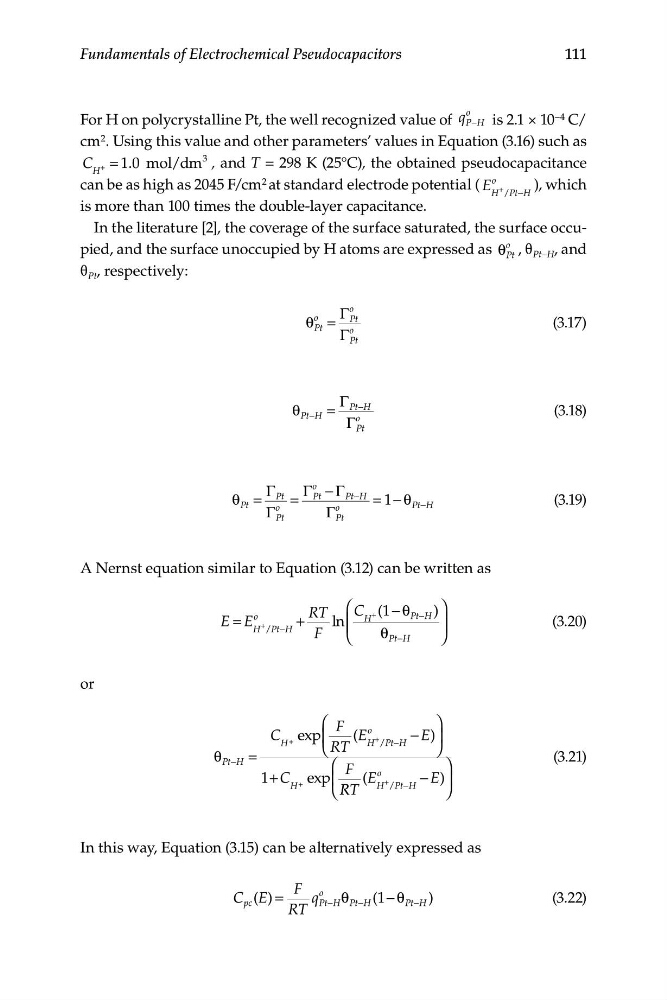
In the literature [2], the coverage of the surface saturated, the surface occupied, and the surface unoccupied by H atoms are expressed as θ
o
Pt , θ Pt–H , and
θ Pt , respectively:
θ
o
Γ
o
Pt
Pt = o
(3.17)
Γ Pt
Γ
θ Pt −H =
Pt − H
(3.18)
Γ
o
Pt
Γ
Γ
o
θ =
Pt
=
Pt − Γ Pt −H
Pt
o
= −
1
o
θ Pt−H
(3.19)
Γ Pt
Γ Pt
A Nernst equation similar to Equation (3.12) can be written as
=
o
RT ⎛ C
E E
+
H
(1− θ Pt H ) ⎞
−
+
H P
/ t−H
+
ln ⎜
⎟
⎜
⎟
(3.20)
F
⎝
θ Pt −H
⎠
or
⎛ F
⎞
C + exp ⎜
(E
o
+ /
H
E
H
H Pt−
− ) ⎟
⎝ RT
⎠
θ Pt −H =
(3.21)
⎛ F
⎞
1+ C
o
+
exp ⎜
(E +
H P
/ t H
− E
H
−
) ⎟
⎝ RT R
⎠
In this way, Equation (3.15) can be alternatively expressed as
F
C E
o
pc ( ) =
q
RT
Pt−H θ Pt − (1− θ Pt )
(3 22)
H
−H
.
111
For H on polycrystalline Pt, the well recognized value of q
o
1 × 10 –4
P H
−
is 2.
C/
cm 2 . Using this value and other parameters’ values in Equation (3.16) such as
C
1 0
. mol/
3
+ =
dm , and T = 298 K (25°C), the obtained pseudocapacitance
H
can be as high as 2045 F/cm 2 at standard electrode potential ( E
o
+
), which
H P
/ t−H
is more than 100 times the double-layer capacitance.
In the literature [2], the coverage of the surface saturated, the surface occupied, and the surface unoccupied by H atoms are expressed as θ
o
Pt , θ Pt–H , and
θ Pt , respectively:
θ
o
Γ
o
Pt
Pt = o
(3.17)
Γ Pt
Γ
θ Pt −H =
Pt − H
(3.18)
Γ
o
Pt
Γ
Γ
o
θ =
Pt
=
Pt − Γ Pt −H
Pt
o
= −
1
o
θ Pt−H
(3.19)
Γ Pt
Γ Pt
A Nernst equation similar to Equation (3.12) can be written as
=
o
RT ⎛ C
E E
+
H
(1− θ Pt H ) ⎞
−
+
H P
/ t−H
+
ln ⎜
⎟
⎜
⎟
(3.20)
F
⎝
θ Pt −H
⎠
or
⎛ F
⎞
C + exp ⎜
(E
o
+ /
H
E
H
H Pt−
− ) ⎟
⎝ RT
⎠
θ Pt −H =
(3.21)
⎛ F
⎞
1+ C
o
+
exp ⎜
(E +
H P
/ t H
− E
H
−
) ⎟
⎝ RT R
⎠
In this way, Equation (3.15) can be alternatively expressed as
F
C E
o
pc ( ) =
q
RT
Pt−H θ Pt − (1− θ Pt )
(3 22)
H
−H
.