

110
Electrochemical Supercapacitors for Energy Storage and Delivery
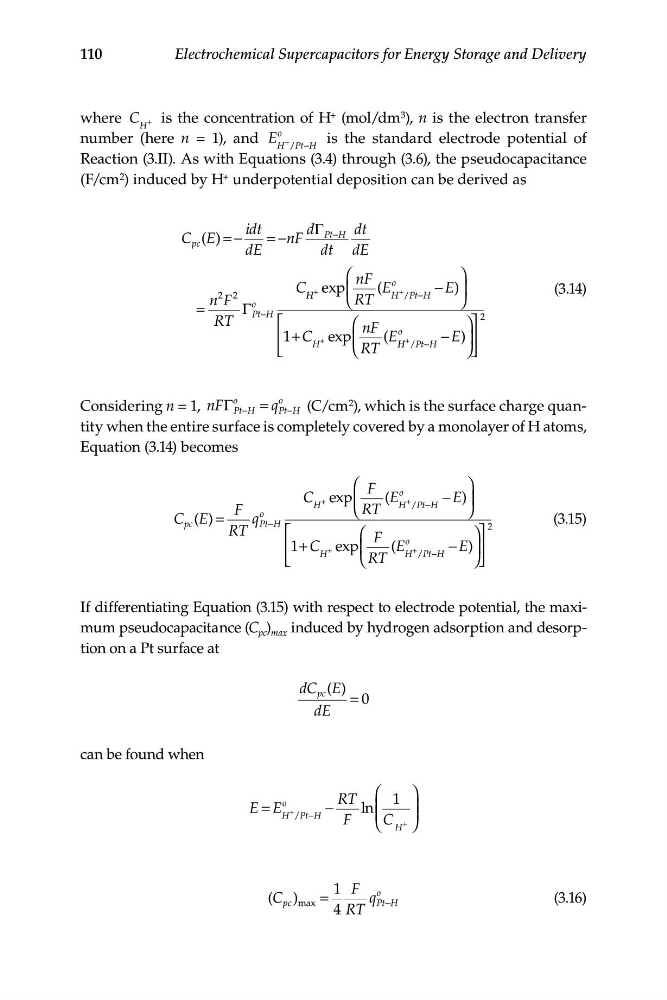
where C is the concentration of H + (mol/dm 3
+
H
), n is the electron transfer
number (here n = 1), and E
o
+
H P
/ t−H
is the standard electrode potential of
Reaction (3.II). As with Equations (3.4) through (3.6), the pseudocapacitance
(F/cm 2 ) induced by H + underpotential deposition can be derived as
idt
dΓ
= −
Pt H dt
C E
pc ( )
= −nF
−
dE
dt dE
⎛ nF
C exp ⎜
(E
o
⎞
+
2 2
H H
+
H /Pt −H
− E) ⎟
(3.14)
n F
⎝ RT
⎠
=
Γ
o
RT
−
Pt H ⎡
⎛
2
nF
⎤
o
⎞
⎢1 + C + exp
(E +
H
⎜
H H P
/ t− H
− E) ⎟⎥
⎣
⎝ RT
⎠⎦
Considering n = 1, nFΓ
o
o
Pt−H = q Pt − H (C/cm 2 ), which is the surface charge quantity when the entire surface is completely covered by a monolayer of H atoms,
Equation (3.14) becomes
⎛ F
C
o
⎞
+ exp ⎜
(E +
H
H /Pt−H
− E) ⎟ ⎟
F
⎝ RT
⎠
C E
o
pc ( ) =
q Pt−H
(3.15)
RT
⎡
⎛ F
⎞ ⎤
2
⎢1+ C ex
o
+
⎣
p ⎜
(E
⎝ RT
+
H
H /Pt−H
− E) ⎟⎥
⎠⎦
If differentiating Equation (3.15) with respect to electrode potential, the maximum pseudocapacitance (C pc ) max induced by hydrogen adsorption and desorption on a Pt surface at
dC pc ( )
E = 0
dE
can be found when
⎛
⎞
RT
1
E E
=
o
+
H
−
ln ⎜
⎟
H P
/ t−
⎜
⎟
F
⎝ C +
H ⎠
1 F
(C
o
pc ) max =
q Pt−H
(3.16)
4 RT
Electrochemical Supercapacitors for Energy Storage and Delivery
where C is the concentration of H + (mol/dm 3
+
H
), n is the electron transfer
number (here n = 1), and E
o
+
H P
/ t−H
is the standard electrode potential of
Reaction (3.II). As with Equations (3.4) through (3.6), the pseudocapacitance
(F/cm 2 ) induced by H + underpotential deposition can be derived as
idt
dΓ
= −
Pt H dt
C E
pc ( )
= −nF
−
dE
dt dE
⎛ nF
C exp ⎜
(E
o
⎞
+
2 2
H H
+
H /Pt −H
− E) ⎟
(3.14)
n F
⎝ RT
⎠
=
Γ
o
RT
−
Pt H ⎡
⎛
2
nF
⎤
o
⎞
⎢1 + C + exp
(E +
H
⎜
H H P
/ t− H
− E) ⎟⎥
⎣
⎝ RT
⎠⎦
Considering n = 1, nFΓ
o
o
Pt−H = q Pt − H (C/cm 2 ), which is the surface charge quantity when the entire surface is completely covered by a monolayer of H atoms,
Equation (3.14) becomes
⎛ F
C
o
⎞
+ exp ⎜
(E +
H
H /Pt−H
− E) ⎟ ⎟
F
⎝ RT
⎠
C E
o
pc ( ) =
q Pt−H
(3.15)
RT
⎡
⎛ F
⎞ ⎤
2
⎢1+ C ex
o
+
⎣
p ⎜
(E
⎝ RT
+
H
H /Pt−H
− E) ⎟⎥
⎠⎦
If differentiating Equation (3.15) with respect to electrode potential, the maximum pseudocapacitance (C pc ) max induced by hydrogen adsorption and desorption on a Pt surface at
dC pc ( )
E = 0
dE
can be found when
⎛
⎞
RT
1
E E
=
o
+
H
−
ln ⎜
⎟
H P
/ t−
⎜
⎟
F
⎝ C +
H ⎠
1 F
(C
o
pc ) max =
q Pt−H
(3.16)
4 RT