

107
Fundamentals of Electrochemical Pseudocapacitors
than that of the double-layer. However, its contribution to total capacitance
may not necessarily be that high because the operation voltage window of
ES is much wider than E off – E on . The contribution of its charge quantity (Q pc )
to the overall electrode capacitance should be divided by a wider voltage
window rather than the narrow window of E off – E on .
In addition, because E off – E on is narrow, the charge and discharge can function only as a narrow voltage range. To achieve a wider operation window,
multiple redox reactions in which each individual redox makes a contribution at a different potential range may be desired. Such systems include metal
oxides and electroactive polymers listed in Table 3.1. They are discussed further in the following sections of this chapter.
If an ES electrode layer contains both double-layer and pseudocapacitive
materials, the coupling of these two materials can boost total capacitance.
However, the interaction between these two materials and their corresponding charge storage processes make the theoretical treatment complicated. We
will discuss experiment measurements further in Section 3.2.4. For an ideal
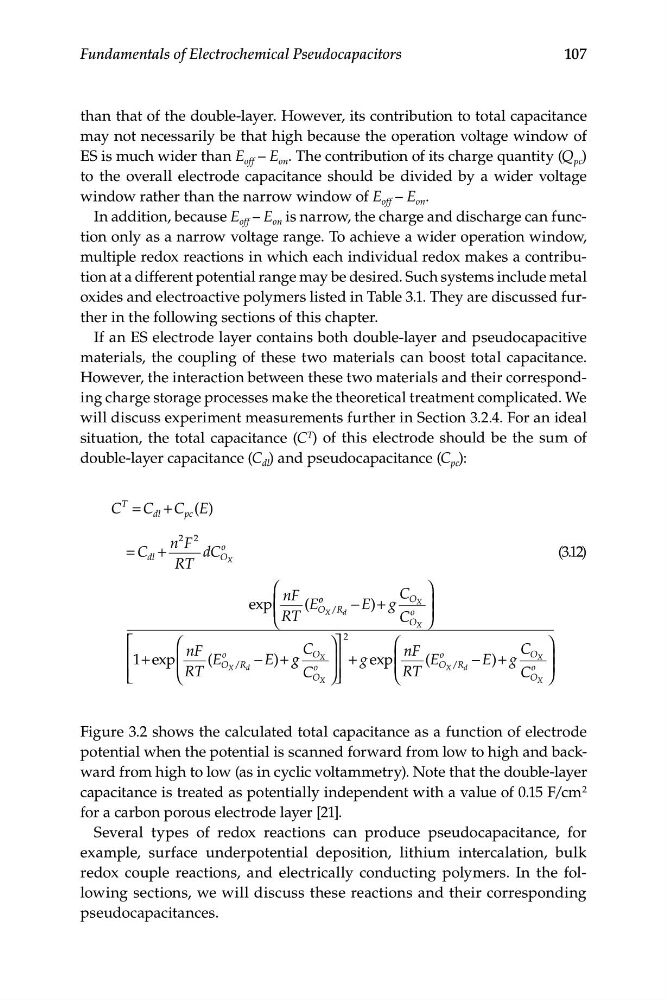
situation, the total capacitance (C T ) of this electrode should be the sum of
double-layer capacitance (C dl ) and pseudocapacitance (C pc ):
C
T
= C dl + C pc ( )
E
n F
2 2
= C dl
dC
o
+
RT
O X
(3.12)
⎛
⎞
nF o o
C
exp ⎜
(E
− +
E) g
O
⎟
⎜
X ⎟
⎝ RT
O X /R d
C
o
O X ⎠
⎡
⎛
⎤
2
⎞
⎛
⎞
nF
C
⎢ 1
⎜
(E
o
O
nF
⎥
o
C
+ exp
X
O
⎜
X
⎢
RT
O X /R d
− E) + g g
⎟
g exp ⎜
(E
C
RT
O
o
+
⎟
⎜
⎥
X /R − − +
E) g
⎟
⎟
⎣
⎝
O X ⎠⎦
d
C
o
⎝
O X ⎠
Figure 3.2 shows the calculated total capacitance as a function of electrode
potential when the potential is scanned forward from low to high and backward from high to low (as in cyclic voltammetry). Note that the double-layer
capacitance is treated as potentially independent with a value of 0.15 F/cm 2
for a carbon porous electrode layer [21].
Several types of redox reactions can produce pseudocapacitance, for
example, surface underpotential deposition, lithium intercalation, bulk
redox couple reactions, and electrically conducting polymers. In the following sections, we will discuss these reactions and their corresponding
pseudocapacitances.
Fundamentals of Electrochemical Pseudocapacitors
than that of the double-layer. However, its contribution to total capacitance
may not necessarily be that high because the operation voltage window of
ES is much wider than E off – E on . The contribution of its charge quantity (Q pc )
to the overall electrode capacitance should be divided by a wider voltage
window rather than the narrow window of E off – E on .
In addition, because E off – E on is narrow, the charge and discharge can function only as a narrow voltage range. To achieve a wider operation window,
multiple redox reactions in which each individual redox makes a contribution at a different potential range may be desired. Such systems include metal
oxides and electroactive polymers listed in Table 3.1. They are discussed further in the following sections of this chapter.
If an ES electrode layer contains both double-layer and pseudocapacitive
materials, the coupling of these two materials can boost total capacitance.
However, the interaction between these two materials and their corresponding charge storage processes make the theoretical treatment complicated. We
will discuss experiment measurements further in Section 3.2.4. For an ideal
situation, the total capacitance (C T ) of this electrode should be the sum of
double-layer capacitance (C dl ) and pseudocapacitance (C pc ):
C
T
= C dl + C pc ( )
E
n F
2 2
= C dl
dC
o
+
RT
O X
(3.12)
⎛
⎞
nF o o
C
exp ⎜
(E
− +
E) g
O
⎟
⎜
X ⎟
⎝ RT
O X /R d
C
o
O X ⎠
⎡
⎛
⎤
2
⎞
⎛
⎞
nF
C
⎢ 1
⎜
(E
o
O
nF
⎥
o
C
+ exp
X
O
⎜
X
⎢
RT
O X /R d
− E) + g g
⎟
g exp ⎜
(E
C
RT
O
o
+
⎟
⎜
⎥
X /R − − +
E) g
⎟
⎟
⎣
⎝
O X ⎠⎦
d
C
o
⎝
O X ⎠
Figure 3.2 shows the calculated total capacitance as a function of electrode
potential when the potential is scanned forward from low to high and backward from high to low (as in cyclic voltammetry). Note that the double-layer
capacitance is treated as potentially independent with a value of 0.15 F/cm 2
for a carbon porous electrode layer [21].
Several types of redox reactions can produce pseudocapacitance, for
example, surface underpotential deposition, lithium intercalation, bulk
redox couple reactions, and electrically conducting polymers. In the following sections, we will discuss these reactions and their corresponding
pseudocapacitances.