

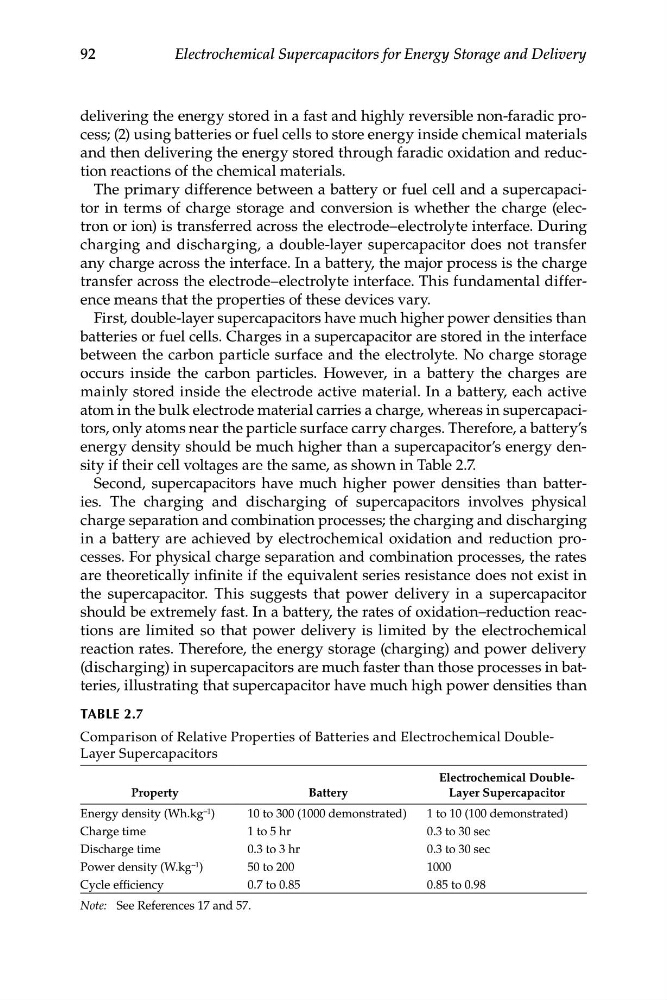
TABLE 2.7
Comparison of Relative Properties of Batteries and Electrochemical DoubleLayer Supercapacitors
92
Electrochemical Supercapacitors for Energy Storage and Delivery
delivering the energy stored in a fast and highly reversible non-faradic process; (2) using batteries or fuel cells to store energy inside chemical materials
and then delivering the energy stored through faradic oxidation and reduction reactions of the chemical materials.
The primary difference between a battery or fuel cell and a supercapacitor in terms of charge storage and conversion is whether the charge (electron or ion) is transferred across the electrode–electrolyte interface. During
charging and discharging, a double-layer supercapacitor does not transfer
any charge across the interface. In a battery, the major process is the charge
transfer across the electrode–electrolyte interface. This fundamental difference means that the properties of these devices vary.
First, double-layer supercapacitors have much higher power densities than
batteries or fuel cells. Charges in a supercapacitor are stored in the interface
between the carbon particle surface and the electrolyte. No charge storage
occurs inside the carbon particles. However, in a battery the charges are
mainly stored inside the electrode active material. In a battery, each active
atom in the bulk electrode material carries a charge, whereas in supercapacitors, only atoms near the particle surface carry charges. Therefore, a battery’s
energy density should be much higher than a supercapacitor’s energy density if their cell voltages are the same, as shown in Table 2.7.
Second, supercapacitors have much higher power densities than batteries. The charging and discharging of supercapacitors involves physical
charge separation and combination processes; the charging and discharging
in a battery are achieved by electrochemical oxidation and reduction processes. For physical charge separation and combination processes, the rates
are theoretically infinite if the equivalent series resistance does not exist in
the supercapacitor. This suggests that power delivery in a supercapacitor
should be extremely fast. In a battery, the rates of oxidation–reduction reactions are limited so that power delivery is limited by the electrochemical
reaction rates. Therefore, the energy storage (charging) and power delivery
(discharging) in supercapacitors are much faster than those processes in batteries, illustrating that supercapacitor have much high power densities than
Electrochemical DoubleProperty
Battery
Layer Supercapacitor
Energy density (Wh.kg –1 )
10 to 300 (1000 demonstrated)
1 to 10 (100 demonstrated)
Charge time
1 to 5 hr
0.3 to 30 sec
Discharge time
0.3 to 3 hr
0.3 to 30 sec
Power density (W.kg –1 )
50 to 200
1000
Cycle efficiency
0.7 to 0.85
0.85 to 0.98
Note: See References 17 and 57.
Comparison of Relative Properties of Batteries and Electrochemical DoubleLayer Supercapacitors
92
Electrochemical Supercapacitors for Energy Storage and Delivery
delivering the energy stored in a fast and highly reversible non-faradic process; (2) using batteries or fuel cells to store energy inside chemical materials
and then delivering the energy stored through faradic oxidation and reduction reactions of the chemical materials.
The primary difference between a battery or fuel cell and a supercapacitor in terms of charge storage and conversion is whether the charge (electron or ion) is transferred across the electrode–electrolyte interface. During
charging and discharging, a double-layer supercapacitor does not transfer
any charge across the interface. In a battery, the major process is the charge
transfer across the electrode–electrolyte interface. This fundamental difference means that the properties of these devices vary.
First, double-layer supercapacitors have much higher power densities than
batteries or fuel cells. Charges in a supercapacitor are stored in the interface
between the carbon particle surface and the electrolyte. No charge storage
occurs inside the carbon particles. However, in a battery the charges are
mainly stored inside the electrode active material. In a battery, each active
atom in the bulk electrode material carries a charge, whereas in supercapacitors, only atoms near the particle surface carry charges. Therefore, a battery’s
energy density should be much higher than a supercapacitor’s energy density if their cell voltages are the same, as shown in Table 2.7.
Second, supercapacitors have much higher power densities than batteries. The charging and discharging of supercapacitors involves physical
charge separation and combination processes; the charging and discharging
in a battery are achieved by electrochemical oxidation and reduction processes. For physical charge separation and combination processes, the rates
are theoretically infinite if the equivalent series resistance does not exist in
the supercapacitor. This suggests that power delivery in a supercapacitor
should be extremely fast. In a battery, the rates of oxidation–reduction reactions are limited so that power delivery is limited by the electrochemical
reaction rates. Therefore, the energy storage (charging) and power delivery
(discharging) in supercapacitors are much faster than those processes in batteries, illustrating that supercapacitor have much high power densities than
Electrochemical DoubleProperty
Battery
Layer Supercapacitor
Energy density (Wh.kg –1 )
10 to 300 (1000 demonstrated)
1 to 10 (100 demonstrated)
Charge time
1 to 5 hr
0.3 to 30 sec
Discharge time
0.3 to 3 hr
0.3 to 30 sec
Power density (W.kg –1 )
50 to 200
1000
Cycle efficiency
0.7 to 0.85
0.85 to 0.98
Note: See References 17 and 57.