

91
Fundamentals of Electrochemical Double-Layer Supercapacitors
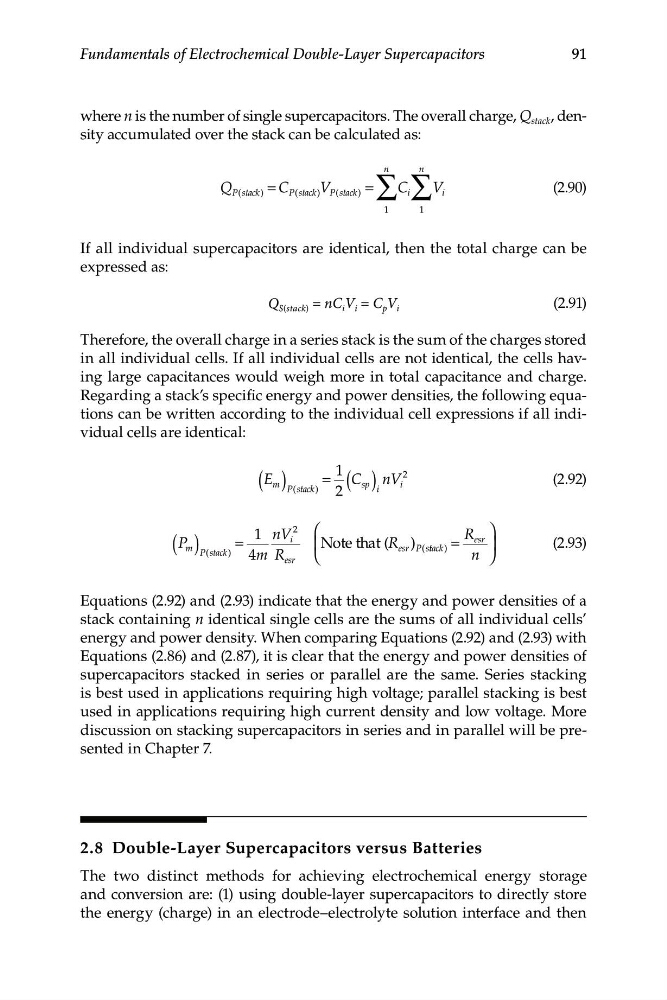
where n is the number of single supercapacitors. The overall charge, Q stack , density accumulated over the stack can be calculated as:
n
n
Q ( ) = C P stack
(
V ( ) =
C i
P stack
) P stack
∑ ∑ V i
(2.90)
1
1
If all individual supercapacitors are identical, then the total charge can be
expressed as:
Q S(stack) = nC i V i = C p V i
(2.91)
Therefore, the overall charge in a series stack is the sum of the charges stored
in all individual cells. If all individual cells are not identical, the cells having large capacitances would weigh more in total capacitance and charge.
Regarding a stack’s specific energy and power densities, the following equations can be written according to the individual cell expressions if all individual cells are identical:
E
C n V
(2.92)
m
= ( )
sp
( ) P stack
(
)
1
i
i
2
2
⎛
⎞
1 nV
2
R
i
esr
( )
P m
=
⎜ Note that ( R esr ) P s
( t tack ) =
⎟
(2.93)
P stack )
(
4m R
⎝
esr
n ⎠
Equations (2.92) and (2.93) indicate that the energy and power densities of a
stack containing n identical single cells are the sums of all individual cells’
energy and power density. When comparing Equations (2.92) and (2.93) with
Equations (2.86) and (2.87), it is clear that the energy and power densities of
supercapacitors stacked in series or parallel are the same. Series stacking
is best used in applications requiring high voltage; parallel stacking is best
used in applications requiring high current density and low voltage. More
discussion on stacking supercapacitors in series and in parallel will be presented in Chapter 7.
2.8 Double-Layer Supercapacitors versus Batteries
The two distinct methods for achieving electrochemical energy storage
and conversion are: (1) using double-layer supercapacitors to directly store
the energy (charge) in an electrode–electrolyte solution interface and then
Fundamentals of Electrochemical Double-Layer Supercapacitors
where n is the number of single supercapacitors. The overall charge, Q stack , density accumulated over the stack can be calculated as:
n
n
Q ( ) = C P stack
(
V ( ) =
C i
P stack
) P stack
∑ ∑ V i
(2.90)
1
1
If all individual supercapacitors are identical, then the total charge can be
expressed as:
Q S(stack) = nC i V i = C p V i
(2.91)
Therefore, the overall charge in a series stack is the sum of the charges stored
in all individual cells. If all individual cells are not identical, the cells having large capacitances would weigh more in total capacitance and charge.
Regarding a stack’s specific energy and power densities, the following equations can be written according to the individual cell expressions if all individual cells are identical:
E
C n V
(2.92)
m
= ( )
sp
( ) P stack
(
)
1
i
i
2
2
⎛
⎞
1 nV
2
R
i
esr
( )
P m
=
⎜ Note that ( R esr ) P s
( t tack ) =
⎟
(2.93)
P stack )
(
4m R
⎝
esr
n ⎠
Equations (2.92) and (2.93) indicate that the energy and power densities of a
stack containing n identical single cells are the sums of all individual cells’
energy and power density. When comparing Equations (2.92) and (2.93) with
Equations (2.86) and (2.87), it is clear that the energy and power densities of
supercapacitors stacked in series or parallel are the same. Series stacking
is best used in applications requiring high voltage; parallel stacking is best
used in applications requiring high current density and low voltage. More
discussion on stacking supercapacitors in series and in parallel will be presented in Chapter 7.
2.8 Double-Layer Supercapacitors versus Batteries
The two distinct methods for achieving electrochemical energy storage
and conversion are: (1) using double-layer supercapacitors to directly store
the energy (charge) in an electrode–electrolyte solution interface and then