

83
Fundamentals of Electrochemical Double-Layer Supercapacitors
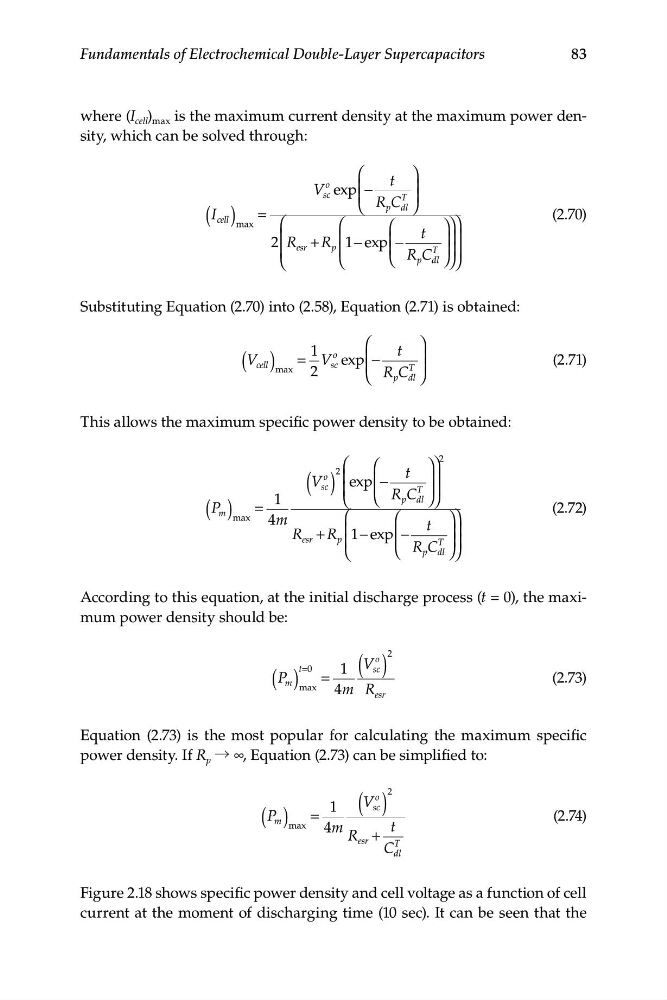
where (I cell ) max is the maximum current density at the maximum power density, which can be solved through:
⎛
⎞
o
t
V sc exp ⎜ −
⎟
⎜
⎟
( )
⎝
T
R C ⎠
I
p dl
cell
=
(2.70)
max
⎛
⎛
⎛
⎞ ⎞⎞
t
2 ⎜ R + R ⎜ 1− − exp ⎜ −
⎟ ⎟⎟
⎜
esr
p
⎜
⎜ R C
T ⎟⎟ ⎟
⎝
⎝
⎝ p dl ⎠⎠ ⎠
Substituting Equation (2.70) into (2.58), Equation (2.71) is obtained:
⎛
⎞
(
1
t
V )
o
ce ll
= V sc exp ⎜ −
⎟
T
(2.71)
max
⎜
2
⎟
⎝ R C
p dl ⎠
This allows the maximum specific power density to be obtained:
2
(
2
⎛
⎛
⎞ ⎞
V
o
⎜
t
sc
exp ⎜ −
⎟⎟ ⎟
⎜
⎜
⎟
( )
T
1
⎟
)
⎝
⎝ R C ⎠
P m
=
p dl ⎠
(2.72)
max
4m
⎛
⎛
⎞ ⎞
t
R esr + R ⎜
p 1− exp ⎜ −
⎟ ⎟
⎜
⎜
T ⎟
R C ⎟
⎝
⎝ p dl ⎠⎠
According to this equation, at the initial discharge process (t = 0), the maximum power density should be:
2
( )
o
t=0
1 ( V
=
sc
P m
)
(2.73)
max
4m R esr
Equation (2.73) is the most popular for calculating the maximum specific
power density. If R p → ∞, Equation (2.73) can be simplified to:
V
1 ( sc )
2
( )
o
P m
=
(2.74)
max
4m
t
R esr +
C
T
dl
Figure 2.18 shows specific power density and cell voltage as a function of cell
current at the moment of discharging time (10 sec). It can be seen that the
Fundamentals of Electrochemical Double-Layer Supercapacitors
where (I cell ) max is the maximum current density at the maximum power density, which can be solved through:
⎛
⎞
o
t
V sc exp ⎜ −
⎟
⎜
⎟
( )
⎝
T
R C ⎠
I
p dl
cell
=
(2.70)
max
⎛
⎛
⎛
⎞ ⎞⎞
t
2 ⎜ R + R ⎜ 1− − exp ⎜ −
⎟ ⎟⎟
⎜
esr
p
⎜
⎜ R C
T ⎟⎟ ⎟
⎝
⎝
⎝ p dl ⎠⎠ ⎠
Substituting Equation (2.70) into (2.58), Equation (2.71) is obtained:
⎛
⎞
(
1
t
V )
o
ce ll
= V sc exp ⎜ −
⎟
T
(2.71)
max
⎜
2
⎟
⎝ R C
p dl ⎠
This allows the maximum specific power density to be obtained:
2
(
2
⎛
⎛
⎞ ⎞
V
o
⎜
t
sc
exp ⎜ −
⎟⎟ ⎟
⎜
⎜
⎟
( )
T
1
⎟
)
⎝
⎝ R C ⎠
P m
=
p dl ⎠
(2.72)
max
4m
⎛
⎛
⎞ ⎞
t
R esr + R ⎜
p 1− exp ⎜ −
⎟ ⎟
⎜
⎜
T ⎟
R C ⎟
⎝
⎝ p dl ⎠⎠
According to this equation, at the initial discharge process (t = 0), the maximum power density should be:
2
( )
o
t=0
1 ( V
=
sc
P m
)
(2.73)
max
4m R esr
Equation (2.73) is the most popular for calculating the maximum specific
power density. If R p → ∞, Equation (2.73) can be simplified to:
V
1 ( sc )
2
( )
o
P m
=
(2.74)
max
4m
t
R esr +
C
T
dl
Figure 2.18 shows specific power density and cell voltage as a function of cell
current at the moment of discharging time (10 sec). It can be seen that the