

66
4 Epitaxial of III-Nitride LED Materials
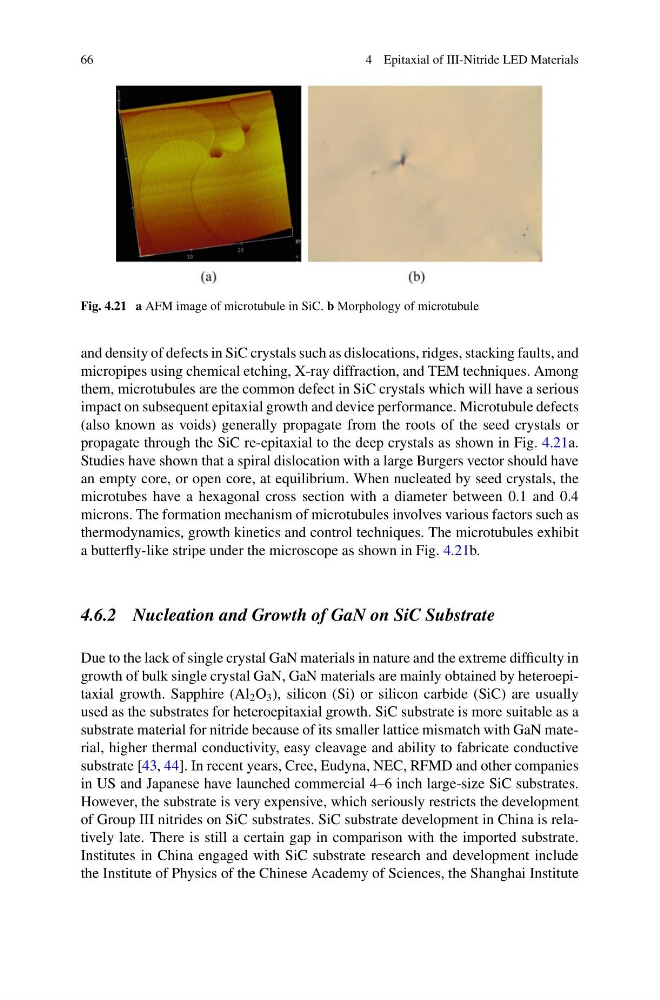
Fig. 4.21 a AFM image of microtubule in SiC. b Morphology of microtubule
and density of defects in SiC crystals such as dislocations, ridges, stacking faults, and
micropipes using chemical etching, X-ray diffraction, and TEM techniques. Among
them, microtubules are the common defect in SiC crystals which will have a serious
impact on subsequent epitaxial growth and device performance. Microtubule defects
(also known as voids) generally propagate from the roots of the seed crystals or
propagate through the SiC re-epitaxial to the deep crystals as shown in Fig. 4.21a.
Studies have shown that a spiral dislocation with a large Burgers vector should have
an empty core, or open core, at equilibrium. When nucleated by seed crystals, the
microtubes have a hexagonal cross section with a diameter between 0.1 and 0.4
microns. The formation mechanism of microtubules involves various factors such as
thermodynamics, growth kinetics and control techniques. The microtubules exhibit
a butterfly-like stripe under the microscope as shown in Fig. 4.21b.
4.6.2 Nucleation and Growth of GaN on SiC Substrate
Due to the lack of single crystal GaN materials in nature and the extreme difficulty in
growth of bulk single crystal GaN, GaN materials are mainly obtained by heteroepitaxial growth. Sapphire (Al 2 O 3 ), silicon (Si) or silicon carbide (SiC) are usually
used as the substrates for heteroepitaxial growth. SiC substrate is more suitable as a
substrate material for nitride because of its smaller lattice mismatch with GaN material, higher thermal conductivity, easy cleavage and ability to fabricate conductive
substrate [43, 44]. In recent years, Cree, Eudyna, NEC, RFMD and other companies
in US and Japanese have launched commercial 4–6 inch large-size SiC substrates.
However, the substrate is very expensive, which seriously restricts the development
of Group III nitrides on SiC substrates. SiC substrate development in China is relatively late. There is still a certain gap in comparison with the imported substrate.
Institutes in China engaged with SiC substrate research and development include
the Institute of Physics of the Chinese Academy of Sciences, the Shanghai Institute
4 Epitaxial of III-Nitride LED Materials
Fig. 4.21 a AFM image of microtubule in SiC. b Morphology of microtubule
and density of defects in SiC crystals such as dislocations, ridges, stacking faults, and
micropipes using chemical etching, X-ray diffraction, and TEM techniques. Among
them, microtubules are the common defect in SiC crystals which will have a serious
impact on subsequent epitaxial growth and device performance. Microtubule defects
(also known as voids) generally propagate from the roots of the seed crystals or
propagate through the SiC re-epitaxial to the deep crystals as shown in Fig. 4.21a.
Studies have shown that a spiral dislocation with a large Burgers vector should have
an empty core, or open core, at equilibrium. When nucleated by seed crystals, the
microtubes have a hexagonal cross section with a diameter between 0.1 and 0.4
microns. The formation mechanism of microtubules involves various factors such as
thermodynamics, growth kinetics and control techniques. The microtubules exhibit
a butterfly-like stripe under the microscope as shown in Fig. 4.21b.
4.6.2 Nucleation and Growth of GaN on SiC Substrate
Due to the lack of single crystal GaN materials in nature and the extreme difficulty in
growth of bulk single crystal GaN, GaN materials are mainly obtained by heteroepitaxial growth. Sapphire (Al 2 O 3 ), silicon (Si) or silicon carbide (SiC) are usually
used as the substrates for heteroepitaxial growth. SiC substrate is more suitable as a
substrate material for nitride because of its smaller lattice mismatch with GaN material, higher thermal conductivity, easy cleavage and ability to fabricate conductive
substrate [43, 44]. In recent years, Cree, Eudyna, NEC, RFMD and other companies
in US and Japanese have launched commercial 4–6 inch large-size SiC substrates.
However, the substrate is very expensive, which seriously restricts the development
of Group III nitrides on SiC substrates. SiC substrate development in China is relatively late. There is still a certain gap in comparison with the imported substrate.
Institutes in China engaged with SiC substrate research and development include
the Institute of Physics of the Chinese Academy of Sciences, the Shanghai Institute