

44
4 Epitaxial of III-Nitride LED Materials
horizontally. Both chambers provide stable planar flow to improve the uniformity of
the epitaxial layer. The MOCVD of AIXTRON in Germany uses “planetary rotation” technology, which uses low-speed substrate rotation and pedestal revolution to
achieve airflow stability and uniformity. Various reaction source gases are injected
through the nozzles at the center of the top of the reaction chamber, and become an
advection mode above the substrate, which tends to cause uneven distribution of the
source. The consistency of rotation of the rotating graphite is poor, and it requires
frequent startup and maintenance, which will affect the consistency from run to
run. The ceiling of the reaction chamber participates in the deposition and needs to
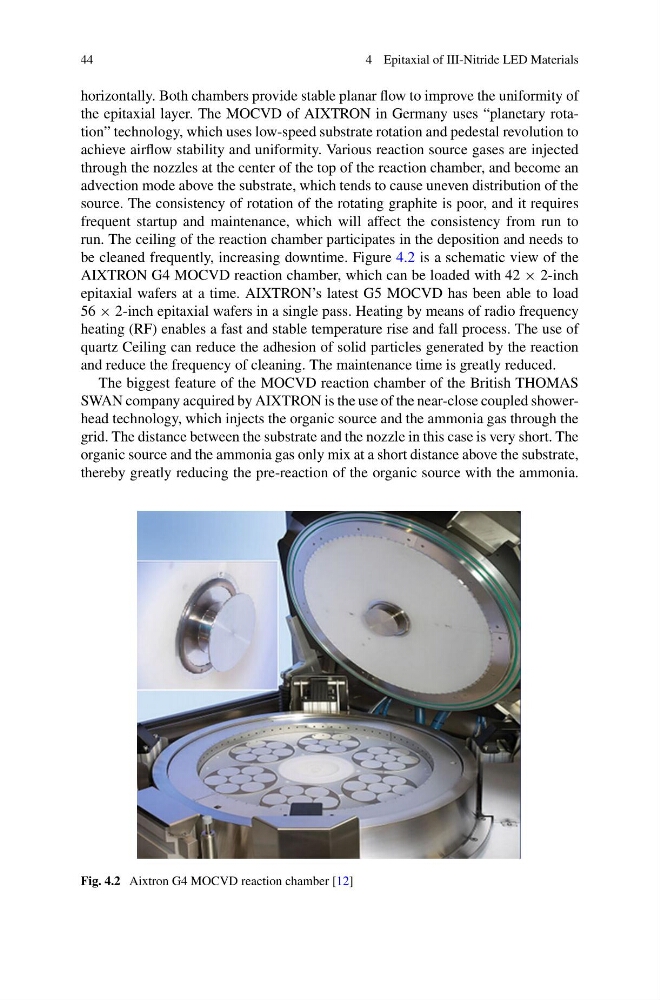
be cleaned frequently, increasing downtime. Figure 4.2 is a schematic view of the
AIXTRON G4 MOCVD reaction chamber, which can be loaded with 42 × 2-inch
epitaxial wafers at a time. AIXTRON’s latest G5 MOCVD has been able to load
56 × 2-inch epitaxial wafers in a single pass. Heating by means of radio frequency
heating (RF) enables a fast and stable temperature rise and fall process. The use of
quartz Ceiling can reduce the adhesion of solid particles generated by the reaction
and reduce the frequency of cleaning. The maintenance time is greatly reduced.
The biggest feature of the MOCVD reaction chamber of the British THOMAS
SWAN company acquired by AIXTRON is the use of the near-close coupled showerhead technology, which injects the organic source and the ammonia gas through the
grid. The distance between the substrate and the nozzle in this case is very short. The
organic source and the ammonia gas only mix at a short distance above the substrate,
thereby greatly reducing the pre-reaction of the organic source with the ammonia.
Fig. 4.2 Aixtron G4 MOCVD reaction chamber [12]
4 Epitaxial of III-Nitride LED Materials
horizontally. Both chambers provide stable planar flow to improve the uniformity of
the epitaxial layer. The MOCVD of AIXTRON in Germany uses “planetary rotation” technology, which uses low-speed substrate rotation and pedestal revolution to
achieve airflow stability and uniformity. Various reaction source gases are injected
through the nozzles at the center of the top of the reaction chamber, and become an
advection mode above the substrate, which tends to cause uneven distribution of the
source. The consistency of rotation of the rotating graphite is poor, and it requires
frequent startup and maintenance, which will affect the consistency from run to
run. The ceiling of the reaction chamber participates in the deposition and needs to
be cleaned frequently, increasing downtime. Figure 4.2 is a schematic view of the
AIXTRON G4 MOCVD reaction chamber, which can be loaded with 42 × 2-inch
epitaxial wafers at a time. AIXTRON’s latest G5 MOCVD has been able to load
56 × 2-inch epitaxial wafers in a single pass. Heating by means of radio frequency
heating (RF) enables a fast and stable temperature rise and fall process. The use of
quartz Ceiling can reduce the adhesion of solid particles generated by the reaction
and reduce the frequency of cleaning. The maintenance time is greatly reduced.
The biggest feature of the MOCVD reaction chamber of the British THOMAS
SWAN company acquired by AIXTRON is the use of the near-close coupled showerhead technology, which injects the organic source and the ammonia gas through the
grid. The distance between the substrate and the nozzle in this case is very short. The
organic source and the ammonia gas only mix at a short distance above the substrate,
thereby greatly reducing the pre-reaction of the organic source with the ammonia.
Fig. 4.2 Aixtron G4 MOCVD reaction chamber [12]