

3.4 Test and Analysis of the Properties of Group III Nitride Materials
31
incident light frequency is Raman scattering, which is an inelastic scattering of the
photon by the molecule. In the Raman scattering, a line having a frequency of υ 0 ±
υ i (i = 1, 2, 3…) is accompanied around each incident line (υ 0 ). The line on the long
wavelength side is called the red line or the Stokes line, and the line on the short side
is called the purple line or the anti-Stokes line. Since υ i is independent of υ 0 , it is
determined by the nature of the scattering material. Each scattering material has its
own specific frequency, and the Raman scattering spectrum can be used to analyze
information such as the composition and structure of the crystal or molecule.
UV-vis Spectrophotometer (UV-vis): The UV-visible absorption spectrum of a
molecule is the absorption spectrum produced by the electron-level transition of a
molecule or atom that absorbs radiation. Since various substances have different
molecules, atoms, and different molecular space structures, the absorption of light
energy is also different. Therefore each substance has its own unique absorption spectrum. Many materials have characteristic absorption peaks in the ultraviolet-visible
(200–800 nm) region. The amount of the substance can be determined based on the
absorbance at certain characteristic wavelengths on the absorption spectrum, which
is the basis for qualitative and quantitative analysis of the spectrophotometer. The
UV-Vis spectrophotometer is an effective mean to study the composition, structure
and interaction of substances according to the absorption line of the substance in the
ultraviolet-visible region.
Hall effect test (Hall): When electrons in a conductor or semiconductor material
move under a magnetic field perpendicular to the electric field, the orbital shift occurs
due to the Lorentz force, creating a lateral potential difference in the sample. This
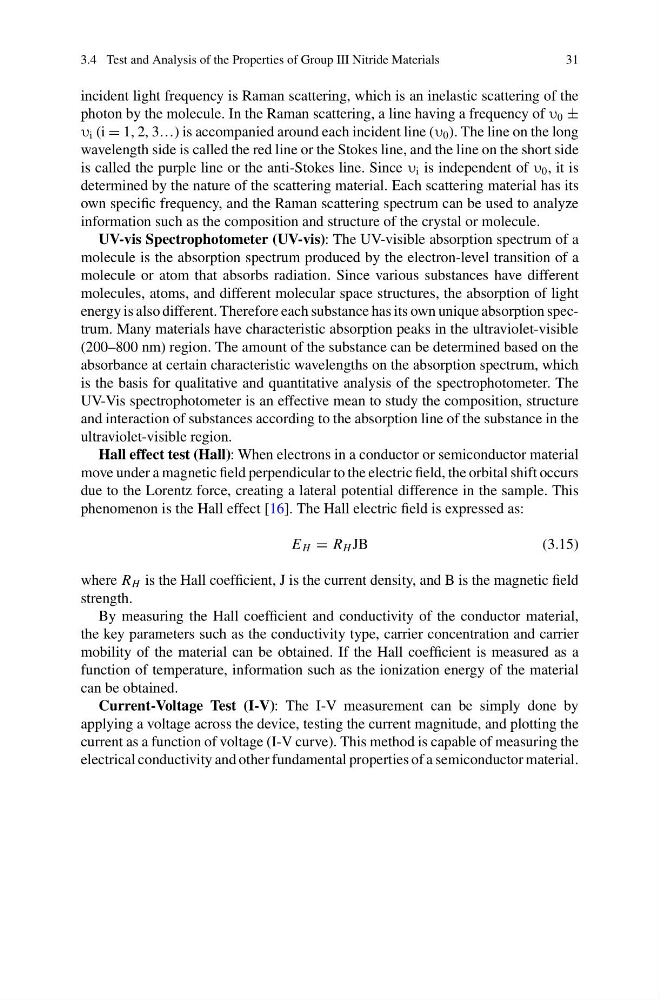
phenomenon is the Hall effect [16]. The Hall electric field is expressed as:
E H = R H JB
(3.15)
where R H is the Hall coefficient, J is the current density, and B is the magnetic field
strength.
By measuring the Hall coefficient and conductivity of the conductor material,
the key parameters such as the conductivity type, carrier concentration and carrier
mobility of the material can be obtained. If the Hall coefficient is measured as a
function of temperature, information such as the ionization energy of the material
can be obtained.
Current-Voltage Test (I-V): The I-V measurement can be simply done by
applying a voltage across the device, testing the current magnitude, and plotting the
current as a function of voltage (I-V curve). This method is capable of measuring the
electrical conductivity and other fundamental properties of a semiconductor material.
31
incident light frequency is Raman scattering, which is an inelastic scattering of the
photon by the molecule. In the Raman scattering, a line having a frequency of υ 0 ±
υ i (i = 1, 2, 3…) is accompanied around each incident line (υ 0 ). The line on the long
wavelength side is called the red line or the Stokes line, and the line on the short side
is called the purple line or the anti-Stokes line. Since υ i is independent of υ 0 , it is
determined by the nature of the scattering material. Each scattering material has its
own specific frequency, and the Raman scattering spectrum can be used to analyze
information such as the composition and structure of the crystal or molecule.
UV-vis Spectrophotometer (UV-vis): The UV-visible absorption spectrum of a
molecule is the absorption spectrum produced by the electron-level transition of a
molecule or atom that absorbs radiation. Since various substances have different
molecules, atoms, and different molecular space structures, the absorption of light
energy is also different. Therefore each substance has its own unique absorption spectrum. Many materials have characteristic absorption peaks in the ultraviolet-visible
(200–800 nm) region. The amount of the substance can be determined based on the
absorbance at certain characteristic wavelengths on the absorption spectrum, which
is the basis for qualitative and quantitative analysis of the spectrophotometer. The
UV-Vis spectrophotometer is an effective mean to study the composition, structure
and interaction of substances according to the absorption line of the substance in the
ultraviolet-visible region.
Hall effect test (Hall): When electrons in a conductor or semiconductor material
move under a magnetic field perpendicular to the electric field, the orbital shift occurs
due to the Lorentz force, creating a lateral potential difference in the sample. This
phenomenon is the Hall effect [16]. The Hall electric field is expressed as:
E H = R H JB
(3.15)
where R H is the Hall coefficient, J is the current density, and B is the magnetic field
strength.
By measuring the Hall coefficient and conductivity of the conductor material,
the key parameters such as the conductivity type, carrier concentration and carrier
mobility of the material can be obtained. If the Hall coefficient is measured as a
function of temperature, information such as the ionization energy of the material
can be obtained.
Current-Voltage Test (I-V): The I-V measurement can be simply done by
applying a voltage across the device, testing the current magnitude, and plotting the
current as a function of voltage (I-V curve). This method is capable of measuring the
electrical conductivity and other fundamental properties of a semiconductor material.