

2.3 LED Optical and Electrical Characteristics
13
= E g +
2 k
2
2
1
m
∗
C
+
1
m
∗
V
− ω = E g +
2 k
2
2m ∗
r
− ω
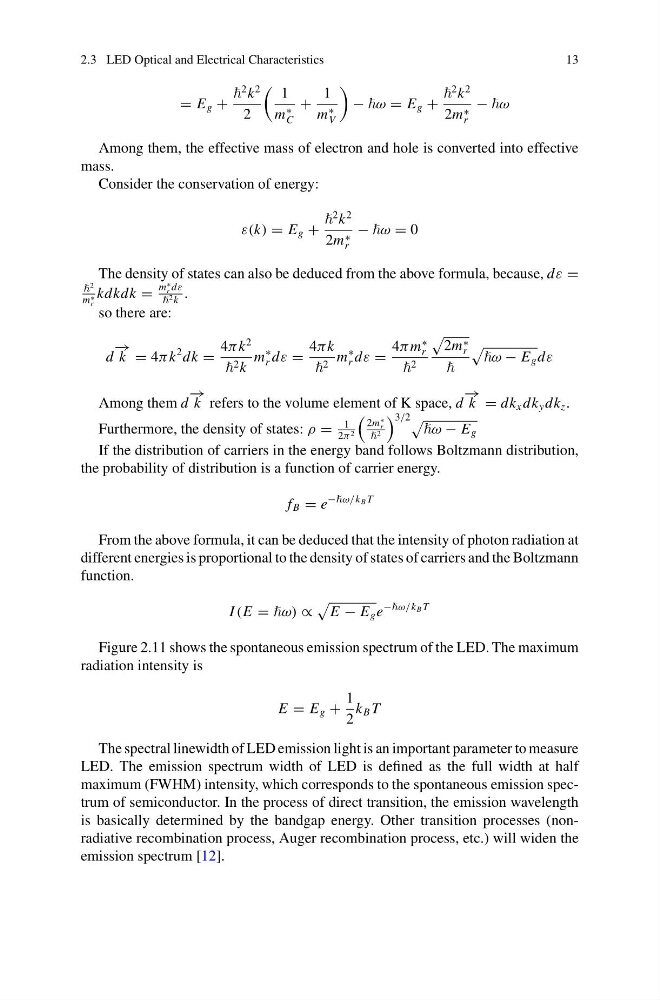
Among them, the effective mass of electron and hole is converted into effective
mass.
Consider the conservation of energy:
ε(k) = E g +
2 k
2
2m ∗
r
− ω = 0
The density of states can also be deduced from the above formula, because, dε =
2
m ∗
r
kdkdk =
m
∗
r dε
2 k
.
so there are:
d
− →
k = 4π k
2 dk =
4π k
2
2 k
m
∗
r dε =
4π k
2 m
∗
r dε =
4π m
∗
r
2
2m ∗
r
ω − E g dε
Among them d
− →
k refers to the volume element of K space, d
− →
k = dk x dk y dk z .
Furthermore, the density of states: ρ =
1
2π 2
2m
∗
r
2
3/2
ω − E g
If the distribution of carriers in the energy band follows Boltzmann distribution,
the probability of distribution is a function of carrier energy.
f B = e
−ω/k B T
From the above formula, it can be deduced that the intensity of photon radiation at
different energies is proportional to the density of states of carriers and the Boltzmann
function.
I (E = ω) ∝
E − E g e
−ω/k B T
Figure 2.11 shows the spontaneous emission spectrum of the LED. The maximum
radiation intensity is
E = E g +
1
2
k B T
The spectral linewidth of LED emission light is an important parameter to measure
LED. The emission spectrum width of LED is defined as the full width at half
maximum (FWHM) intensity, which corresponds to the spontaneous emission spectrum of semiconductor. In the process of direct transition, the emission wavelength
is basically determined by the bandgap energy. Other transition processes (nonradiative recombination process, Auger recombination process, etc.) will widen the
emission spectrum [12].
13
= E g +
2 k
2
2
1
m
∗
C
+
1
m
∗
V
− ω = E g +
2 k
2
2m ∗
r
− ω
Among them, the effective mass of electron and hole is converted into effective
mass.
Consider the conservation of energy:
ε(k) = E g +
2 k
2
2m ∗
r
− ω = 0
The density of states can also be deduced from the above formula, because, dε =
2
m ∗
r
kdkdk =
m
∗
r dε
2 k
.
so there are:
d
− →
k = 4π k
2 dk =
4π k
2
2 k
m
∗
r dε =
4π k
2 m
∗
r dε =
4π m
∗
r
2
2m ∗
r
ω − E g dε
Among them d
− →
k refers to the volume element of K space, d
− →
k = dk x dk y dk z .
Furthermore, the density of states: ρ =
1
2π 2
2m
∗
r
2
3/2
ω − E g
If the distribution of carriers in the energy band follows Boltzmann distribution,
the probability of distribution is a function of carrier energy.
f B = e
−ω/k B T
From the above formula, it can be deduced that the intensity of photon radiation at
different energies is proportional to the density of states of carriers and the Boltzmann
function.
I (E = ω) ∝
E − E g e
−ω/k B T
Figure 2.11 shows the spontaneous emission spectrum of the LED. The maximum
radiation intensity is
E = E g +
1
2
k B T
The spectral linewidth of LED emission light is an important parameter to measure
LED. The emission spectrum width of LED is defined as the full width at half
maximum (FWHM) intensity, which corresponds to the spontaneous emission spectrum of semiconductor. In the process of direct transition, the emission wavelength
is basically determined by the bandgap energy. Other transition processes (nonradiative recombination process, Auger recombination process, etc.) will widen the
emission spectrum [12].