

12
2 Basic Principles of LED
of various loss mechanisms, the number of photons propagating outside the active
region will be less than the number of photons generated in the active region. There
are three main loss mechanisms:
(1) Absorption in LED materials: due to the characteristics of semiconductor
materials;
(2) Fresnel loss: caused by internal reflection of semiconductor;
(3) Critical angular loss: When photons incident to the surface at an angle greater
than the critical angle, they are caused by total reflection.
The ratio of the number of photons radiated to the outside in the active area of
LED per unit time to the number of photons produced by the radiation recombination
in the active area is called light extraction efficiency. The external quantum efficiency
of LED refers to the ratio of the number of photons radiated to the outside of the
diode per unit time to the number of carriers injected. It can be seen that the external
quantum efficiency of LED is the product of the internal quantum efficiency and the
light extraction efficiency [10].
2.3.2 Radiation Spectrum
Because the physical mechanism of LED luminescence is the recombination of electrons and holes in the active region with spontaneous radiation, the optical properties
of LED are determined by spontaneous radiation.
The photon energy emitted in the active region of LED is not simply equal to the
bandgap E g of related materials because the energy distribution of conduction band
electrons and valence band holes in the material follows certain rules. The following
is deduced from the basic theory of semiconductor physics [11].
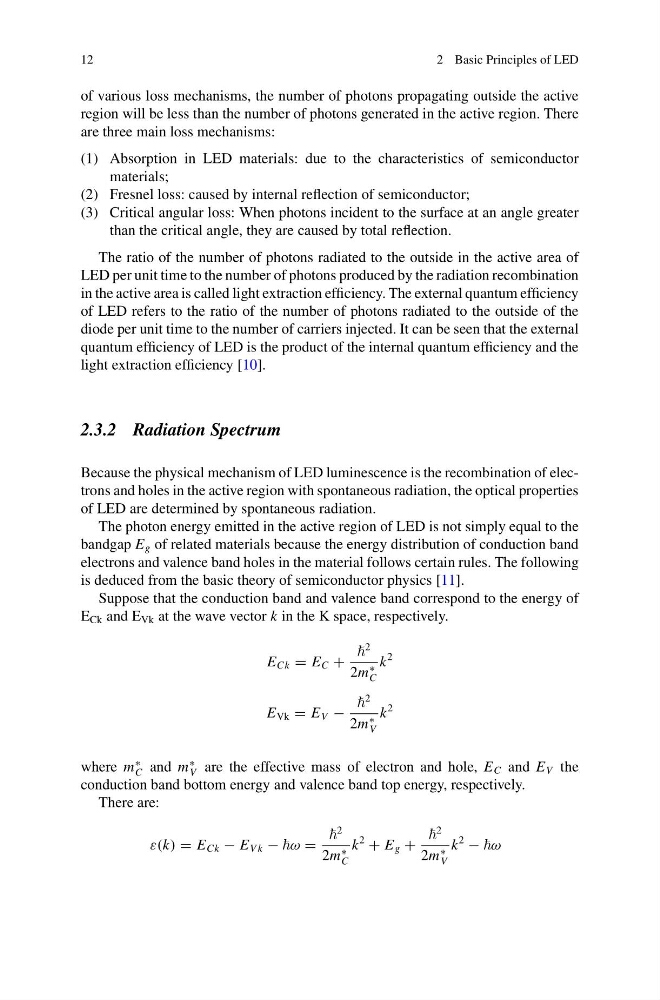
Suppose that the conduction band and valence band correspond to the energy of
E Ck and E Vk at the wave vector k in the K space, respectively.
E Ck = E C +
2
2m
∗
C
k
2
E Vk = E V −
2
2m
∗
V
k
2
where m
∗
C and m
∗
V are the effective mass of electron and hole, E C and E V the
conduction band bottom energy and valence band top energy, respectively.
There are:
ε(k) = E Ck − E V k − ω =
2
2m
∗
C
k
2
+ E g +
2
2m
∗
V
k
2
− ω
2 Basic Principles of LED
of various loss mechanisms, the number of photons propagating outside the active
region will be less than the number of photons generated in the active region. There
are three main loss mechanisms:
(1) Absorption in LED materials: due to the characteristics of semiconductor
materials;
(2) Fresnel loss: caused by internal reflection of semiconductor;
(3) Critical angular loss: When photons incident to the surface at an angle greater
than the critical angle, they are caused by total reflection.
The ratio of the number of photons radiated to the outside in the active area of
LED per unit time to the number of photons produced by the radiation recombination
in the active area is called light extraction efficiency. The external quantum efficiency
of LED refers to the ratio of the number of photons radiated to the outside of the
diode per unit time to the number of carriers injected. It can be seen that the external
quantum efficiency of LED is the product of the internal quantum efficiency and the
light extraction efficiency [10].
2.3.2 Radiation Spectrum
Because the physical mechanism of LED luminescence is the recombination of electrons and holes in the active region with spontaneous radiation, the optical properties
of LED are determined by spontaneous radiation.
The photon energy emitted in the active region of LED is not simply equal to the
bandgap E g of related materials because the energy distribution of conduction band
electrons and valence band holes in the material follows certain rules. The following
is deduced from the basic theory of semiconductor physics [11].
Suppose that the conduction band and valence band correspond to the energy of
E Ck and E Vk at the wave vector k in the K space, respectively.
E Ck = E C +
2
2m
∗
C
k
2
E Vk = E V −
2
2m
∗
V
k
2
where m
∗
C and m
∗
V are the effective mass of electron and hole, E C and E V the
conduction band bottom energy and valence band top energy, respectively.
There are:
ε(k) = E Ck − E V k − ω =
2
2m
∗
C
k
2
+ E g +
2
2m
∗
V
k
2
− ω