

12.2 Quantum Dot LED
267
Among them
M
2
is the transition matrix element, and g(hv) is the density of
states. For quantum well light-emitting devices, there is usually only one luminescence peak. For quantum dot light-emitting devices, as the carriers may occupy
several discrete levels of quantum dot, the quantum dots correspondingly have a
plurality of sub-level peaks.
The spontaneous emission spectrum of quantum dots is determined by the density
distribution of states and the level of carrier occupancy [17]. Simultaneously, there is
also a unique influencing factor: phonon relaxation [18]. When electrons are excited
by light to a high energy level or injected into the energy level of the barrier region,
they need to rely on the scattering of phonons (generally releasing LO phonons) to
relax to the discrete sub-level of the quantum dot. Phonon scattering requires conservation of energy and momentum. For a quantum well, the conservation condition is
easy to satisfy due to the existence of a continuous energy level distribution. However,
for a quantum dot, the energy level is discrete and the energy difference between the
occupied high energy level and the discrete energy level of quantum dot is very high.
Thus, it is hard for the energy difference to be equal to an integer multiple of the
phonon energy. Therefore, it is believed that quantum dots lack an effective carrier
relaxation path, which is called “phonon bottleneck”.
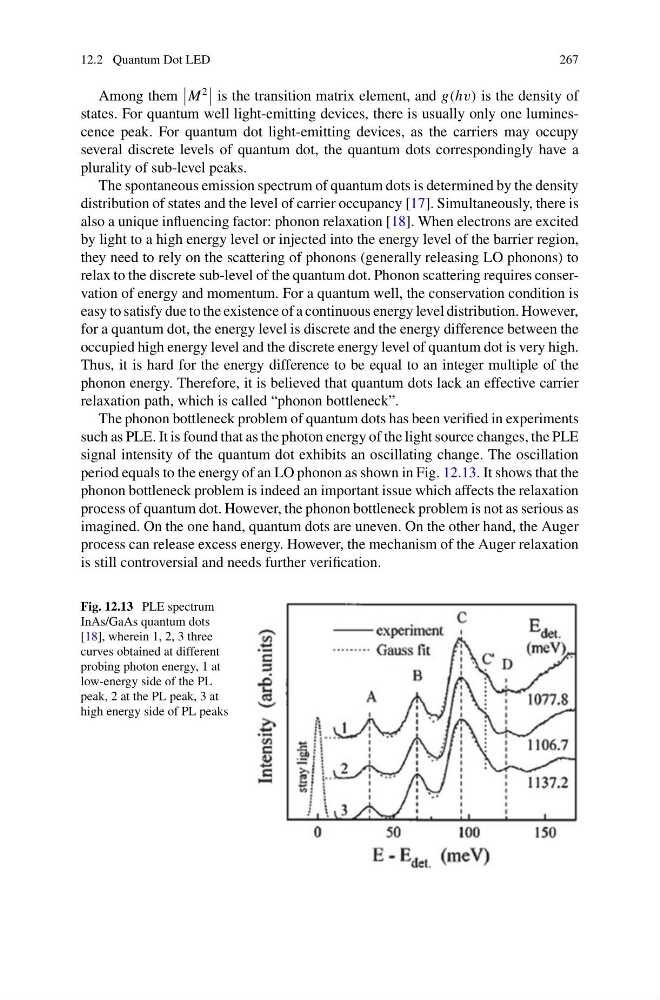
The phonon bottleneck problem of quantum dots has been verified in experiments
such as PLE. It is found that as the photon energy of the light source changes, the PLE
signal intensity of the quantum dot exhibits an oscillating change. The oscillation
period equals to the energy of an LO phonon as shown in Fig. 12.13. It shows that the
phonon bottleneck problem is indeed an important issue which affects the relaxation
process of quantum dot. However, the phonon bottleneck problem is not as serious as
imagined. On the one hand, quantum dots are uneven. On the other hand, the Auger
process can release excess energy. However, the mechanism of the Auger relaxation
is still controversial and needs further verification.
Fig. 12.13 PLE spectrum
InAs/GaAs quantum dots
[18], wherein 1, 2, 3 three
curves obtained at different
probing photon energy, 1 at
low-energy side of the PL
peak, 2 at the PL peak, 3 at
high energy side of PL peaks
267
Among them
M
2
is the transition matrix element, and g(hv) is the density of
states. For quantum well light-emitting devices, there is usually only one luminescence peak. For quantum dot light-emitting devices, as the carriers may occupy
several discrete levels of quantum dot, the quantum dots correspondingly have a
plurality of sub-level peaks.
The spontaneous emission spectrum of quantum dots is determined by the density
distribution of states and the level of carrier occupancy [17]. Simultaneously, there is
also a unique influencing factor: phonon relaxation [18]. When electrons are excited
by light to a high energy level or injected into the energy level of the barrier region,
they need to rely on the scattering of phonons (generally releasing LO phonons) to
relax to the discrete sub-level of the quantum dot. Phonon scattering requires conservation of energy and momentum. For a quantum well, the conservation condition is
easy to satisfy due to the existence of a continuous energy level distribution. However,
for a quantum dot, the energy level is discrete and the energy difference between the
occupied high energy level and the discrete energy level of quantum dot is very high.
Thus, it is hard for the energy difference to be equal to an integer multiple of the
phonon energy. Therefore, it is believed that quantum dots lack an effective carrier
relaxation path, which is called “phonon bottleneck”.
The phonon bottleneck problem of quantum dots has been verified in experiments
such as PLE. It is found that as the photon energy of the light source changes, the PLE
signal intensity of the quantum dot exhibits an oscillating change. The oscillation
period equals to the energy of an LO phonon as shown in Fig. 12.13. It shows that the
phonon bottleneck problem is indeed an important issue which affects the relaxation
process of quantum dot. However, the phonon bottleneck problem is not as serious as
imagined. On the one hand, quantum dots are uneven. On the other hand, the Auger
process can release excess energy. However, the mechanism of the Auger relaxation
is still controversial and needs further verification.
Fig. 12.13 PLE spectrum
InAs/GaAs quantum dots
[18], wherein 1, 2, 3 three
curves obtained at different
probing photon energy, 1 at
low-energy side of the PL
peak, 2 at the PL peak, 3 at
high energy side of PL peaks