

266
12 Novel Nitride LED Technology
the position and size of the 3D island formed in the SK mode are generally random.
This implies that it is difficult to achieve uniform growth.
Stress-induced formation of quantum dots is an interesting method for preparation
of quantum dot. The formation of a horizontally structure with modulated stress on
the quantum well, such as a nano-island, can regulate the stress state of the below
quantum well. Thus, characteristics of quantum dot can be obtained. For example,
an InP self-organized quantum dot structure is grown on an InGaAs/GaAs quantum
well to form GaAs stress-induced quantum dots [16].
12.2.2 Optical Properties of Quantum Dots
Quantum dots have unique luminescent properties due to their unique threedimensional limitations. Next, we will introduce the unique optical properties of
quantum dots compared to quantum wells.
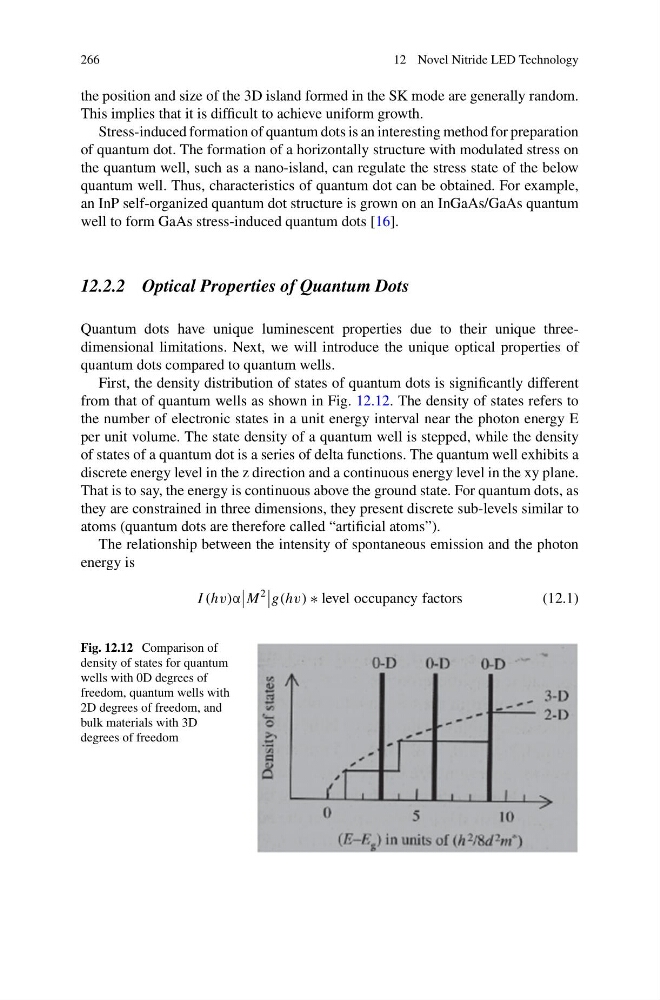
First, the density distribution of states of quantum dots is significantly different
from that of quantum wells as shown in Fig. 12.12. The density of states refers to
the number of electronic states in a unit energy interval near the photon energy E
per unit volume. The state density of a quantum well is stepped, while the density
of states of a quantum dot is a series of delta functions. The quantum well exhibits a
discrete energy level in the z direction and a continuous energy level in the xy plane.
That is to say, the energy is continuous above the ground state. For quantum dots, as
they are constrained in three dimensions, they present discrete sub-levels similar to
atoms (quantum dots are therefore called “artificial atoms”).
The relationship between the intensity of spontaneous emission and the photon
energy is
I (hv)α
M
2
g(hv) ∗ level occupancy factors
(12.1)
Fig. 12.12 Comparison of
density of states for quantum
wells with 0D degrees of
freedom, quantum wells with
2D degrees of freedom, and
bulk materials with 3D
degrees of freedom
12 Novel Nitride LED Technology
the position and size of the 3D island formed in the SK mode are generally random.
This implies that it is difficult to achieve uniform growth.
Stress-induced formation of quantum dots is an interesting method for preparation
of quantum dot. The formation of a horizontally structure with modulated stress on
the quantum well, such as a nano-island, can regulate the stress state of the below
quantum well. Thus, characteristics of quantum dot can be obtained. For example,
an InP self-organized quantum dot structure is grown on an InGaAs/GaAs quantum
well to form GaAs stress-induced quantum dots [16].
12.2.2 Optical Properties of Quantum Dots
Quantum dots have unique luminescent properties due to their unique threedimensional limitations. Next, we will introduce the unique optical properties of
quantum dots compared to quantum wells.
First, the density distribution of states of quantum dots is significantly different
from that of quantum wells as shown in Fig. 12.12. The density of states refers to
the number of electronic states in a unit energy interval near the photon energy E
per unit volume. The state density of a quantum well is stepped, while the density
of states of a quantum dot is a series of delta functions. The quantum well exhibits a
discrete energy level in the z direction and a continuous energy level in the xy plane.
That is to say, the energy is continuous above the ground state. For quantum dots, as
they are constrained in three dimensions, they present discrete sub-levels similar to
atoms (quantum dots are therefore called “artificial atoms”).
The relationship between the intensity of spontaneous emission and the photon
energy is
I (hv)α
M
2
g(hv) ∗ level occupancy factors
(12.1)
Fig. 12.12 Comparison of
density of states for quantum
wells with 0D degrees of
freedom, quantum wells with
2D degrees of freedom, and
bulk materials with 3D
degrees of freedom