

10.3 LED System Reliability
225
Case two [24]
Consider the luminous flux probability of the single LED at a specific time rather
than the failure probability. The total luminous flux probability of the single LED
can be obtained by the Bayesian network algorithm. To obtain the total luminous
flux of all LEDs light sources, it can simply multiply the number of LEDs in it and
the luminous of individual devices. By setting the light failure criterion, you can get
the probability of the light source and calculate the reliability when it embedded into
system. The probability distribution of the estimated luminous flux can be expressed
as
P(L E D_Failure) = P(3_led_out put ≤ 0.70) =
70
0
f 3_led_out put (z)dz
(10.25)
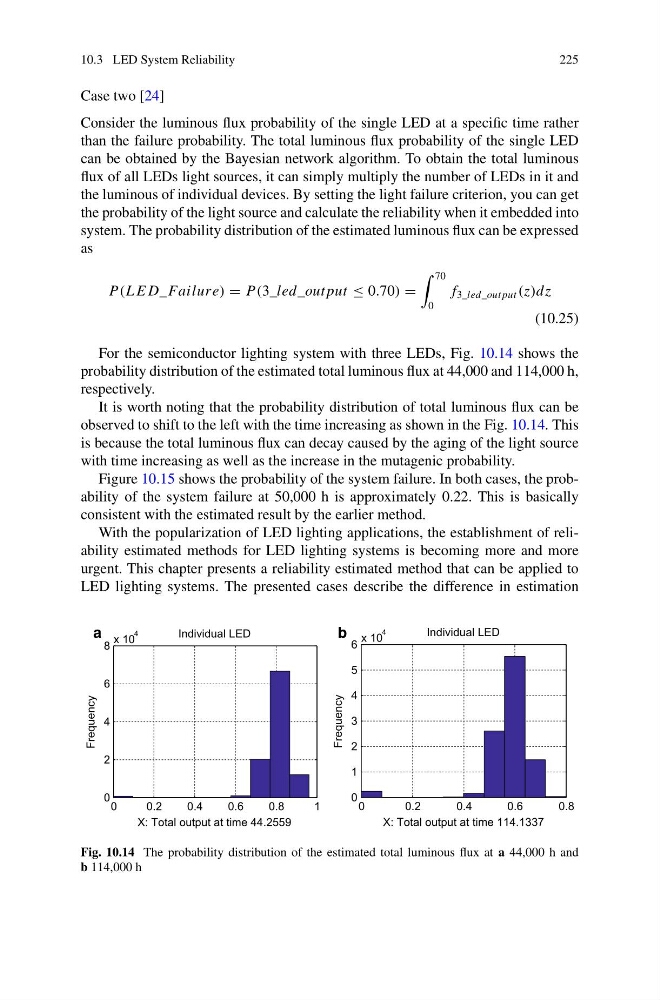
For the semiconductor lighting system with three LEDs, Fig. 10.14 shows the
probability distribution of the estimated total luminous flux at 44,000 and 114,000 h,
respectively.
It is worth noting that the probability distribution of total luminous flux can be
observed to shift to the left with the time increasing as shown in the Fig. 10.14. This
is because the total luminous flux can decay caused by the aging of the light source
with time increasing as well as the increase in the mutagenic probability.
Figure 10.15 shows the probability of the system failure. In both cases, the probability of the system failure at 50,000 h is approximately 0.22. This is basically
consistent with the estimated result by the earlier method.
With the popularization of LED lighting applications, the establishment of reliability estimated methods for LED lighting systems is becoming more and more
urgent. This chapter presents a reliability estimated method that can be applied to
LED lighting systems. The presented cases describe the difference in estimation
0
0.2
0.4
0.6
0.8
1
0
2
4
6
8
x 10
4
Individual LED
X: Total output at time 44.2559
Frequency
0
0.2
0.4
0.6
0.8
0
1
2
3
4
5
6
x 10
4
Individual LED
X: Total output at time 114.1337
Frequency
a
b
Fig. 10.14 The probability distribution of the estimated total luminous flux at a 44,000 h and
b 114,000 h
225
Case two [24]
Consider the luminous flux probability of the single LED at a specific time rather
than the failure probability. The total luminous flux probability of the single LED
can be obtained by the Bayesian network algorithm. To obtain the total luminous
flux of all LEDs light sources, it can simply multiply the number of LEDs in it and
the luminous of individual devices. By setting the light failure criterion, you can get
the probability of the light source and calculate the reliability when it embedded into
system. The probability distribution of the estimated luminous flux can be expressed
as
P(L E D_Failure) = P(3_led_out put ≤ 0.70) =
70
0
f 3_led_out put (z)dz
(10.25)
For the semiconductor lighting system with three LEDs, Fig. 10.14 shows the
probability distribution of the estimated total luminous flux at 44,000 and 114,000 h,
respectively.
It is worth noting that the probability distribution of total luminous flux can be
observed to shift to the left with the time increasing as shown in the Fig. 10.14. This
is because the total luminous flux can decay caused by the aging of the light source
with time increasing as well as the increase in the mutagenic probability.
Figure 10.15 shows the probability of the system failure. In both cases, the probability of the system failure at 50,000 h is approximately 0.22. This is basically
consistent with the estimated result by the earlier method.
With the popularization of LED lighting applications, the establishment of reliability estimated methods for LED lighting systems is becoming more and more
urgent. This chapter presents a reliability estimated method that can be applied to
LED lighting systems. The presented cases describe the difference in estimation
0
0.2
0.4
0.6
0.8
1
0
2
4
6
8
x 10
4
Individual LED
X: Total output at time 44.2559
Frequency
0
0.2
0.4
0.6
0.8
0
1
2
3
4
5
6
x 10
4
Individual LED
X: Total output at time 114.1337
Frequency
a
b
Fig. 10.14 The probability distribution of the estimated total luminous flux at a 44,000 h and
b 114,000 h