

214
10 Reliability Analysis of Group III Nitride LEDs Devices
The above equation is the acceleration equation based on the Arrhenius model
with the temperature stress as the acceleration variable. Where t represents the time
at which a device reaches a cumulative failure probability F(t). Its logarithm and
the inverse of the absolute temperature show a linear relationship. Using the ln(t) ~
1/T coordinate map, one can get a straight line. You can use the graph estimation
method or numerical method to calculate the lifetime value of the LEDs at different
temperatures, and figure out the activation energy of the device.
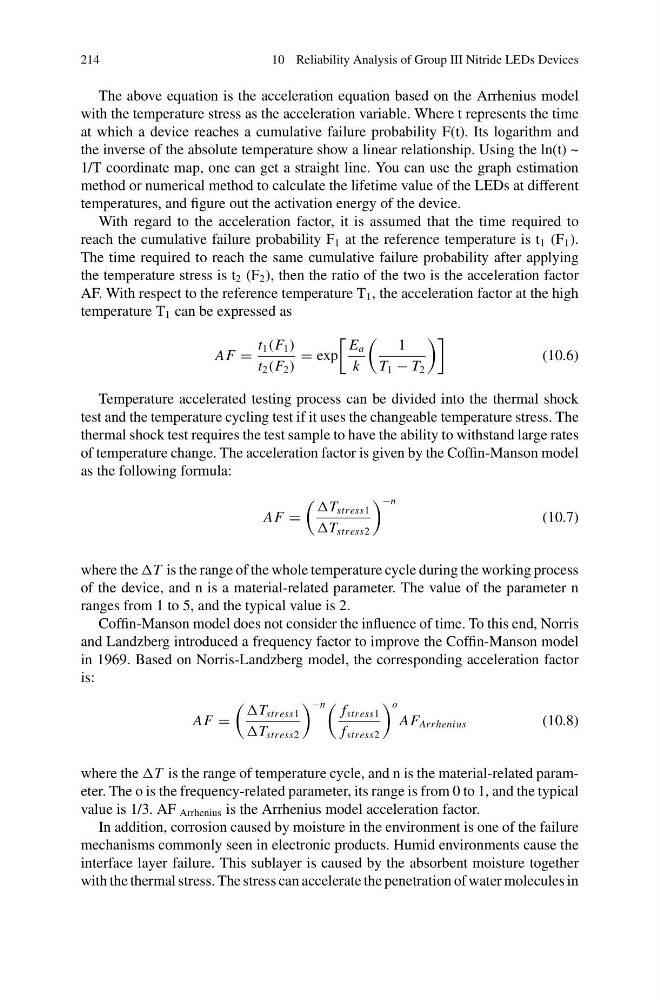
With regard to the acceleration factor, it is assumed that the time required to
reach the cumulative failure probability F 1 at the reference temperature is t 1 (F 1 ).
The time required to reach the same cumulative failure probability after applying
the temperature stress is t 2 (F 2 ), then the ratio of the two is the acceleration factor
AF. With respect to the reference temperature T 1 , the acceleration factor at the high
temperature T 1 can be expressed as
AF =
t 1 (F 1 )
t 2 (F 2 )
= exp
E a
k
1
T 1 − T 2
(10.6)
Temperature accelerated testing process can be divided into the thermal shock
test and the temperature cycling test if it uses the changeable temperature stress. The
thermal shock test requires the test sample to have the ability to withstand large rates
of temperature change. The acceleration factor is given by the Coffin-Manson model
as the following formula:
AF =
T stress1
T stress2
−n
(10.7)
where the T is the range of the whole temperature cycle during the working process
of the device, and n is a material-related parameter. The value of the parameter n
ranges from 1 to 5, and the typical value is 2.
Coffin-Manson model does not consider the influence of time. To this end, Norris
and Landzberg introduced a frequency factor to improve the Coffin-Manson model
in 1969. Based on Norris-Landzberg model, the corresponding acceleration factor
is:
AF =
T stress1
T stress2
−n
f stress1
f stress2
o
AF Arr henius
(10.8)
where the T is the range of temperature cycle, and n is the material-related parameter. The o is the frequency-related parameter, its range is from 0 to 1, and the typical
value is 1/3. AF Arrhenius is the Arrhenius model acceleration factor.
In addition, corrosion caused by moisture in the environment is one of the failure
mechanisms commonly seen in electronic products. Humid environments cause the
interface layer failure. This sublayer is caused by the absorbent moisture together
with the thermal stress. The stress can accelerate the penetration of water molecules in
10 Reliability Analysis of Group III Nitride LEDs Devices
The above equation is the acceleration equation based on the Arrhenius model
with the temperature stress as the acceleration variable. Where t represents the time
at which a device reaches a cumulative failure probability F(t). Its logarithm and
the inverse of the absolute temperature show a linear relationship. Using the ln(t) ~
1/T coordinate map, one can get a straight line. You can use the graph estimation
method or numerical method to calculate the lifetime value of the LEDs at different
temperatures, and figure out the activation energy of the device.
With regard to the acceleration factor, it is assumed that the time required to
reach the cumulative failure probability F 1 at the reference temperature is t 1 (F 1 ).
The time required to reach the same cumulative failure probability after applying
the temperature stress is t 2 (F 2 ), then the ratio of the two is the acceleration factor
AF. With respect to the reference temperature T 1 , the acceleration factor at the high
temperature T 1 can be expressed as
AF =
t 1 (F 1 )
t 2 (F 2 )
= exp
E a
k
1
T 1 − T 2
(10.6)
Temperature accelerated testing process can be divided into the thermal shock
test and the temperature cycling test if it uses the changeable temperature stress. The
thermal shock test requires the test sample to have the ability to withstand large rates
of temperature change. The acceleration factor is given by the Coffin-Manson model
as the following formula:
AF =
T stress1
T stress2
−n
(10.7)
where the T is the range of the whole temperature cycle during the working process
of the device, and n is a material-related parameter. The value of the parameter n
ranges from 1 to 5, and the typical value is 2.
Coffin-Manson model does not consider the influence of time. To this end, Norris
and Landzberg introduced a frequency factor to improve the Coffin-Manson model
in 1969. Based on Norris-Landzberg model, the corresponding acceleration factor
is:
AF =
T stress1
T stress2
−n
f stress1
f stress2
o
AF Arr henius
(10.8)
where the T is the range of temperature cycle, and n is the material-related parameter. The o is the frequency-related parameter, its range is from 0 to 1, and the typical
value is 1/3. AF Arrhenius is the Arrhenius model acceleration factor.
In addition, corrosion caused by moisture in the environment is one of the failure
mechanisms commonly seen in electronic products. Humid environments cause the
interface layer failure. This sublayer is caused by the absorbent moisture together
with the thermal stress. The stress can accelerate the penetration of water molecules in