

8.7 Vertical Structure LEDs
175
vacuum, and pressure conditions, the two metal layers are bonded to complete the
bonding of GaN to the substrate material. Heat treatment is a very important step
in the wafer bonding process. The heat treatment of the bonded wafer can effectively increase the inter-diffusion between the interface atoms, thereby increasing
the bonding strength. However, if the coefficients of thermal expansion between
the wafers are relatively large, a relatively large internal strain will be generated
between the two layers of materials, causing warpage of the wafer and even cracking
and cracking of the wafer during the high-temperature heat treatment. Therefore, the
difference in thermal expansion coefficient of the material is a parameter that must
be considered during the high temperature bonding process.
The bonding between the wafer and the substrate is achieved by inter-diffusion
between the metals after reaching a certain temperature. It is commonly believed
that there is no interaction force between the wafer and the substrate parallel to the
interface direction at this high temperature. Inter-diffusion between metals after a
period of high temperature has caused the wafer to bond with the substrate. During
the temperature cooling down to room temperature, interactions between the wafers
will be mutually parallel to the interface direction due to the difference in thermal
expansion coefficient between the wafers. The force, which is the cause of stress
during the bonding process, is also the basis for calculating the stress. Obviously,
this view ignores the influence of the applied pressure during the bonding process.
The applied longitudinal pressure itself can cause the deformation of the material.
The deformation of the material is also related to the mechanical parameters such
as the elastic modulus and Poisson’s ratio of the material. The difference in material
mechanical parameters between the two wafers may cause another part of the stress,
which is complicated if the bonding pressure is taken into account when calculating
the stress of the wafer bond. In calculating the internal stress after bonding, we can
ignore the influence of the bonding pressure on the internal stress if the bonding
pressure is not very large.
8.7.3 Laser Lift-Off
The principle of laser lift-off is mainly to utilize the pyrolysis characteristics of
GaN materials and the band gap between GaN and sapphire. Using an ultraviolet
pulsed laser with a photon energy greater than the GaN bandgap and less than the
sapphire bandgap, the GaN material is irradiated through the sapphire substrate.
Strong absorption at the interface occurs, causing local temperature to rise as well as
GaN gasification and decomposition, thereby realizing separation of GaN material
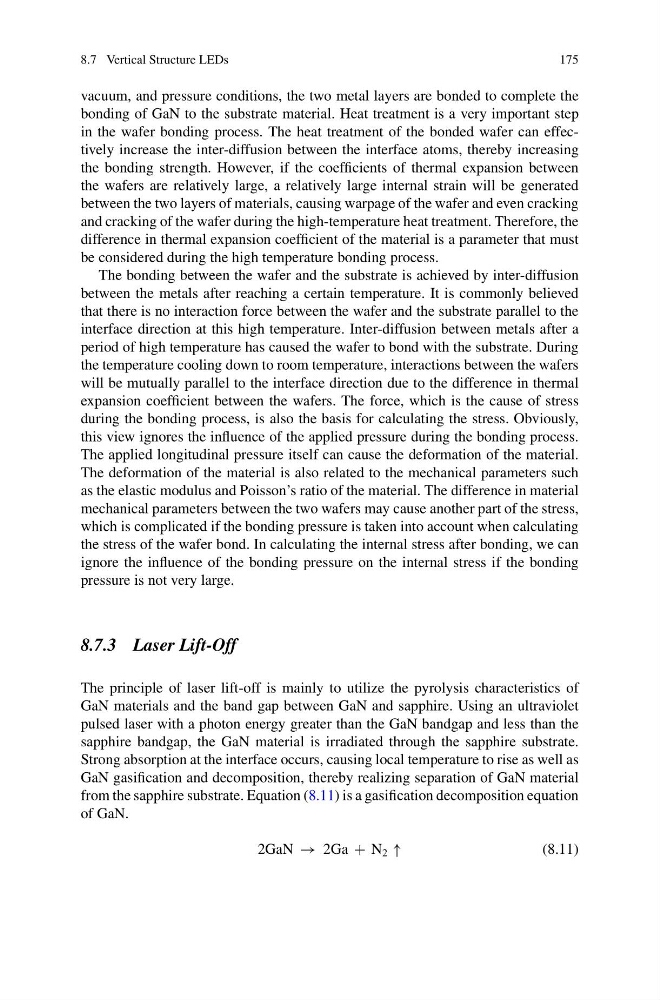
from the sapphire substrate. Equation (8.11) is a gasification decomposition equation
of GaN.
2GaN → 2Ga + N 2 ↑
(8.11)
175
vacuum, and pressure conditions, the two metal layers are bonded to complete the
bonding of GaN to the substrate material. Heat treatment is a very important step
in the wafer bonding process. The heat treatment of the bonded wafer can effectively increase the inter-diffusion between the interface atoms, thereby increasing
the bonding strength. However, if the coefficients of thermal expansion between
the wafers are relatively large, a relatively large internal strain will be generated
between the two layers of materials, causing warpage of the wafer and even cracking
and cracking of the wafer during the high-temperature heat treatment. Therefore, the
difference in thermal expansion coefficient of the material is a parameter that must
be considered during the high temperature bonding process.
The bonding between the wafer and the substrate is achieved by inter-diffusion
between the metals after reaching a certain temperature. It is commonly believed
that there is no interaction force between the wafer and the substrate parallel to the
interface direction at this high temperature. Inter-diffusion between metals after a
period of high temperature has caused the wafer to bond with the substrate. During
the temperature cooling down to room temperature, interactions between the wafers
will be mutually parallel to the interface direction due to the difference in thermal
expansion coefficient between the wafers. The force, which is the cause of stress
during the bonding process, is also the basis for calculating the stress. Obviously,
this view ignores the influence of the applied pressure during the bonding process.
The applied longitudinal pressure itself can cause the deformation of the material.
The deformation of the material is also related to the mechanical parameters such
as the elastic modulus and Poisson’s ratio of the material. The difference in material
mechanical parameters between the two wafers may cause another part of the stress,
which is complicated if the bonding pressure is taken into account when calculating
the stress of the wafer bond. In calculating the internal stress after bonding, we can
ignore the influence of the bonding pressure on the internal stress if the bonding
pressure is not very large.
8.7.3 Laser Lift-Off
The principle of laser lift-off is mainly to utilize the pyrolysis characteristics of
GaN materials and the band gap between GaN and sapphire. Using an ultraviolet
pulsed laser with a photon energy greater than the GaN bandgap and less than the
sapphire bandgap, the GaN material is irradiated through the sapphire substrate.
Strong absorption at the interface occurs, causing local temperature to rise as well as
GaN gasification and decomposition, thereby realizing separation of GaN material
from the sapphire substrate. Equation (8.11) is a gasification decomposition equation
of GaN.
2GaN → 2Ga + N 2 ↑
(8.11)