

8.6 Flip-Chip LEDs
169
8.6 Flip-Chip LEDs
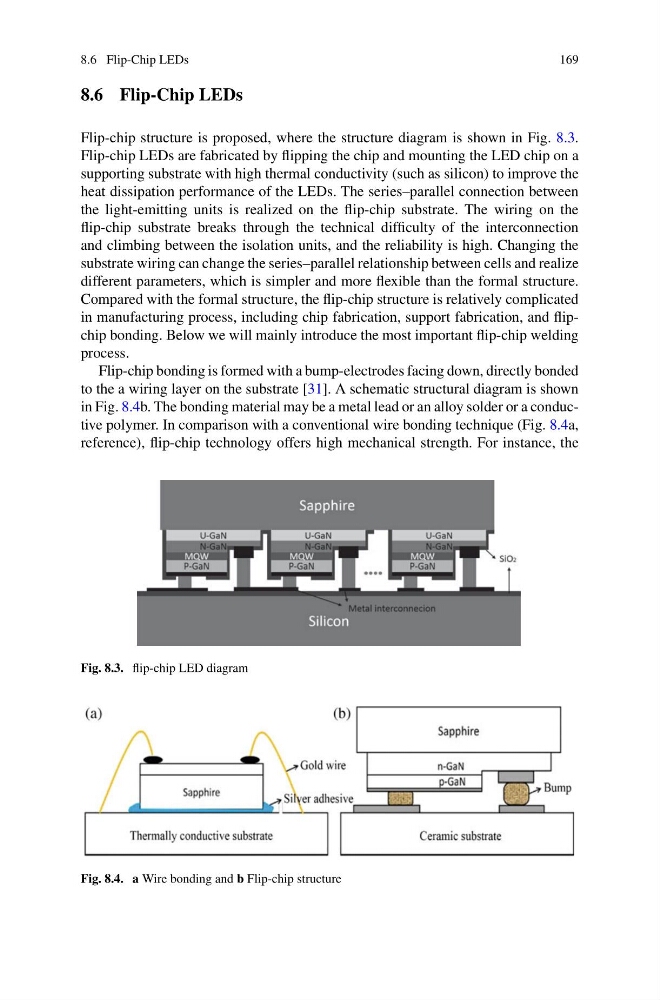
Flip-chip structure is proposed, where the structure diagram is shown in Fig. 8.3.
Flip-chip LEDs are fabricated by flipping the chip and mounting the LED chip on a
supporting substrate with high thermal conductivity (such as silicon) to improve the
heat dissipation performance of the LEDs. The series–parallel connection between
the light-emitting units is realized on the flip-chip substrate. The wiring on the
flip-chip substrate breaks through the technical difficulty of the interconnection
and climbing between the isolation units, and the reliability is high. Changing the
substrate wiring can change the series–parallel relationship between cells and realize
different parameters, which is simpler and more flexible than the formal structure.
Compared with the formal structure, the flip-chip structure is relatively complicated
in manufacturing process, including chip fabrication, support fabrication, and flipchip bonding. Below we will mainly introduce the most important flip-chip welding
process.
Flip-chip bonding is formed with a bump-electrodes facing down, directly bonded
to the a wiring layer on the substrate [31]. A schematic structural diagram is shown
in Fig. 8.4b. The bonding material may be a metal lead or an alloy solder or a conductive polymer. In comparison with a conventional wire bonding technique (Fig. 8.4a,
reference), flip-chip technology offers high mechanical strength. For instance, the
Fig. 8.3. flip-chip LED diagram
Fig. 8.4. a Wire bonding and b Flip-chip structure
169
8.6 Flip-Chip LEDs
Flip-chip structure is proposed, where the structure diagram is shown in Fig. 8.3.
Flip-chip LEDs are fabricated by flipping the chip and mounting the LED chip on a
supporting substrate with high thermal conductivity (such as silicon) to improve the
heat dissipation performance of the LEDs. The series–parallel connection between
the light-emitting units is realized on the flip-chip substrate. The wiring on the
flip-chip substrate breaks through the technical difficulty of the interconnection
and climbing between the isolation units, and the reliability is high. Changing the
substrate wiring can change the series–parallel relationship between cells and realize
different parameters, which is simpler and more flexible than the formal structure.
Compared with the formal structure, the flip-chip structure is relatively complicated
in manufacturing process, including chip fabrication, support fabrication, and flipchip bonding. Below we will mainly introduce the most important flip-chip welding
process.
Flip-chip bonding is formed with a bump-electrodes facing down, directly bonded
to the a wiring layer on the substrate [31]. A schematic structural diagram is shown
in Fig. 8.4b. The bonding material may be a metal lead or an alloy solder or a conductive polymer. In comparison with a conventional wire bonding technique (Fig. 8.4a,
reference), flip-chip technology offers high mechanical strength. For instance, the
Fig. 8.3. flip-chip LED diagram
Fig. 8.4. a Wire bonding and b Flip-chip structure